



Medieval Persian Seljuk Pottery Ewer with Raised Animal Relief | Circa 12th–13th Century CE
Couldn't load pickup availability


Medieval Persian Seljuk Pottery Ewer with Raised Animal Relief | Circa 12th–13th Century CE
Description
More
Less
Historical Context & Origin
Region: Eastern Iran, Greater Khorasan region (stylistic attribution)
Material: Buff-coloured earthenware with raised relief decoration and wheel-finished elements
Period: Medieval Islamic Period, Seljuk to Early Post-Seljuk tradition, circa 12th–13th century CE (1100–1300)
Description
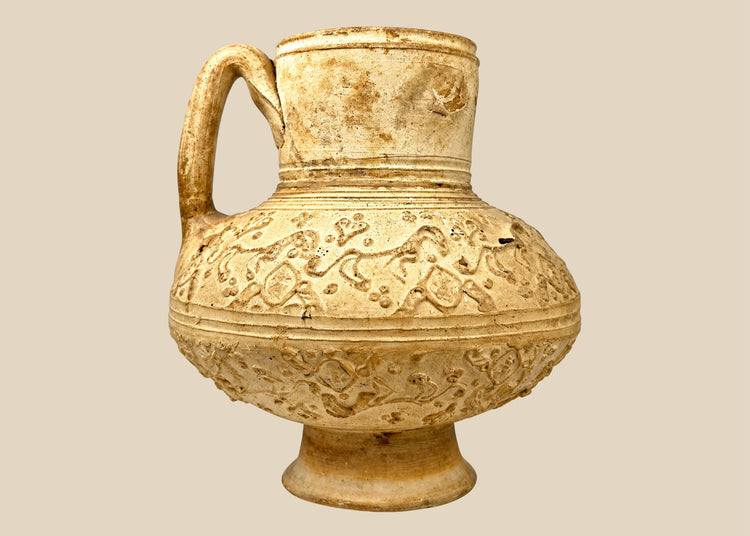
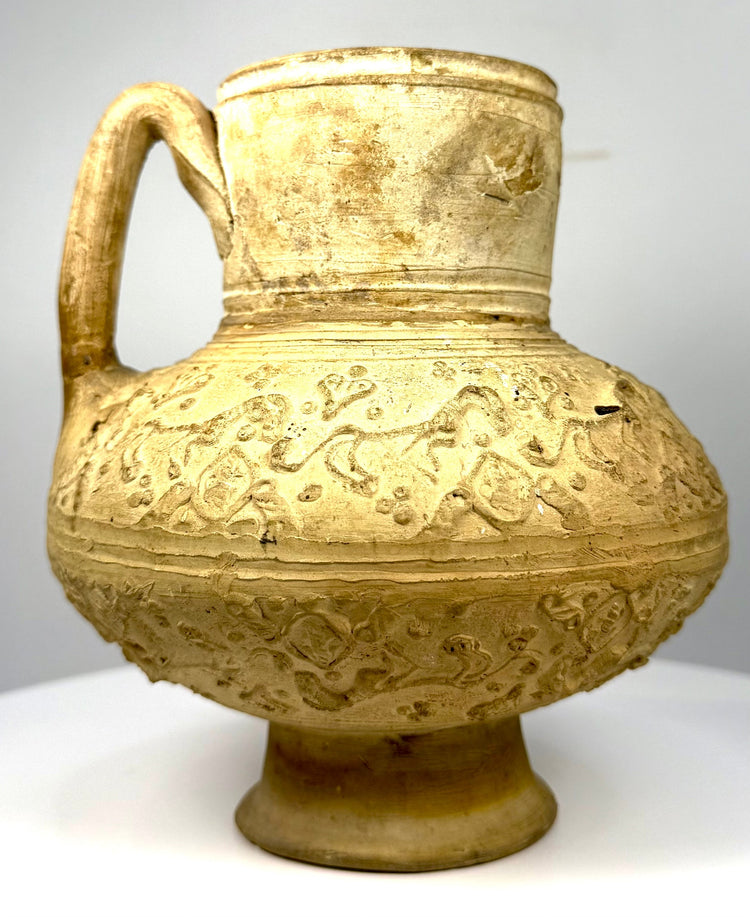
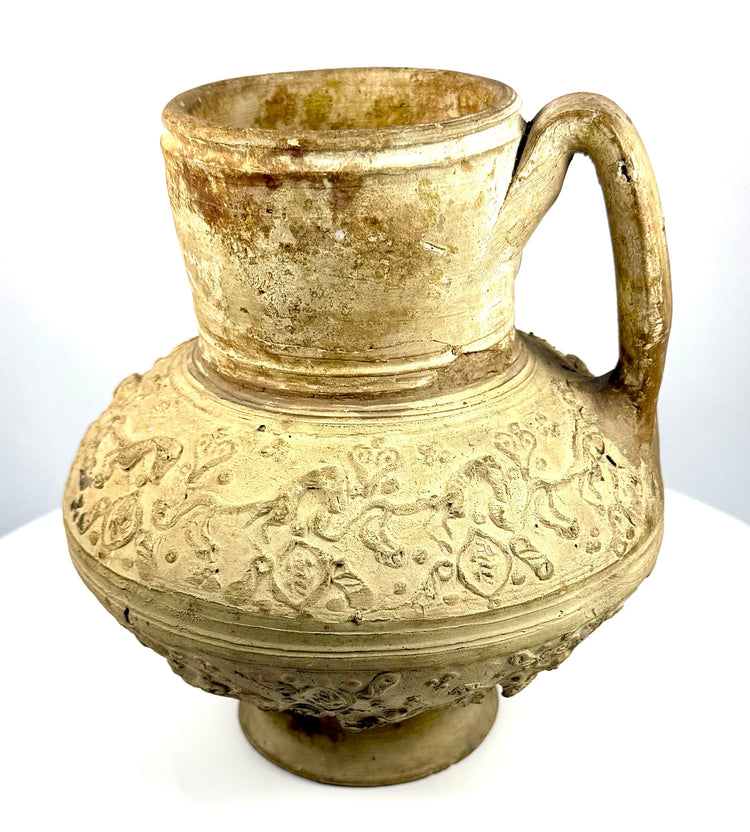
An intricately decorated medieval Islamic earthenware ewer, stylistically associated with the Persian ceramic traditions of the Seljuk and early post-Seljuk periods. The vessel features a distinctive broad, compressed rounded body adorned with elaborate raised animal figures, circular ornamental medallions, and repeating decorative patterns, reflecting the sophisticated pottery-making traditions of the medieval Islamic world.
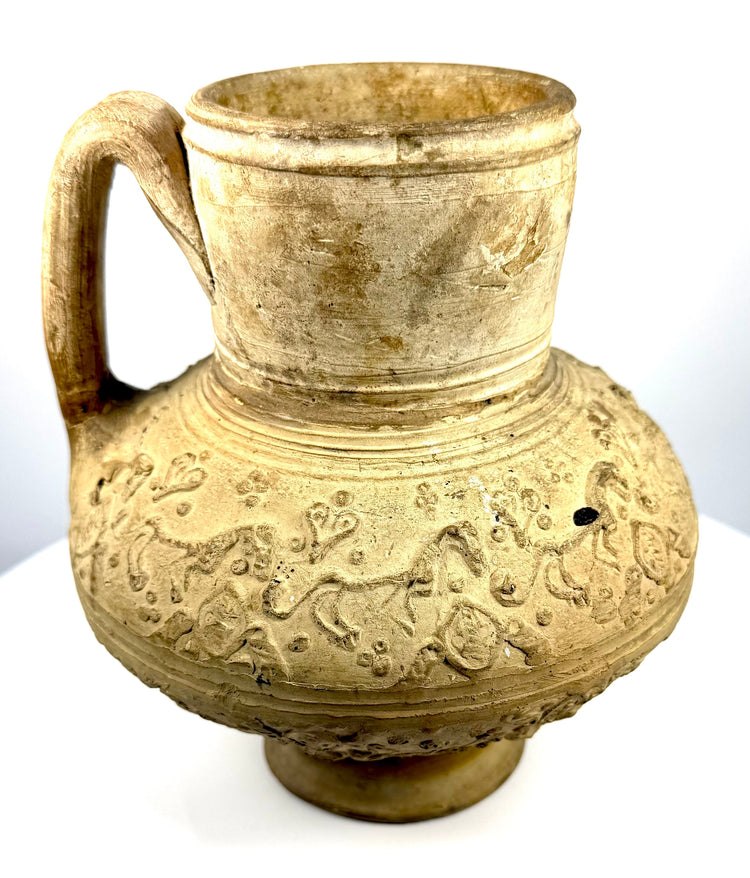
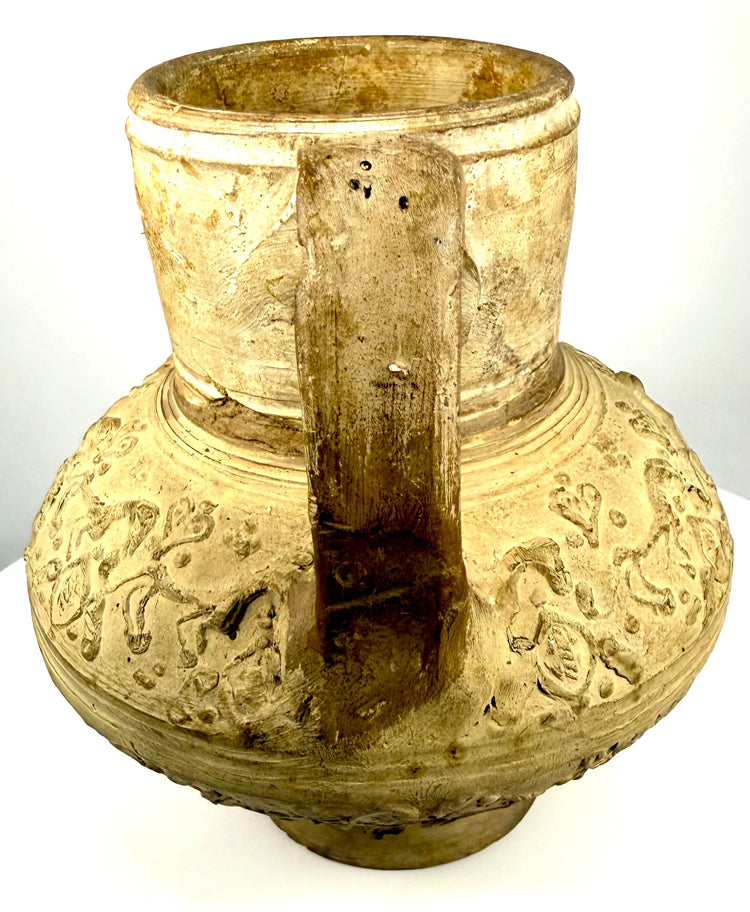
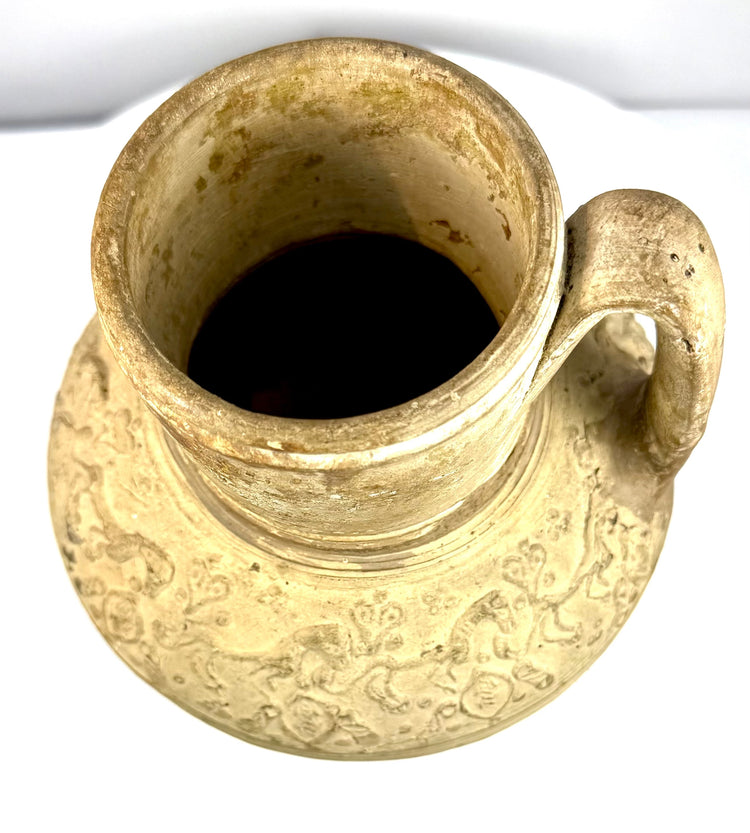
The vessel rests upon a short, flared circular foot and rises into a broad, rounded body with a pronounced shoulder. Above the shoulder is a tall cylindrical neck with a gently flaring mouth and thickened rim. A substantial curved loop handle connects the upper neck to the shoulder, completing the traditional single-handled ewer form.
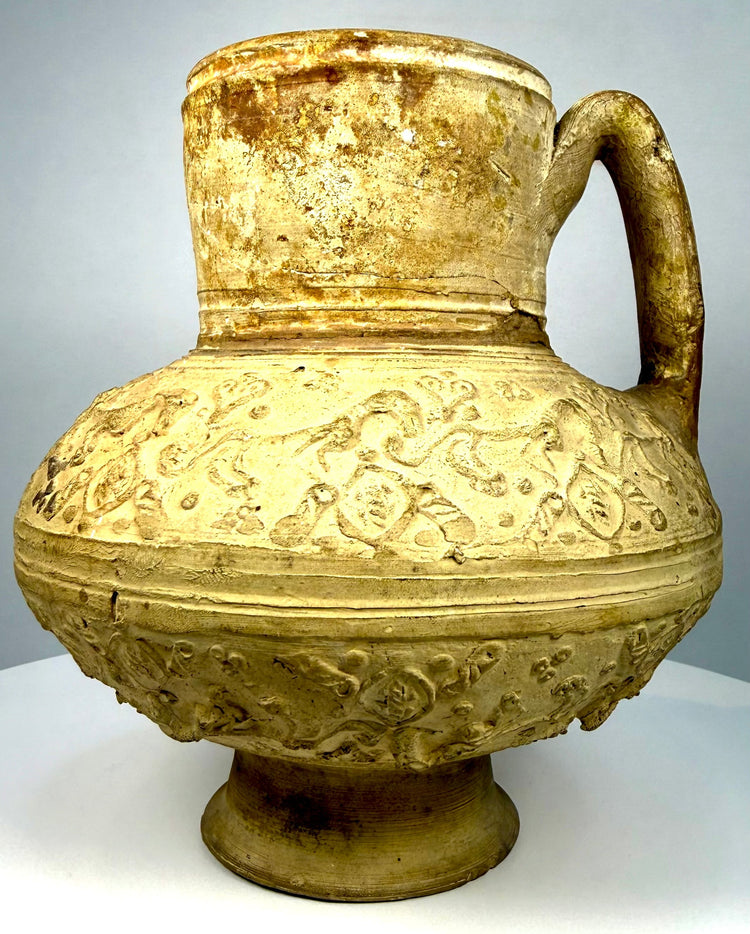
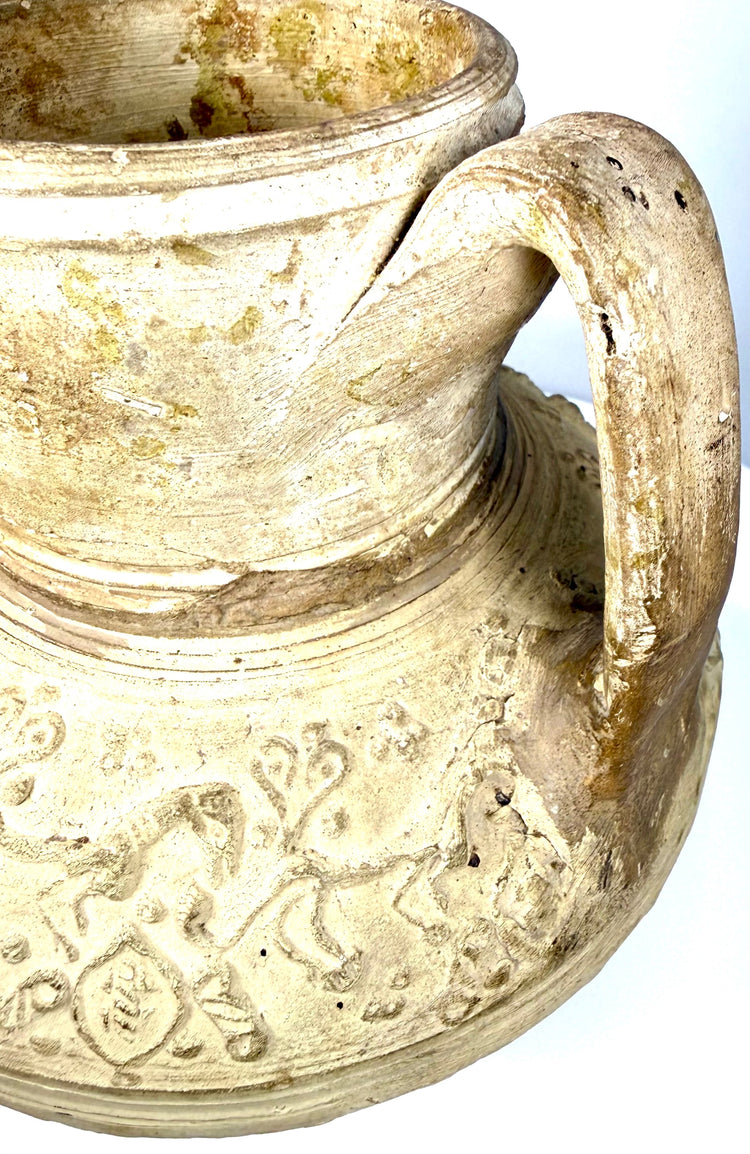
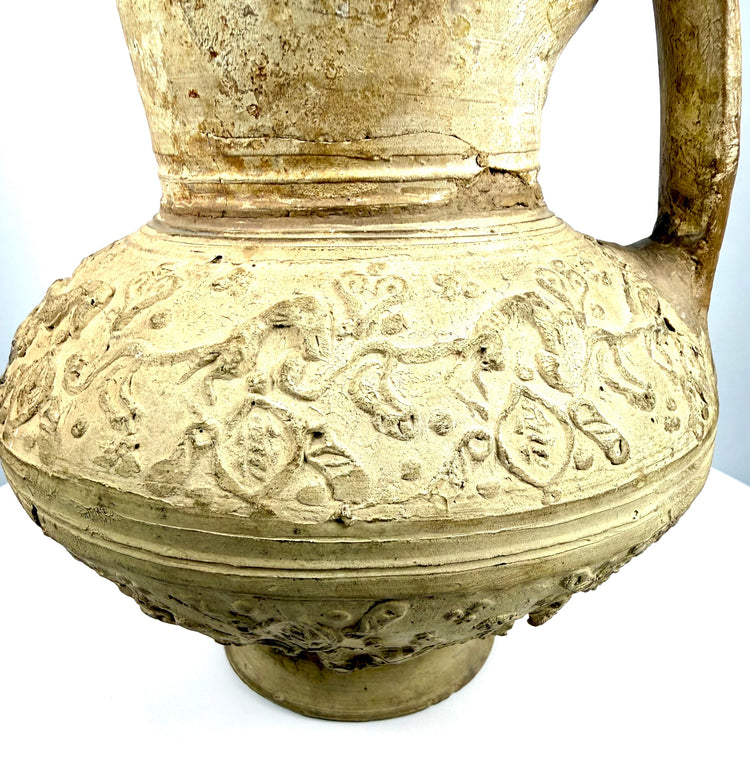
The most striking feature is the continuous band of raised relief decoration encircling the upper body. This ornamental register incorporates a procession of stylized quadrupeds depicted with elongated bodies and extended limbs, creating a sense of movement across the vessel's surface.
The animal figures are interspersed with circular medallions, scrolling foliate devices, and smaller geometric ornaments. The arrangement creates a densely textured composition characteristic of the decorative traditions found on medieval Islamic moulded earthenware vessels.
A series of pronounced horizontal bands separates the principal decorative register from the lower body. Further raised organic and geometric ornamentation extends beneath these bands toward the circular foot, creating a layered composition that contrasts with the smoother neck and rim.
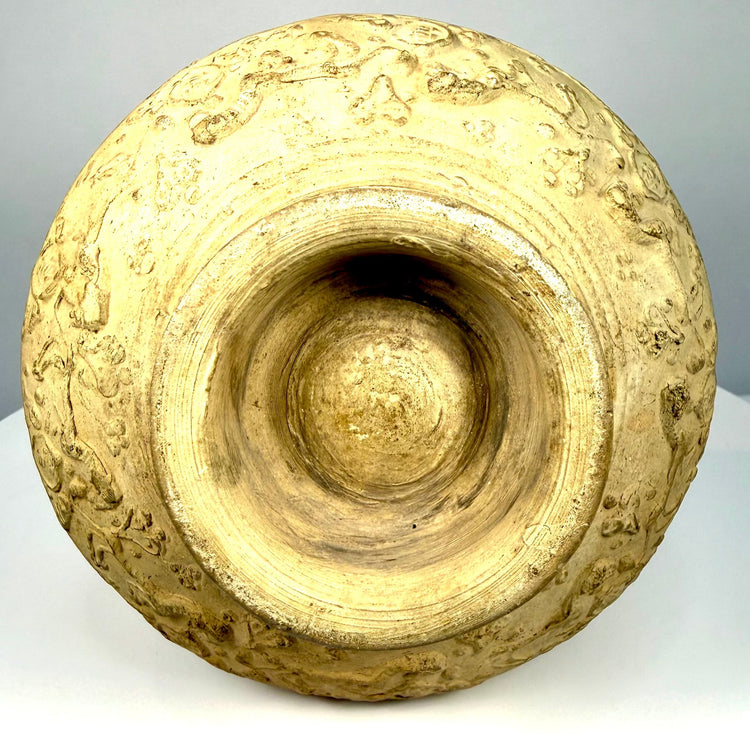
The vessel displays a pale cream-to-buff ceramic surface with varied tan and brown discolouration, scattered deposits, and visible signs of age and use. Concentric forming marks around the neck, shoulder junction, and foot provide additional evidence of its ceramic construction.
The form, relief decoration, and proportions closely correspond with examples of medieval Islamic earthenware preserved in major museum collections. Particularly relevant comparisons are found among 12th–13th-century moulded ewers excavated at Nishapur in northeastern Iran, where similar vessels were produced with elaborate repeating ornamental designs.
While the vessel's precise workshop and original archaeological context remain undocumented, its overall form and decorative vocabulary provide a compelling connection to the ceramic craftsmanship of the medieval Persianate world.
Features
- Distinctive broad, compressed rounded body with single curved loop handle
- Raised relief decoration extending around the upper and lower body
- Continuous ornamental register featuring stylized quadrupeds with elongated bodies and extended limbs
- Repeating circular medallions, foliate devices, and geometric motifs
- Tall cylindrical neck with gently flaring mouth and thickened rim
- Pronounced horizontal moulded bands separating the decorative registers
- Short, flared circular foot with visible concentric forming marks
- Pale buff-coloured earthenware with naturally varied surface coloration
- Decorative characteristics comparable to medieval Islamic moulded pottery of the 12th–13th centuries
Cultural Significance
During the 11th through 13th centuries, pottery production flourished throughout Iran and the broader Islamic world. Ceramic workshops produced vessels that combined practical household functions with elaborate decorative craftsmanship, reflecting the artistic tastes and technological achievements of the medieval period.
The Seljuk era was particularly important in the development of Islamic ceramic traditions. Potters employed a wide range of techniques, including moulding, stamping, carving, applied decoration, and glazing, creating vessels with increasingly complex forms and ornamental surfaces.
Nishapur, a major commercial and cultural centre in northeastern Iran, was associated with a remarkable variety of pottery production. Archaeological excavations have revealed earthenware vessels decorated with repeating geometric patterns, foliate ornamentation, animal figures, and inscriptions.
One significant manufacturing technique involved forming sections of a vessel within decorated moulds. These sections could be joined to create the rounded body, with separately fashioned necks, handles, and feet completing the object. The process allowed potters to produce intricate raised designs while maintaining practical vessel forms.
Animal imagery formed an important part of medieval Persian and Islamic decorative arts. Stylized quadrupeds, birds, and mythical creatures appeared across ceramics, metalwork, textiles, and architectural ornamentation, often arranged within repeating bands or decorative compartments.
The animal figures and foliate devices on this ewer reflect this wider ornamental tradition. Their rhythmic arrangement transforms the vessel's rounded body into a continuous decorative composition, emphasizing both the sculptural qualities of the earthenware and the skill involved in its manufacture.
Unglazed pottery remained important for domestic use throughout the medieval Islamic world. Porous earthenware vessels were valued for practical purposes, including storing and serving liquids, while decorated examples demonstrate the integration of functional design and artistic expression.
The present vessel is distinguished by its compressed rounded proportions, extensive raised decoration, and contrasting smooth and ornamented surfaces. Its design illustrates the sophisticated ceramic traditions associated with medieval Islamic craftsmanship.
Condition
The vessel survives in substantially complete overall form, retaining its cylindrical neck, curved loop handle, rounded body, decorative relief, and circular foot.
The surface exhibits widespread wear, abrasion, uneven coloration, darker staining, and accumulated deposits. The raised animal figures and ornamental motifs remain distinguishable, although portions of the decoration show softening and localized surface loss.
Fine cracking and surface irregularities are reported around the lower neck and handle area. Small chips, minor losses, localized pitting, and edge wear are present, including along the foot rim.
The interior displays staining, surface irregularities, and concentric forming marks. Additional wear and unevenness are visible around the junction of the neck and shoulder.
The overall form and much of the decorative composition remain preserved, with the historic surface contributing to the vessel's visual character.
Dimensions (Approximate)
Height: 7 in
Diameter: 6.75 in
Age (Approximate)
700–900 years old
Provenance
Formerly part of a private collection in Newark, New Jersey, United States.
Learn More
Compare this vessel with a 12th–13th-century moulded earthenware ewer excavated at Nishapur in The Metropolitan Museum of Art
Browse more historical treasures in our Middle Eastern Antiquities & Ancient Art Collection
Description
Historical Context & Origin
Region: Eastern Iran, Greater Khorasan region (stylistic attribution)
Material: Buff-coloured earthenware with raised relief decoration and wheel-finished elements
Period: Medieval Islamic Period, Seljuk to Early Post-Seljuk tradition, circa 12th–13th century CE (1100–1300)
Description
An intricately decorated medieval Islamic earthenware ewer, stylistically associated with the Persian ceramic traditions of the Seljuk and early post-Seljuk periods. The vessel features a distinctive broad, compressed rounded body adorned with elaborate raised animal figures, circular ornamental medallions, and repeating decorative patterns, reflecting the sophisticated pottery-making traditions of the medieval Islamic world.
The vessel rests upon a short, flared circular foot and rises into a broad, rounded body with a pronounced shoulder. Above the shoulder is a tall cylindrical neck with a gently flaring mouth and thickened rim. A substantial curved loop handle connects the upper neck to the shoulder, completing the traditional single-handled ewer form.
The most striking feature is the continuous band of raised relief decoration encircling the upper body. This ornamental register incorporates a procession of stylized quadrupeds depicted with elongated bodies and extended limbs, creating a sense of movement across the vessel's surface.
The animal figures are interspersed with circular medallions, scrolling foliate devices, and smaller geometric ornaments. The arrangement creates a densely textured composition characteristic of the decorative traditions found on medieval Islamic moulded earthenware vessels.
A series of pronounced horizontal bands separates the principal decorative register from the lower body. Further raised organic and geometric ornamentation extends beneath these bands toward the circular foot, creating a layered composition that contrasts with the smoother neck and rim.
The vessel displays a pale cream-to-buff ceramic surface with varied tan and brown discolouration, scattered deposits, and visible signs of age and use. Concentric forming marks around the neck, shoulder junction, and foot provide additional evidence of its ceramic construction.
The form, relief decoration, and proportions closely correspond with examples of medieval Islamic earthenware preserved in major museum collections. Particularly relevant comparisons are found among 12th–13th-century moulded ewers excavated at Nishapur in northeastern Iran, where similar vessels were produced with elaborate repeating ornamental designs.
While the vessel's precise workshop and original archaeological context remain undocumented, its overall form and decorative vocabulary provide a compelling connection to the ceramic craftsmanship of the medieval Persianate world.
Features
- Distinctive broad, compressed rounded body with single curved loop handle
- Raised relief decoration extending around the upper and lower body
- Continuous ornamental register featuring stylized quadrupeds with elongated bodies and extended limbs
- Repeating circular medallions, foliate devices, and geometric motifs
- Tall cylindrical neck with gently flaring mouth and thickened rim
- Pronounced horizontal moulded bands separating the decorative registers
- Short, flared circular foot with visible concentric forming marks
- Pale buff-coloured earthenware with naturally varied surface coloration
- Decorative characteristics comparable to medieval Islamic moulded pottery of the 12th–13th centuries
Cultural Significance
During the 11th through 13th centuries, pottery production flourished throughout Iran and the broader Islamic world. Ceramic workshops produced vessels that combined practical household functions with elaborate decorative craftsmanship, reflecting the artistic tastes and technological achievements of the medieval period.
The Seljuk era was particularly important in the development of Islamic ceramic traditions. Potters employed a wide range of techniques, including moulding, stamping, carving, applied decoration, and glazing, creating vessels with increasingly complex forms and ornamental surfaces.
Nishapur, a major commercial and cultural centre in northeastern Iran, was associated with a remarkable variety of pottery production. Archaeological excavations have revealed earthenware vessels decorated with repeating geometric patterns, foliate ornamentation, animal figures, and inscriptions.
One significant manufacturing technique involved forming sections of a vessel within decorated moulds. These sections could be joined to create the rounded body, with separately fashioned necks, handles, and feet completing the object. The process allowed potters to produce intricate raised designs while maintaining practical vessel forms.
Animal imagery formed an important part of medieval Persian and Islamic decorative arts. Stylized quadrupeds, birds, and mythical creatures appeared across ceramics, metalwork, textiles, and architectural ornamentation, often arranged within repeating bands or decorative compartments.
The animal figures and foliate devices on this ewer reflect this wider ornamental tradition. Their rhythmic arrangement transforms the vessel's rounded body into a continuous decorative composition, emphasizing both the sculptural qualities of the earthenware and the skill involved in its manufacture.
Unglazed pottery remained important for domestic use throughout the medieval Islamic world. Porous earthenware vessels were valued for practical purposes, including storing and serving liquids, while decorated examples demonstrate the integration of functional design and artistic expression.
The present vessel is distinguished by its compressed rounded proportions, extensive raised decoration, and contrasting smooth and ornamented surfaces. Its design illustrates the sophisticated ceramic traditions associated with medieval Islamic craftsmanship.
Condition
The vessel survives in substantially complete overall form, retaining its cylindrical neck, curved loop handle, rounded body, decorative relief, and circular foot.
The surface exhibits widespread wear, abrasion, uneven coloration, darker staining, and accumulated deposits. The raised animal figures and ornamental motifs remain distinguishable, although portions of the decoration show softening and localized surface loss.
Fine cracking and surface irregularities are reported around the lower neck and handle area. Small chips, minor losses, localized pitting, and edge wear are present, including along the foot rim.
The interior displays staining, surface irregularities, and concentric forming marks. Additional wear and unevenness are visible around the junction of the neck and shoulder.
The overall form and much of the decorative composition remain preserved, with the historic surface contributing to the vessel's visual character.
Dimensions (Approximate)
Height: 7 in
Diameter: 6.75 in
Age (Approximate)
700–900 years old
Provenance
Formerly part of a private collection in Newark, New Jersey, United States.
Learn More
Compare this vessel with a 12th–13th-century moulded earthenware ewer excavated at Nishapur in The Metropolitan Museum of Art
Browse more historical treasures in our Middle Eastern Antiquities & Ancient Art Collection
You May Also Like
