

Mid-19th Century English School Oil Portrait of a Gentleman | Early Victorian Era | Circa 1835 – 1850
Couldn't load pickup availability


Mid-19th Century English School Oil Portrait of a Gentleman | Early Victorian Era | Circa 1835 – 1850
Description
More
Less
Historical Context & Origin
Region: British School, likely England
Material: Oil on canvas housed in an antique giltwood frame
Period: Early Victorian era, circa 1835–1850
Description
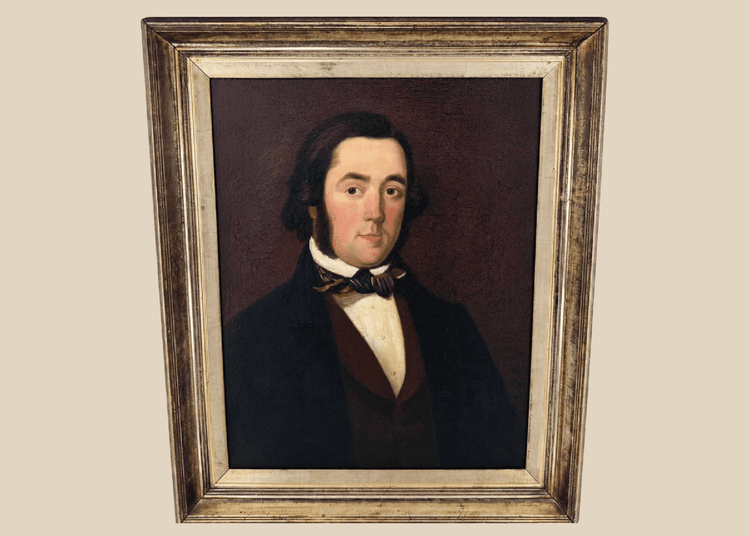
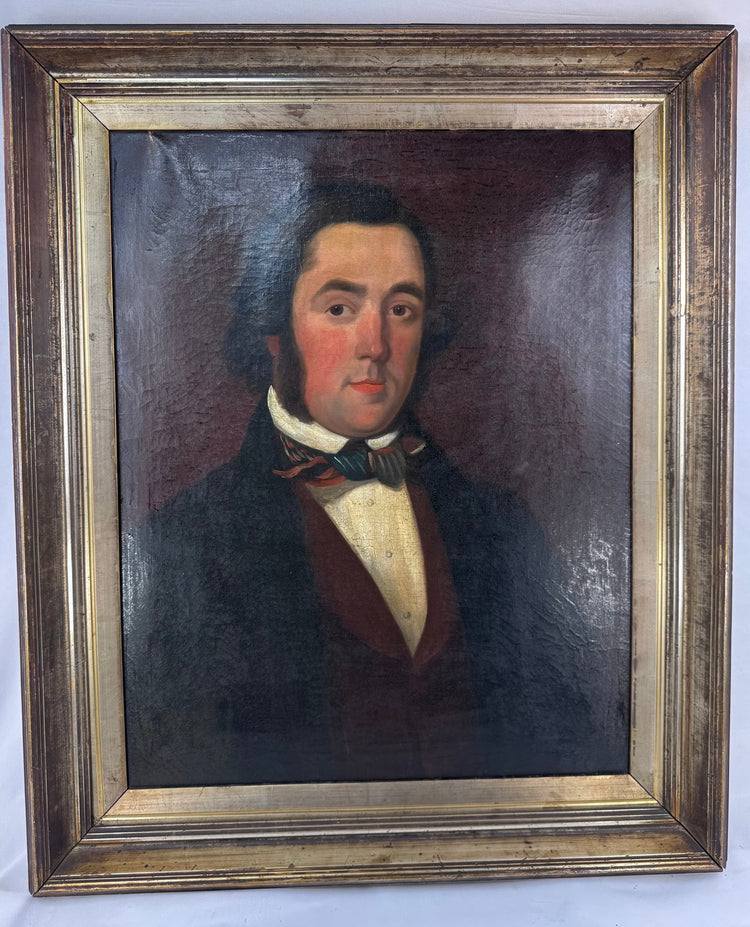
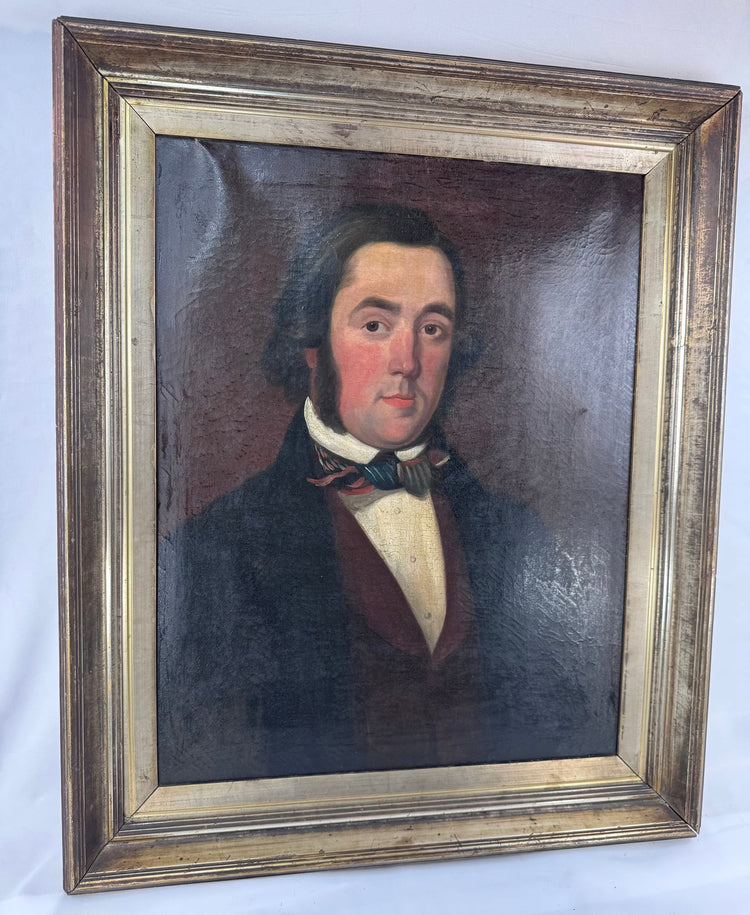
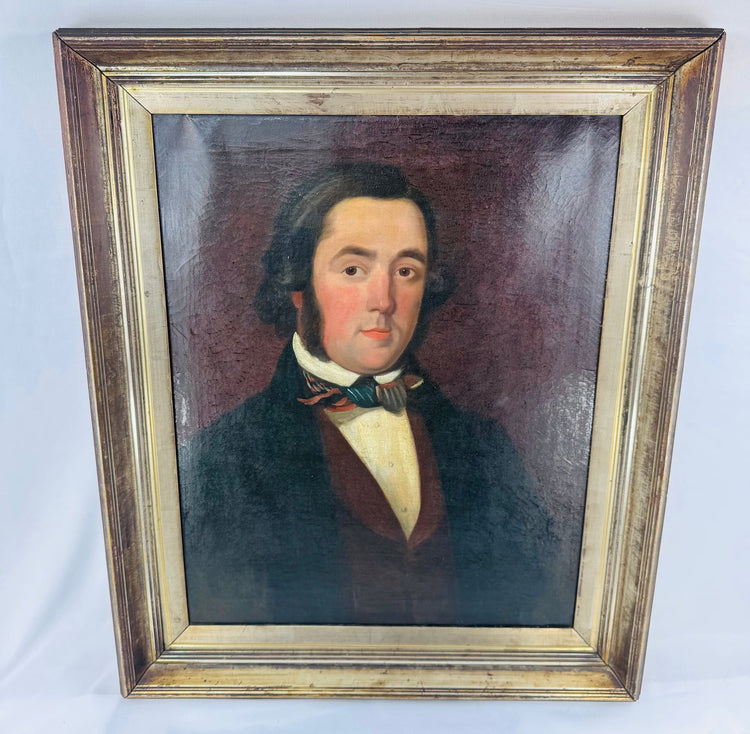
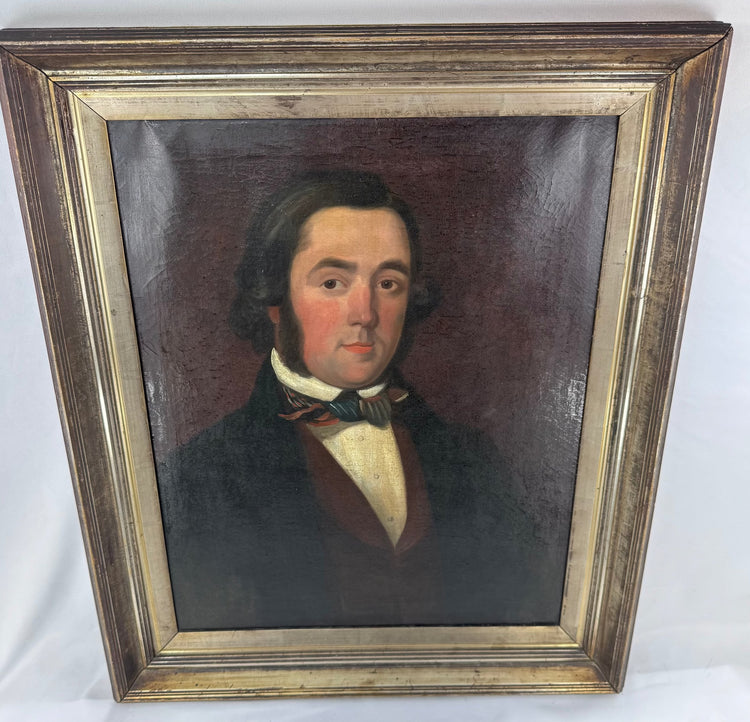
This distinguished mid-19th-century oil painting depicts an unidentified gentleman presented in a formal bust-length portrait against a deep burgundy-brown background.
The sitter is shown facing slightly to one side while directing his composed gaze toward the viewer. He is portrayed with dark, carefully arranged hair, prominent sideburns, strongly defined eyebrows, rosy cheeks, and a reserved expression characteristic of formal portraiture from the early Victorian period.
He wears a dark frock coat over a burgundy waistcoat and cream-coloured shirt. A high, turned-up collar frames the neck, beneath which is tied a decorative dark silk cravat incorporating muted green, red, and brown tones.
Dark frock coats, white shirts with starched collars, and silk cravats tied in flat bows were characteristic elements of respectable men’s dress during the 1840s, supporting a date near the middle of the nineteenth century.
The artist has concentrated particular attention on the sitter’s facial features, complexion, and clothing while allowing the dark coat to merge gradually into the background. This restrained treatment places emphasis on the gentleman’s social standing, character, and dignified presentation rather than upon an elaborate surrounding setting.
The painting is housed within a substantial period-style wooden frame with broad stepped mouldings and a gilt or metallic finish. The frame retains considerable surface wear and patination, complementing the aged appearance of the portrait.
Features
- Attributed to the British or English School
- Oil painted on canvas
- Early Victorian formal dress
- Dark frock coat and burgundy waistcoat
- High white collar with patterned silk cravat
- Prominent sideburns and period hairstyle
- Deep burgundy-brown background
- Housed in an antique giltwood frame
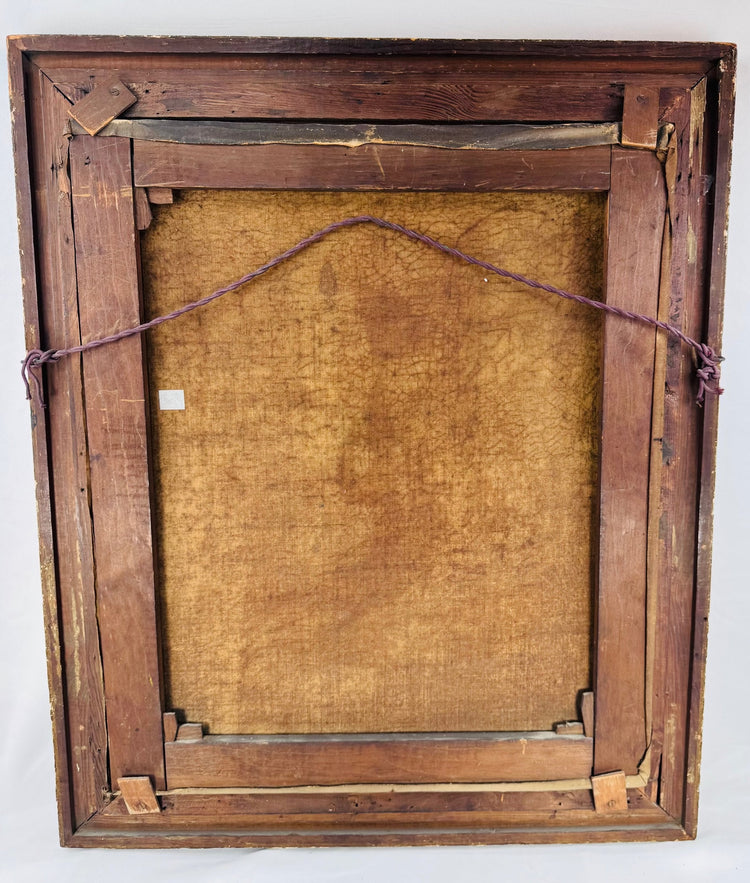
- Original exposed canvas and stretcher visible from the reverse
Cultural Significance
Portraiture occupied an important place in nineteenth-century British society. As prosperity expanded among professional and mercantile families, commissioned portraits were no longer restricted exclusively to the aristocracy.
Gentlemen were frequently portrayed in restrained dark clothing intended to communicate respectability, stability, education, and social position.
The sitter’s understated frock coat and formal cravat reflect the increasingly sombre character of fashionable menswear during the 1840s, when conspicuous colour and exaggerated tailoring gave way to a narrower and more conservative silhouette.
Condition
The painting remains visually appealing and presents well for its age. The canvas exhibits widespread age-related craquelure, surface texture, minor abrasions, scattered small losses, and areas of thinning or wear, particularly around the outer edges and darker passages.
Uneven varnish, surface sheen, discoloration, and possible historic retouching or restoration are visible in places. The canvas appears to remain mounted on an older wooden stretcher, with expected age-related staining and oxidation visible on the reverse.
The giltwood frame displays extensive rubbing, scratches, abrasions, darkening, small chips, separation at some joints, and areas of loss to the metallic finish consistent with age and handling.
Dimensions (Approximate)
Canvas Height: 24 in
Canvas Width: 20 in
Framed Height: 29 in
Framed Width: 24 in
Age (Approximate)
175–190 years old
Provenance
Formerly held in a private collection in Montreal, Quebec, Canada, where the portrait was preserved as an example of nineteenth-century British portraiture and period decorative art.
Learn More
View a comparable British portrait from circa 1840–1845 in the collection of The Metropolitan Museum of Art
Explore our curated Collection of 19th-Century Artifacts
Description
Historical Context & Origin
Region: British School, likely England
Material: Oil on canvas housed in an antique giltwood frame
Period: Early Victorian era, circa 1835–1850
Description
This distinguished mid-19th-century oil painting depicts an unidentified gentleman presented in a formal bust-length portrait against a deep burgundy-brown background.
The sitter is shown facing slightly to one side while directing his composed gaze toward the viewer. He is portrayed with dark, carefully arranged hair, prominent sideburns, strongly defined eyebrows, rosy cheeks, and a reserved expression characteristic of formal portraiture from the early Victorian period.
He wears a dark frock coat over a burgundy waistcoat and cream-coloured shirt. A high, turned-up collar frames the neck, beneath which is tied a decorative dark silk cravat incorporating muted green, red, and brown tones.
Dark frock coats, white shirts with starched collars, and silk cravats tied in flat bows were characteristic elements of respectable men’s dress during the 1840s, supporting a date near the middle of the nineteenth century.
The artist has concentrated particular attention on the sitter’s facial features, complexion, and clothing while allowing the dark coat to merge gradually into the background. This restrained treatment places emphasis on the gentleman’s social standing, character, and dignified presentation rather than upon an elaborate surrounding setting.
The painting is housed within a substantial period-style wooden frame with broad stepped mouldings and a gilt or metallic finish. The frame retains considerable surface wear and patination, complementing the aged appearance of the portrait.
Features
- Attributed to the British or English School
- Oil painted on canvas
- Early Victorian formal dress
- Dark frock coat and burgundy waistcoat
- High white collar with patterned silk cravat
- Prominent sideburns and period hairstyle
- Deep burgundy-brown background
- Housed in an antique giltwood frame
- Original exposed canvas and stretcher visible from the reverse
Cultural Significance
Portraiture occupied an important place in nineteenth-century British society. As prosperity expanded among professional and mercantile families, commissioned portraits were no longer restricted exclusively to the aristocracy.
Gentlemen were frequently portrayed in restrained dark clothing intended to communicate respectability, stability, education, and social position.
The sitter’s understated frock coat and formal cravat reflect the increasingly sombre character of fashionable menswear during the 1840s, when conspicuous colour and exaggerated tailoring gave way to a narrower and more conservative silhouette.
Condition
The painting remains visually appealing and presents well for its age. The canvas exhibits widespread age-related craquelure, surface texture, minor abrasions, scattered small losses, and areas of thinning or wear, particularly around the outer edges and darker passages.
Uneven varnish, surface sheen, discoloration, and possible historic retouching or restoration are visible in places. The canvas appears to remain mounted on an older wooden stretcher, with expected age-related staining and oxidation visible on the reverse.
The giltwood frame displays extensive rubbing, scratches, abrasions, darkening, small chips, separation at some joints, and areas of loss to the metallic finish consistent with age and handling.
Dimensions (Approximate)
Canvas Height: 24 in
Canvas Width: 20 in
Framed Height: 29 in
Framed Width: 24 in
Age (Approximate)
175–190 years old
Provenance
Formerly held in a private collection in Montreal, Quebec, Canada, where the portrait was preserved as an example of nineteenth-century British portraiture and period decorative art.
Learn More
View a comparable British portrait from circa 1840–1845 in the collection of The Metropolitan Museum of Art
Explore our curated Collection of 19th-Century Artifacts
You May Also Like
