
Pair of Ancient Socketed Bronze Axe Heads | Circa 500 BCE – 300 CE
Couldn't load pickup availability


Pair of Ancient Socketed Bronze Axe Heads | Circa 500 BCE – 300 CE
Description
More
Less
Historical Context & Origin
Culture: Dong Son Culture
Region: Northern Vietnam, Southeast Asia
Material: Cast bronze
Period: Dong Son Period, circa 500 BCE–300 CE
Description
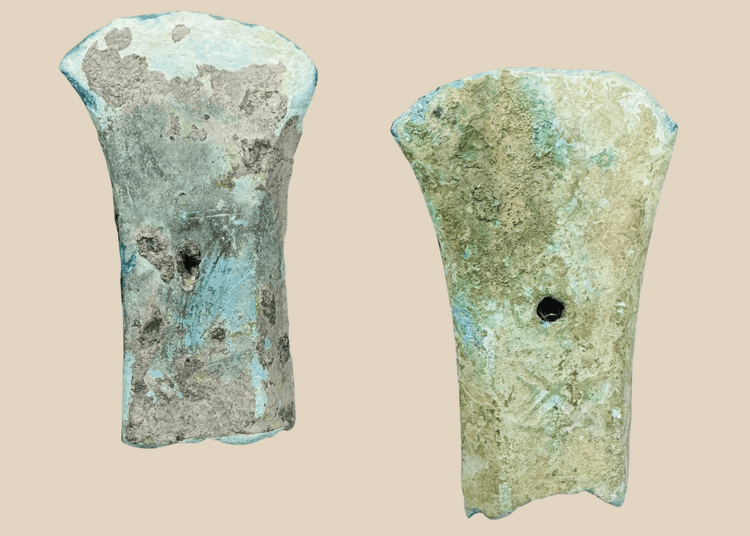
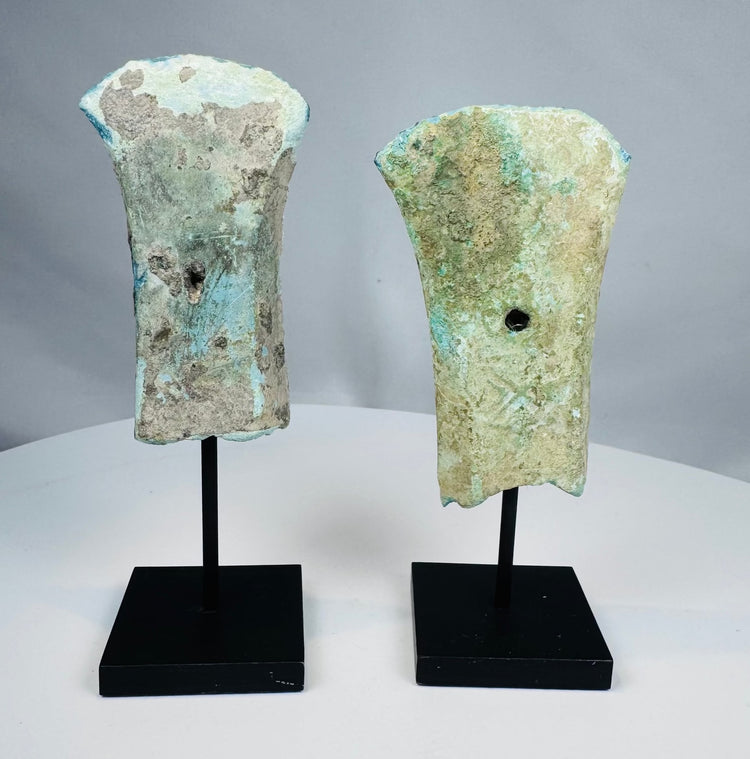
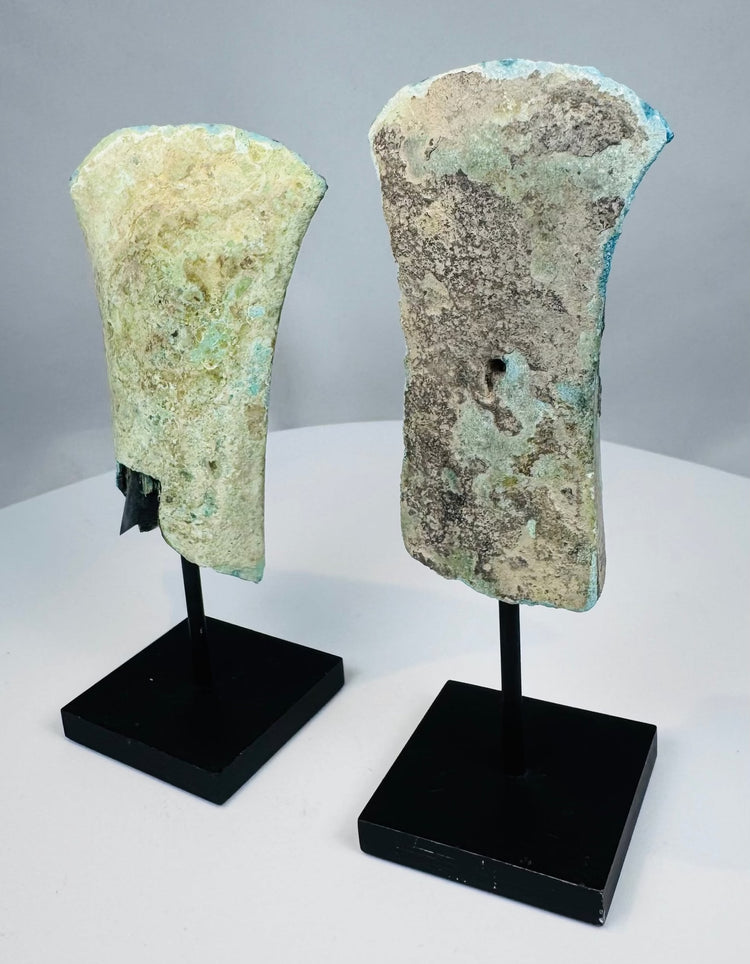
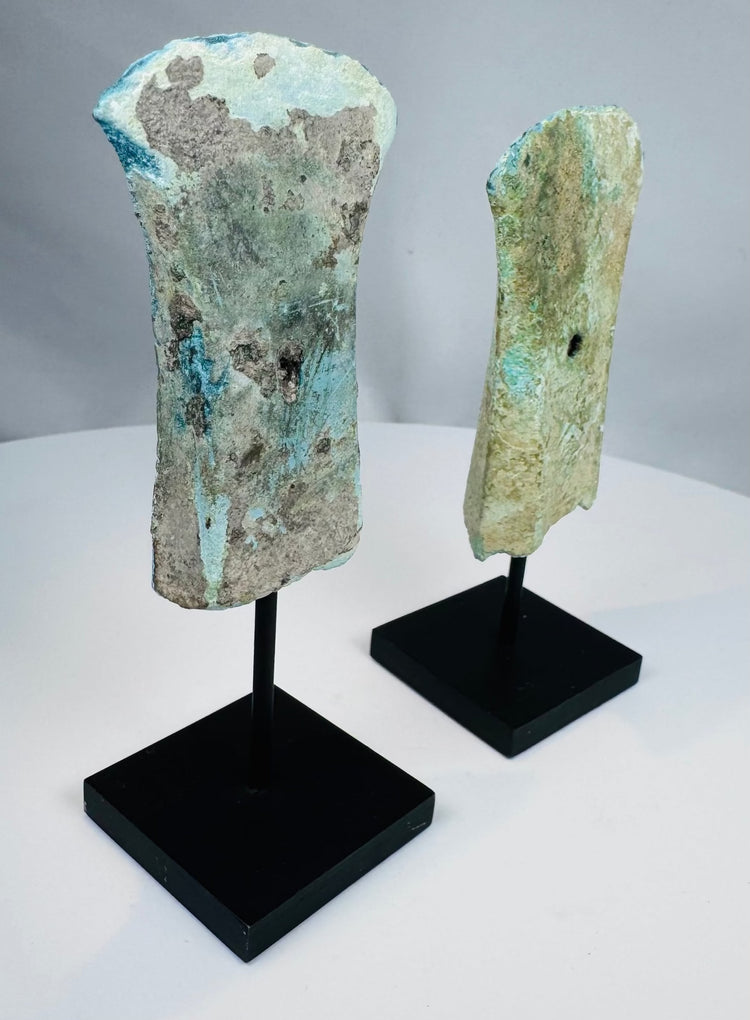
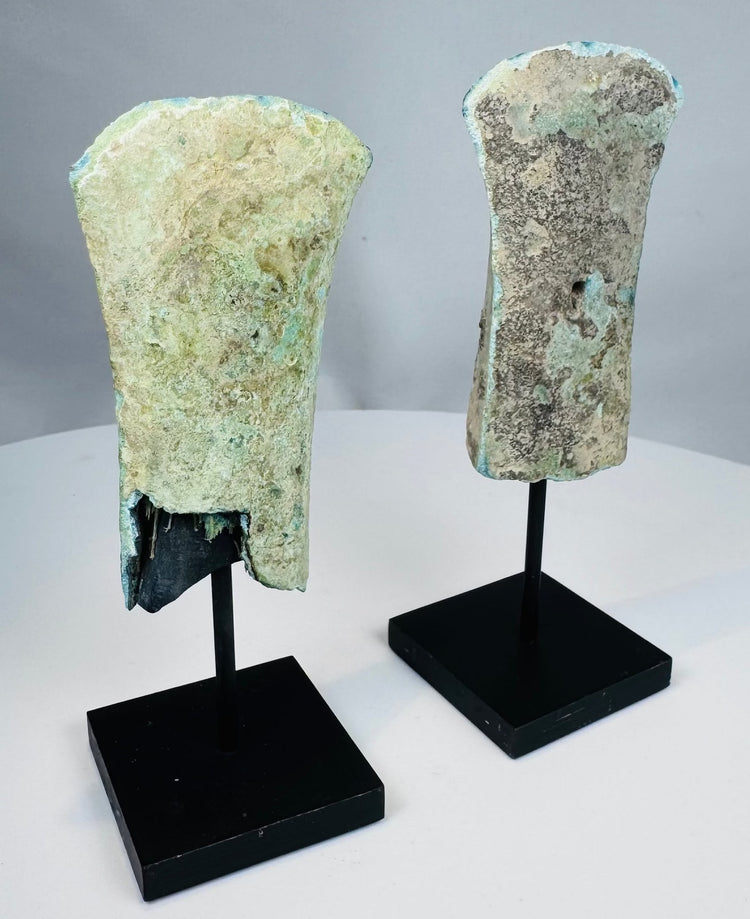
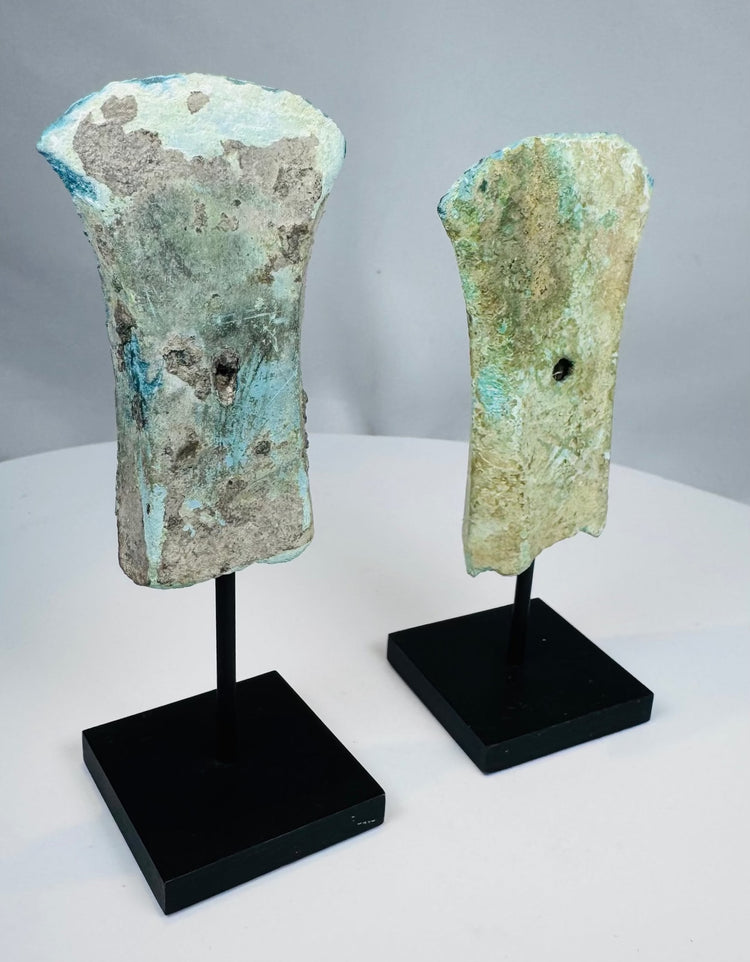
This mounted pair comprises two ancient bronze socketed axe heads attributed to the Dong Son cultural tradition of northern Vietnam, one of the most accomplished bronze-working societies of prehistoric Southeast Asia.
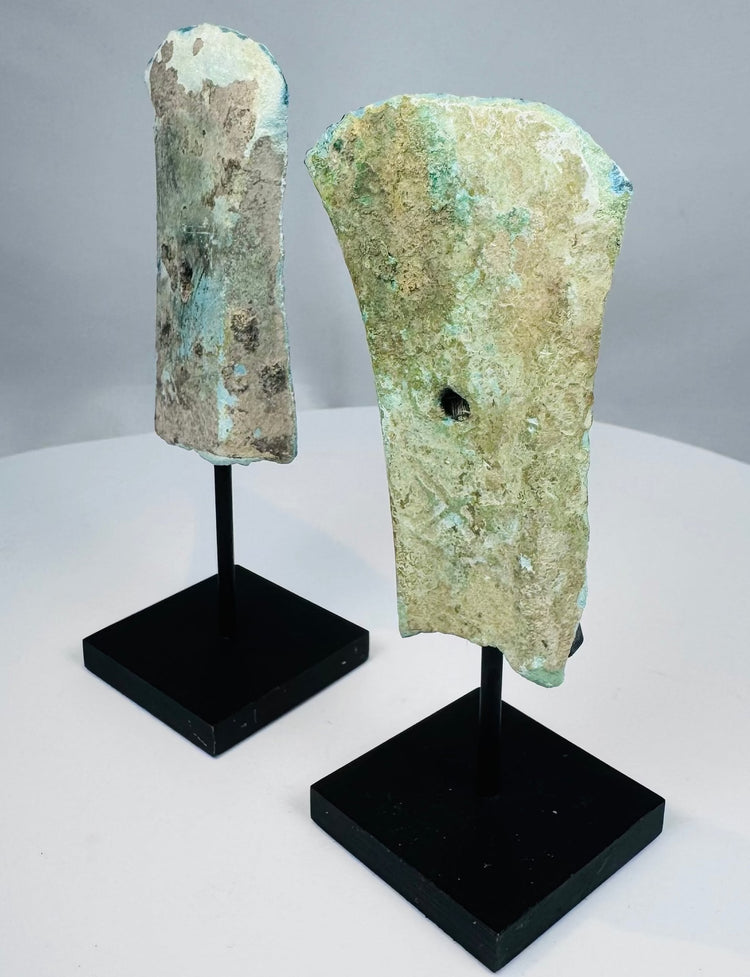
Both examples display elongated bodies expanding toward broad, gently curved cutting edges. Their hollow socketed construction originally allowed each implement to be fitted onto a wooden haft, creating a functional axe or adze-like tool.
Small lateral apertures are preserved through the bodies. Such openings are associated with the hafting and securing systems employed on socketed bronze implements and would have helped stabilize the bronze head when mounted to its original wooden handle.
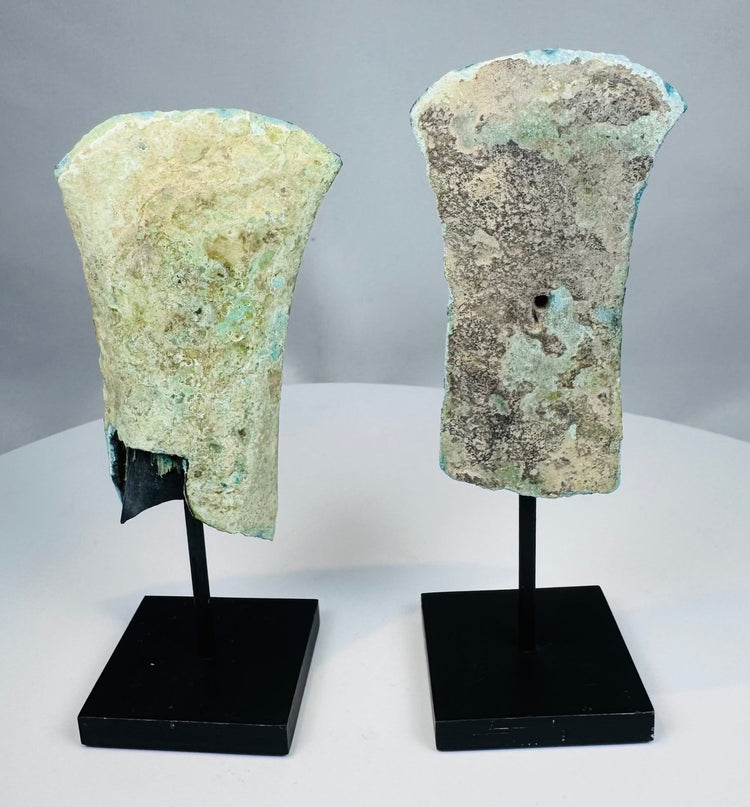
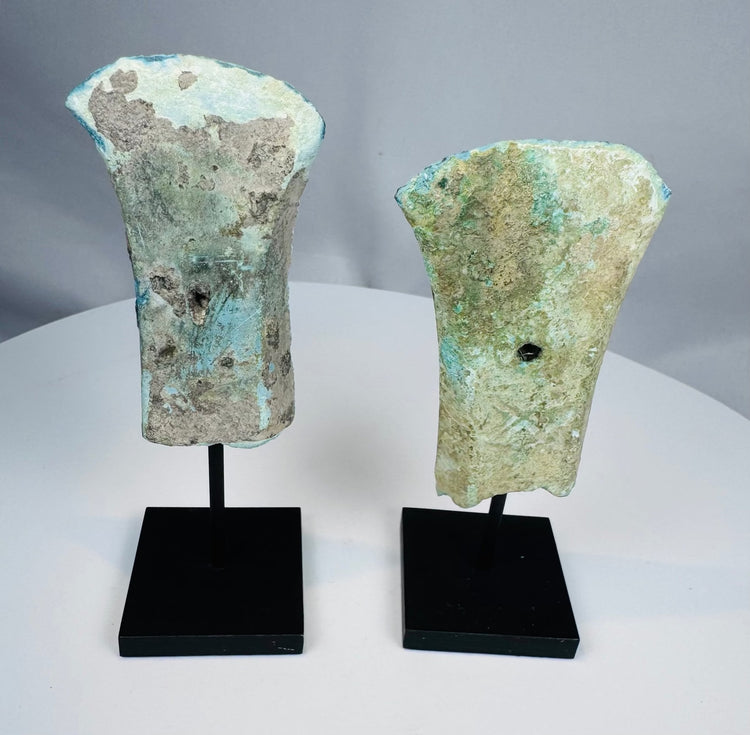
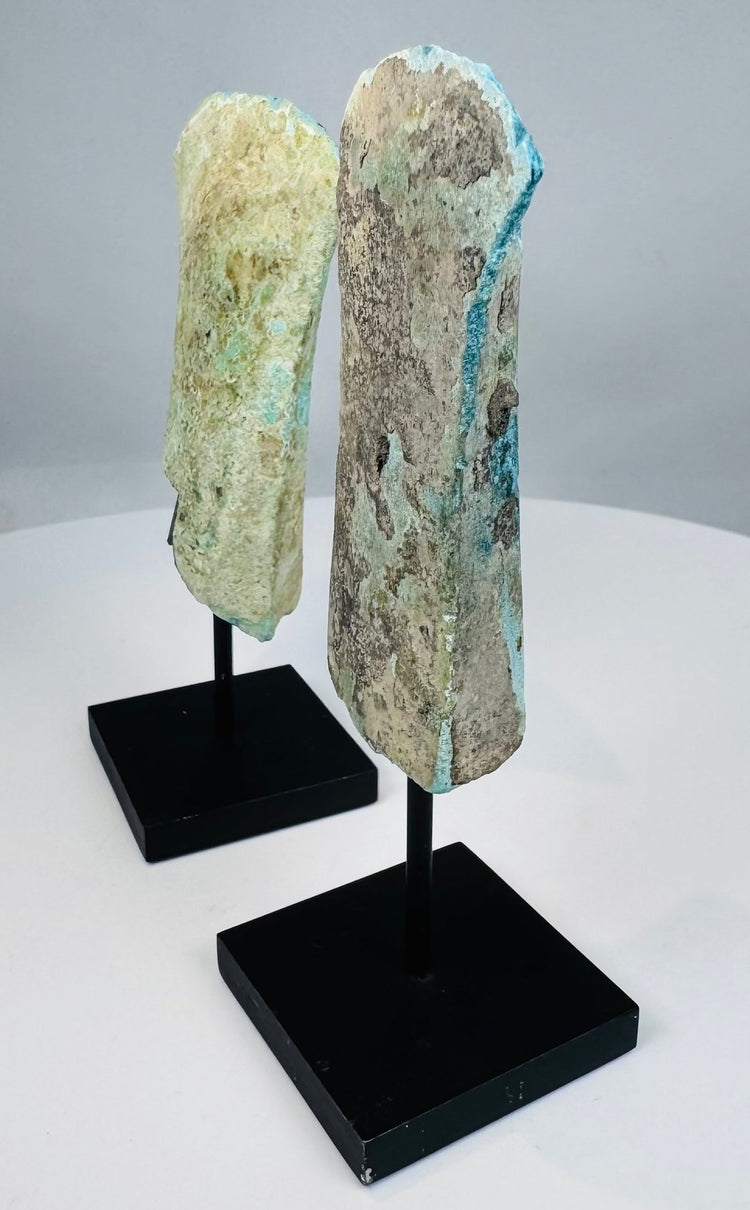
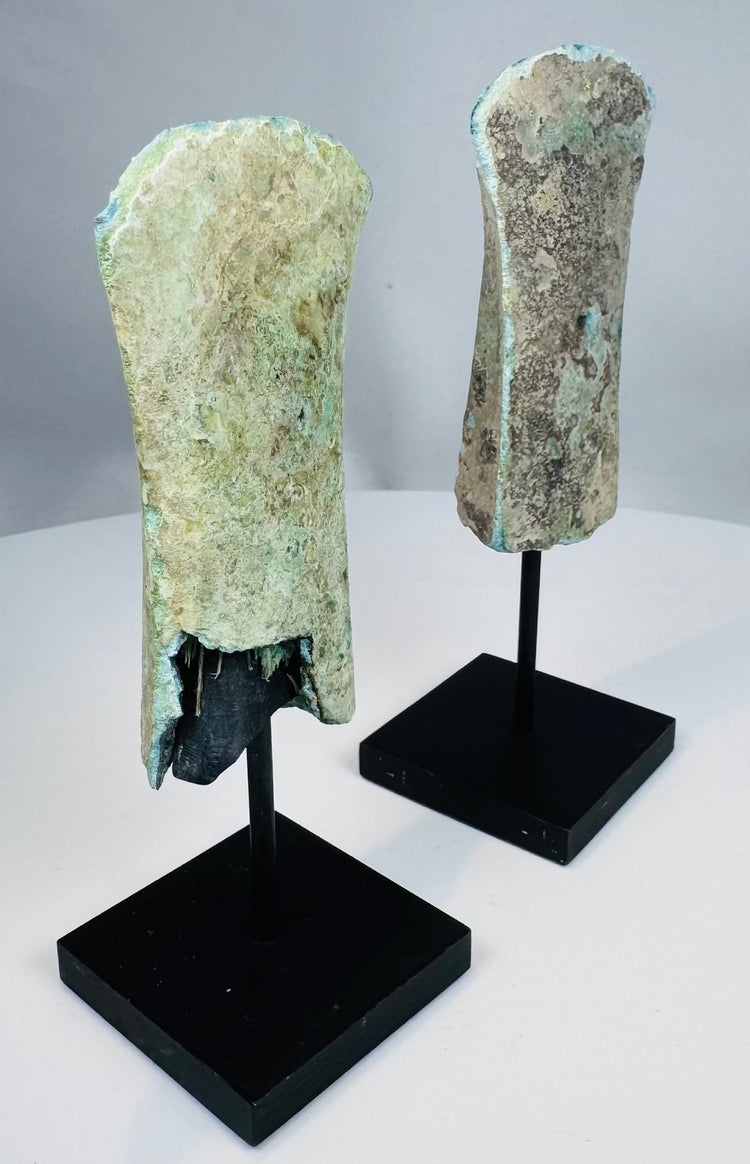
Although closely related, the two axes display individual variations in proportion and manufacture. One has a broader, more pronounced flaring blade and heavily mineralized pale surface, while the other is comparatively rectangular with a subtly expanded cutting edge and darker areas of exposed bronze and mineral accretion.
The surfaces display extensive pale green, blue-green, beige, brown, and grey archaeological patination resulting from prolonged burial and oxidation of the copper alloy.
Features
- Broad flaring cutting edges
- Hollow construction for attachment to wooden hafts
- Small lateral hafting or securing apertures
- Individually cast bronze construction
- Extensive archaeological mineral encrustation
- Green and blue-green copper-alloy patination
- Two distinct but closely related forms
- Individually mounted on modern black metal display stands
Cultural Significance
The Dong Son culture flourished in northern Vietnam during the later first millennium BCE and early centuries CE and developed one of Southeast Asia's most sophisticated traditions of bronze metallurgy.
While the culture is particularly renowned for its monumental decorated bronze drums, Dong Son metalworkers also produced an extensive range of weapons and utilitarian implements, including spearheads, daggers, axes, adzes, agricultural tools, ornaments, and vessels.
Socketed bronze axes represented an important technological development. Their hollow construction permitted a wooden haft to be inserted or incorporated into the bronze head, producing a durable composite implement capable of use in woodworking, agriculture, and potentially combat. The subtle differences between these two examples illustrate the variety of forms produced by ancient Southeast Asian bronze workers rather than a single standardized pattern.
Condition
Both axe heads remain in archaeological condition with extensive mineral encrustation, oxidation, patination, surface deposits, pitting, edge wear, and areas of material loss. The cutting edges display irregularity, rounding, losses, and surface deterioration consistent with prolonged burial and considerable age.
One example displays a substantial loss to the lower socket area, exposing part of the modern internal mounting support. The second remains more complete but displays extensive surface alteration and mineralization. Green and blue-green copper-alloy oxidation is visible throughout both pieces together with pale beige, brown, grey, and darker deposits.
Dimensions (Approximate)
Height: 4.5 in
Width: 1.5 in
Depth: 1.5 in
Age (Approximate)
1,700–2,500 years old
Provenance
Ex-Butterfield / Butterfields, United States, reportedly 2006, a prominent American auction house historically known for handling fine art, antiques, Asian art, and archaeological material.
Later offered by Material Culture, Philadelphia, Pennsylvania, an established auction house and gallery specializing in ethnographic art, antiquities, decorative arts, and material culture from around the world.
Learn More
View a related socketed bronze axehead preserved by the National Museum of Ireland.
Browse our Collection of Arms, Armour and Historical Weaponry.
Description
Historical Context & Origin
Culture: Dong Son Culture
Region: Northern Vietnam, Southeast Asia
Material: Cast bronze
Period: Dong Son Period, circa 500 BCE–300 CE
Description
This mounted pair comprises two ancient bronze socketed axe heads attributed to the Dong Son cultural tradition of northern Vietnam, one of the most accomplished bronze-working societies of prehistoric Southeast Asia.
Both examples display elongated bodies expanding toward broad, gently curved cutting edges. Their hollow socketed construction originally allowed each implement to be fitted onto a wooden haft, creating a functional axe or adze-like tool.
Small lateral apertures are preserved through the bodies. Such openings are associated with the hafting and securing systems employed on socketed bronze implements and would have helped stabilize the bronze head when mounted to its original wooden handle.
Although closely related, the two axes display individual variations in proportion and manufacture. One has a broader, more pronounced flaring blade and heavily mineralized pale surface, while the other is comparatively rectangular with a subtly expanded cutting edge and darker areas of exposed bronze and mineral accretion.
The surfaces display extensive pale green, blue-green, beige, brown, and grey archaeological patination resulting from prolonged burial and oxidation of the copper alloy.
Features
- Broad flaring cutting edges
- Hollow construction for attachment to wooden hafts
- Small lateral hafting or securing apertures
- Individually cast bronze construction
- Extensive archaeological mineral encrustation
- Green and blue-green copper-alloy patination
- Two distinct but closely related forms
- Individually mounted on modern black metal display stands
Cultural Significance
The Dong Son culture flourished in northern Vietnam during the later first millennium BCE and early centuries CE and developed one of Southeast Asia's most sophisticated traditions of bronze metallurgy.
While the culture is particularly renowned for its monumental decorated bronze drums, Dong Son metalworkers also produced an extensive range of weapons and utilitarian implements, including spearheads, daggers, axes, adzes, agricultural tools, ornaments, and vessels.
Socketed bronze axes represented an important technological development. Their hollow construction permitted a wooden haft to be inserted or incorporated into the bronze head, producing a durable composite implement capable of use in woodworking, agriculture, and potentially combat. The subtle differences between these two examples illustrate the variety of forms produced by ancient Southeast Asian bronze workers rather than a single standardized pattern.
Condition
Both axe heads remain in archaeological condition with extensive mineral encrustation, oxidation, patination, surface deposits, pitting, edge wear, and areas of material loss. The cutting edges display irregularity, rounding, losses, and surface deterioration consistent with prolonged burial and considerable age.
One example displays a substantial loss to the lower socket area, exposing part of the modern internal mounting support. The second remains more complete but displays extensive surface alteration and mineralization. Green and blue-green copper-alloy oxidation is visible throughout both pieces together with pale beige, brown, grey, and darker deposits.
Dimensions (Approximate)
Height: 4.5 in
Width: 1.5 in
Depth: 1.5 in
Age (Approximate)
1,700–2,500 years old
Provenance
Ex-Butterfield / Butterfields, United States, reportedly 2006, a prominent American auction house historically known for handling fine art, antiques, Asian art, and archaeological material.
Later offered by Material Culture, Philadelphia, Pennsylvania, an established auction house and gallery specializing in ethnographic art, antiquities, decorative arts, and material culture from around the world.
Learn More
View a related socketed bronze axehead preserved by the National Museum of Ireland.
Browse our Collection of Arms, Armour and Historical Weaponry.
You May Also Like
