



Ancient Punic Terracotta Open Oil Lamp with Bronze Coins | Circa 4th–2nd Century BCE
Couldn't load pickup availability


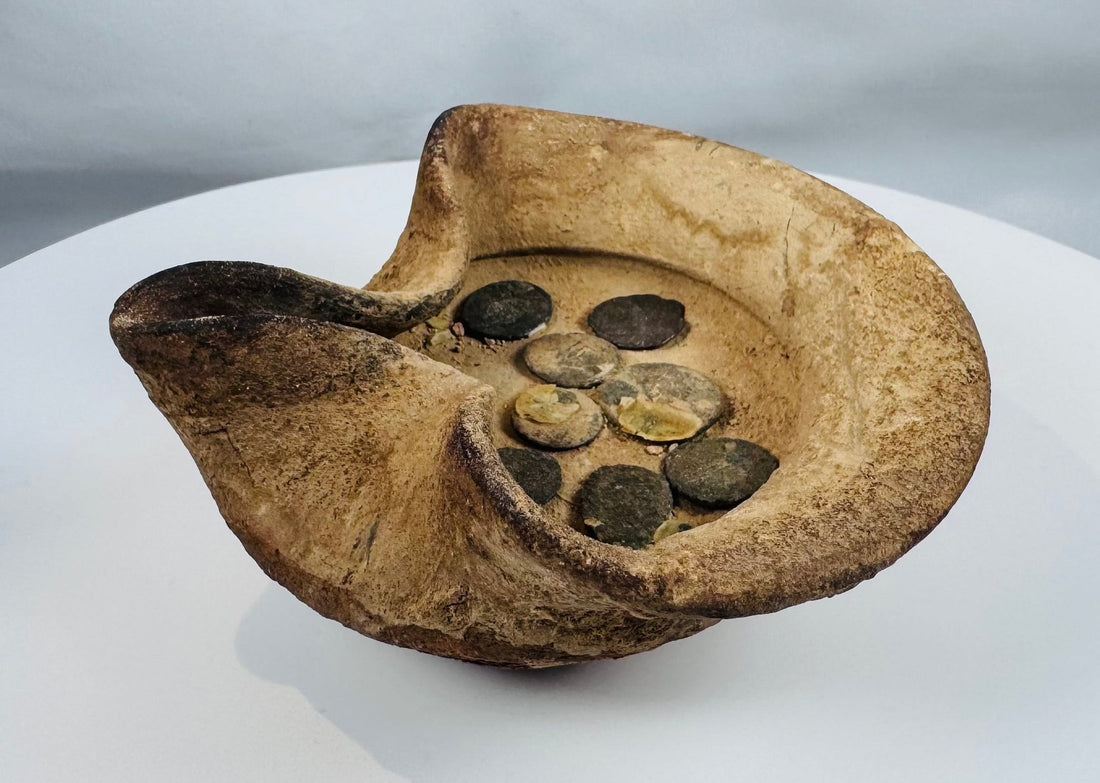


Ancient Punic Terracotta Open Oil Lamp with Bronze Coins | Circa 4th–2nd Century BCE
Description
More
Less
Historical Context & Origin
Region: North Africa, Punic Cultural Sphere
Material: Wheel-Made Terracotta (Fired Clay), with Associated Bronze Coins
Period: Punic Period, circa 4th–2nd Century BCE
Description
This distinctive ancient Punic terracotta oil lamp originates from the artistic and utilitarian traditions of North Africa during the 4th–2nd century BCE, a period marked by the continued influence of Carthaginian civilization throughout the western Mediterranean.
The lamp features a broad, shallow, open reservoir with a characteristic saucer-shaped profile. Fashioned from wheel-made terracotta, its circular body is distinguished by a rim folded inward along the sides and carefully pinched into a single upright nozzle at one end.
This practical design provided a convenient means of containing oil while positioning a wick at the projecting nozzle. The nozzle exhibits pronounced darkening, consistent in appearance with burning associated with the lamp's original function.
The ceramic fabric displays variations of buff and brown coloration, together with scattered earthy deposits, visible firing imperfections, and minor losses. These characteristics contribute to the vessel's distinctive archaeological appearance and reflect the surface condition of the surviving terracotta.
Of particular interest is the accompanying group of bronze coins arranged within the lamp's shallow reservoir. The coins display substantial surface patination, corrosion, and extensive wear, with their original inscriptions and identifying details no longer clearly discernible in the available photographs.
Although presented together, the precise chronological relationship between the lamp and the associated coins has not been established. Their inclusion provides an engaging display of ancient material culture, combining a functional ceramic vessel with examples of early bronze coinage.
The artifact is further accompanied by an older French collector's label traditionally identifying the vessel as originating from archaeological excavations at Carthage and dating to the Roman period.
The combination of its distinctive open reservoir, pinched nozzle, weathered ceramic fabric, accompanying bronze coins, and historical collector's label makes this an intriguing example of ancient North African material culture.
Features
-
Traditional shallow, saucer-shaped open reservoir
-
Broad circular body with an inward-folded rim along the sides
-
Single upright nozzle formed by pinching the terracotta rim
-
Pronounced darkening around the nozzle
-
Buff to brown ceramic fabric with natural variations in coloration
-
Earthy surface deposits, firing imperfections, and minor losses
-
Associated group of heavily patinated bronze coins
-
Coins exhibiting substantial wear and indistinct identifying details
-
Accompanied by a vintage French collector's label referencing Carthage
-
Distinctive example of Punic-period North African ceramic craftsmanship
Cultural Significance
The Punic civilization played a significant role in the political, economic, and cultural development of the ancient Mediterranean, particularly throughout North Africa and the western Mediterranean basin.
Centred on the powerful city of Carthage, located in present-day Tunisia, Punic society developed from Phoenician colonial traditions and established extensive networks of maritime commerce, agricultural production, and cultural exchange.
Between the 4th and 2nd centuries BCE, Carthage remained an important Mediterranean power, maintaining commercial and cultural connections with communities across North Africa, Sicily, Sardinia, the Iberian Peninsula, and the wider Mediterranean world.
Terracotta oil lamps were essential household objects within these ancient communities, providing a practical and economical source of artificial illumination.
Before enclosed mould-made lamps became increasingly widespread, open oil lamps represented an established form of lighting technology. These vessels typically consisted of a shallow reservoir designed to contain olive oil or another combustible fuel, with a pinched or projecting section of the rim supporting a wick.
Their relatively straightforward construction allowed ceramic craftsmen to produce functional lighting devices using established pottery techniques.
The present example illustrates this tradition through its wheel-made construction, broad open reservoir, inward-folded sides, and single upright pinched nozzle.
Such vessels reflect the practical ingenuity of ancient Mediterranean communities, combining efficient ceramic production with everyday domestic requirements.
Bronze coinage also played an important role in the commercial and economic systems of the ancient Mediterranean. Punic authorities and neighbouring cultures issued bronze denominations for various monetary purposes, reflecting the increasing importance of coinage in regional exchange.
The associated bronze coins accompanying this lamp provide an additional element of historical interest, although their precise origin, issuing authority, and date remain undetermined.
Condition
The lamp survives in worn ancient condition, retaining its broad, shallow reservoir, inward-folded rim, and distinctive upright pinched nozzle.
The terracotta exhibits earthy surface deposits, areas of discoloration, firing imperfections, minor losses, and age-related irregularities throughout.
Pronounced darkening is visible around the nozzle, consistent in appearance with historical burning or accumulated combustion deposits.
The buff to brown ceramic fabric displays uneven coloration and localized surface wear.
The associated bronze coins exhibit extensive patination, corrosion, and substantial wear. Their inscriptions and other diagnostic details are not sufficiently legible in the available photographs to establish individual identifications.
Dimensions (Approximate)
Width: 5 in
Depth: 5 in
Height: 2.5 inches
Age (Approximate)
Approximately 2,125–2,425 years old
Provenance
Accompanied by an old French collector's label reading:
"Très rare plat avec monnaies, fouilles archéologiques à Carthage. Empire Romain, Ier siècle."
(Translated: "Very rare dish with coins, archaeological excavations at Carthage. Roman Empire, 1st Century.")
Subsequently held in a private collection in Montreal, QC, Canada.
Expert Assessment: Examined by Luca Salvaggio, an Italian archaeologist specializing in ancient Mediterranean material, with a Postgraduate Diploma from the Italian Archaeological School at Athens (IASA) and accreditation for preventive archaeology from the Italian Ministry of Culture (MiC). He identified the artifact as a Punic terracotta open oil lamp from North Africa, dating to the 4th–2nd century BCE. His assessment considered its wheel-made construction, wide shallow reservoir, inward-folded rim, single upright pinched nozzle with evidence of darkening, and buff to brown ceramic fabric exhibiting earthy deposits, firing imperfections, and minor losses.
Learn More
Discover the history and function of ancient saucer-shaped oil lamps through The Metropolitan Museum of Art
Explore Our Collection of Roman & Greek Artifacts
Description
Historical Context & Origin
Region: North Africa, Punic Cultural Sphere
Material: Wheel-Made Terracotta (Fired Clay), with Associated Bronze Coins
Period: Punic Period, circa 4th–2nd Century BCE
Description
This distinctive ancient Punic terracotta oil lamp originates from the artistic and utilitarian traditions of North Africa during the 4th–2nd century BCE, a period marked by the continued influence of Carthaginian civilization throughout the western Mediterranean.
The lamp features a broad, shallow, open reservoir with a characteristic saucer-shaped profile. Fashioned from wheel-made terracotta, its circular body is distinguished by a rim folded inward along the sides and carefully pinched into a single upright nozzle at one end.
This practical design provided a convenient means of containing oil while positioning a wick at the projecting nozzle. The nozzle exhibits pronounced darkening, consistent in appearance with burning associated with the lamp's original function.
The ceramic fabric displays variations of buff and brown coloration, together with scattered earthy deposits, visible firing imperfections, and minor losses. These characteristics contribute to the vessel's distinctive archaeological appearance and reflect the surface condition of the surviving terracotta.
Of particular interest is the accompanying group of bronze coins arranged within the lamp's shallow reservoir. The coins display substantial surface patination, corrosion, and extensive wear, with their original inscriptions and identifying details no longer clearly discernible in the available photographs.
Although presented together, the precise chronological relationship between the lamp and the associated coins has not been established. Their inclusion provides an engaging display of ancient material culture, combining a functional ceramic vessel with examples of early bronze coinage.
The artifact is further accompanied by an older French collector's label traditionally identifying the vessel as originating from archaeological excavations at Carthage and dating to the Roman period.
The combination of its distinctive open reservoir, pinched nozzle, weathered ceramic fabric, accompanying bronze coins, and historical collector's label makes this an intriguing example of ancient North African material culture.
Features
-
Traditional shallow, saucer-shaped open reservoir
-
Broad circular body with an inward-folded rim along the sides
-
Single upright nozzle formed by pinching the terracotta rim
-
Pronounced darkening around the nozzle
-
Buff to brown ceramic fabric with natural variations in coloration
-
Earthy surface deposits, firing imperfections, and minor losses
-
Associated group of heavily patinated bronze coins
-
Coins exhibiting substantial wear and indistinct identifying details
-
Accompanied by a vintage French collector's label referencing Carthage
-
Distinctive example of Punic-period North African ceramic craftsmanship
Cultural Significance
The Punic civilization played a significant role in the political, economic, and cultural development of the ancient Mediterranean, particularly throughout North Africa and the western Mediterranean basin.
Centred on the powerful city of Carthage, located in present-day Tunisia, Punic society developed from Phoenician colonial traditions and established extensive networks of maritime commerce, agricultural production, and cultural exchange.
Between the 4th and 2nd centuries BCE, Carthage remained an important Mediterranean power, maintaining commercial and cultural connections with communities across North Africa, Sicily, Sardinia, the Iberian Peninsula, and the wider Mediterranean world.
Terracotta oil lamps were essential household objects within these ancient communities, providing a practical and economical source of artificial illumination.
Before enclosed mould-made lamps became increasingly widespread, open oil lamps represented an established form of lighting technology. These vessels typically consisted of a shallow reservoir designed to contain olive oil or another combustible fuel, with a pinched or projecting section of the rim supporting a wick.
Their relatively straightforward construction allowed ceramic craftsmen to produce functional lighting devices using established pottery techniques.
The present example illustrates this tradition through its wheel-made construction, broad open reservoir, inward-folded sides, and single upright pinched nozzle.
Such vessels reflect the practical ingenuity of ancient Mediterranean communities, combining efficient ceramic production with everyday domestic requirements.
Bronze coinage also played an important role in the commercial and economic systems of the ancient Mediterranean. Punic authorities and neighbouring cultures issued bronze denominations for various monetary purposes, reflecting the increasing importance of coinage in regional exchange.
The associated bronze coins accompanying this lamp provide an additional element of historical interest, although their precise origin, issuing authority, and date remain undetermined.
Condition
The lamp survives in worn ancient condition, retaining its broad, shallow reservoir, inward-folded rim, and distinctive upright pinched nozzle.
The terracotta exhibits earthy surface deposits, areas of discoloration, firing imperfections, minor losses, and age-related irregularities throughout.
Pronounced darkening is visible around the nozzle, consistent in appearance with historical burning or accumulated combustion deposits.
The buff to brown ceramic fabric displays uneven coloration and localized surface wear.
The associated bronze coins exhibit extensive patination, corrosion, and substantial wear. Their inscriptions and other diagnostic details are not sufficiently legible in the available photographs to establish individual identifications.
Dimensions (Approximate)
Width: 5 in
Depth: 5 in
Height: 2.5 inches
Age (Approximate)
Approximately 2,125–2,425 years old
Provenance
Accompanied by an old French collector's label reading:
"Très rare plat avec monnaies, fouilles archéologiques à Carthage. Empire Romain, Ier siècle."
(Translated: "Very rare dish with coins, archaeological excavations at Carthage. Roman Empire, 1st Century.")
Subsequently held in a private collection in Montreal, QC, Canada.
Expert Assessment: Examined by Luca Salvaggio, an Italian archaeologist specializing in ancient Mediterranean material, with a Postgraduate Diploma from the Italian Archaeological School at Athens (IASA) and accreditation for preventive archaeology from the Italian Ministry of Culture (MiC). He identified the artifact as a Punic terracotta open oil lamp from North Africa, dating to the 4th–2nd century BCE. His assessment considered its wheel-made construction, wide shallow reservoir, inward-folded rim, single upright pinched nozzle with evidence of darkening, and buff to brown ceramic fabric exhibiting earthy deposits, firing imperfections, and minor losses.
Learn More
Discover the history and function of ancient saucer-shaped oil lamps through The Metropolitan Museum of Art
Explore Our Collection of Roman & Greek Artifacts
You May Also Like
