


Antique Rococo-Style Carved Wooden Crucifix | Gilded Corpus Christi & Ornate Religious Frame | Circa Late 19th–Early 20th Century
Couldn't load pickup availability





Antique Rococo-Style Carved Wooden Crucifix | Gilded Corpus Christi & Ornate Religious Frame | Circa Late 19th–Early 20th Century
Description
More
Less
Historical Context & Origin
Region: Continental Europe
Material: Carved wood with gilded and polychrome finishes, red textile backing, and metal fittings
Period: Rococo Revival, circa late 19th–early 20th Century
Description
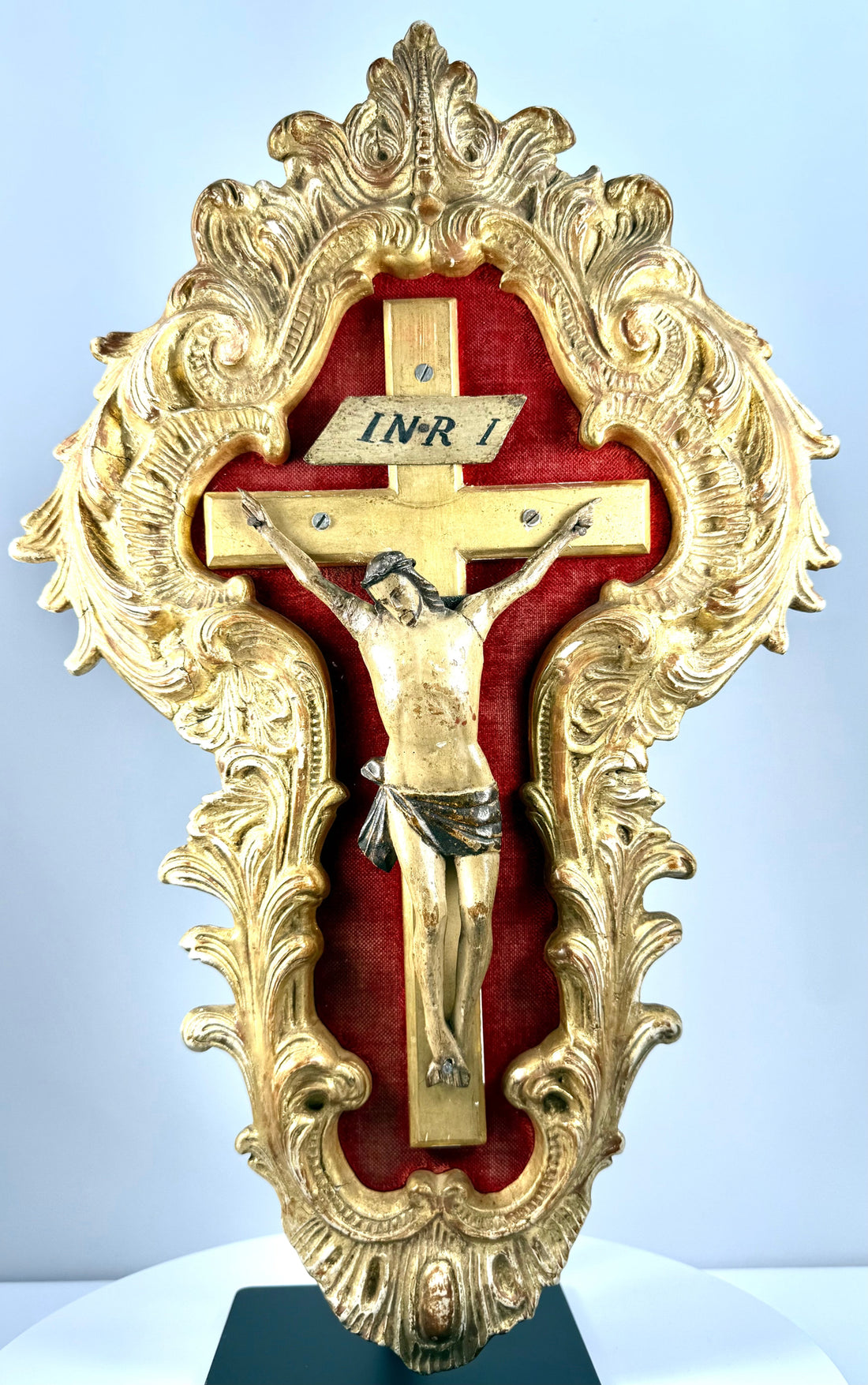
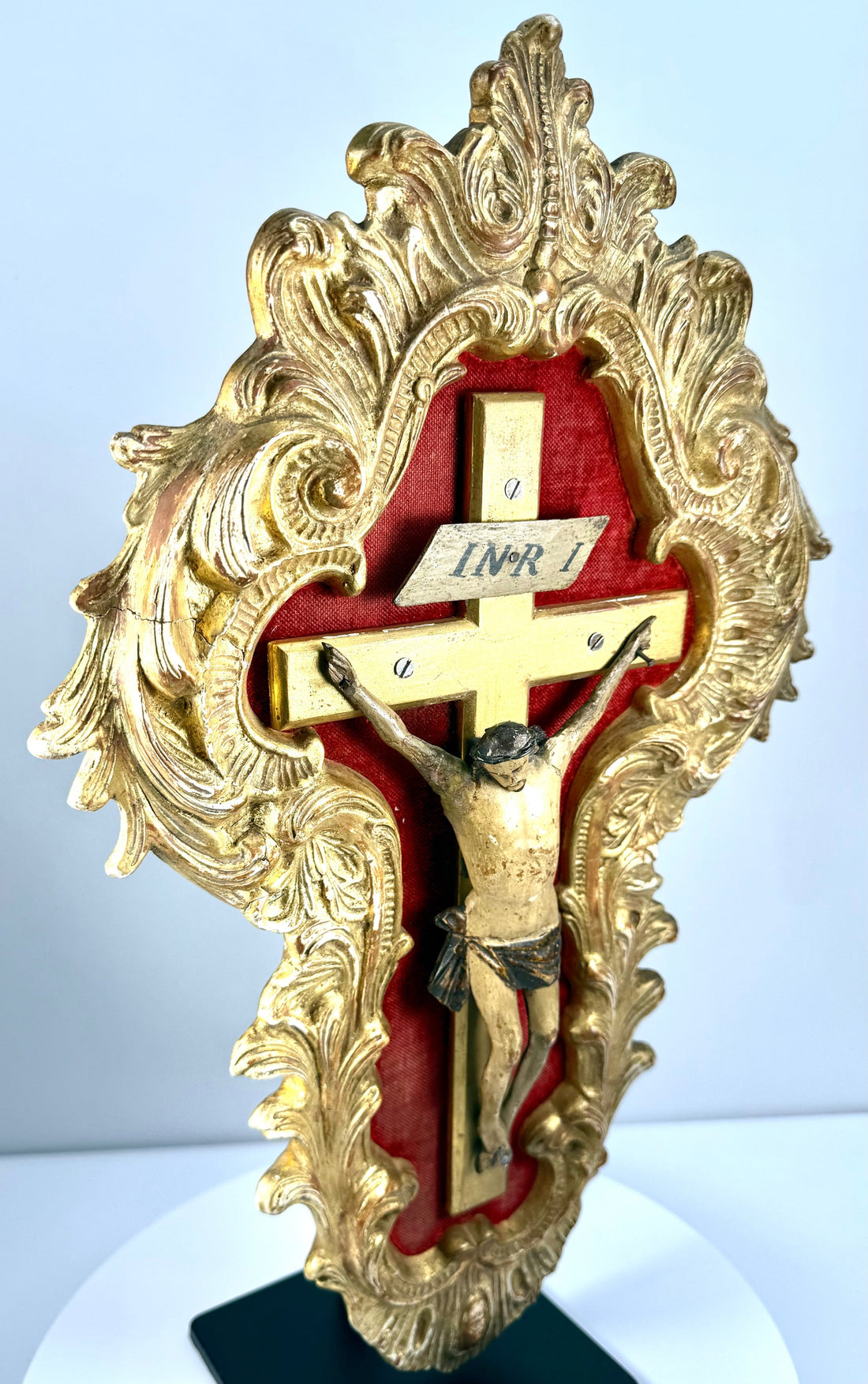
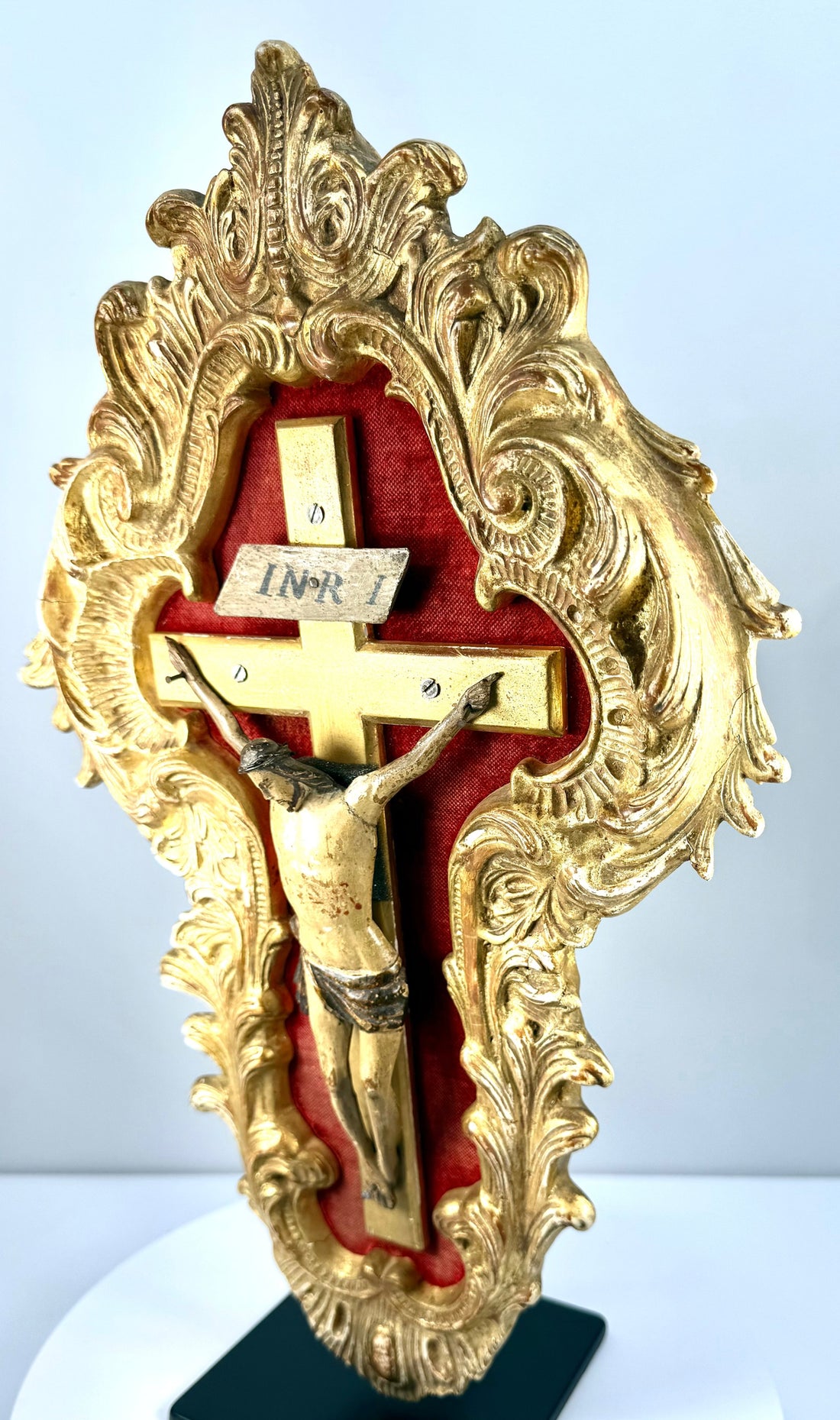
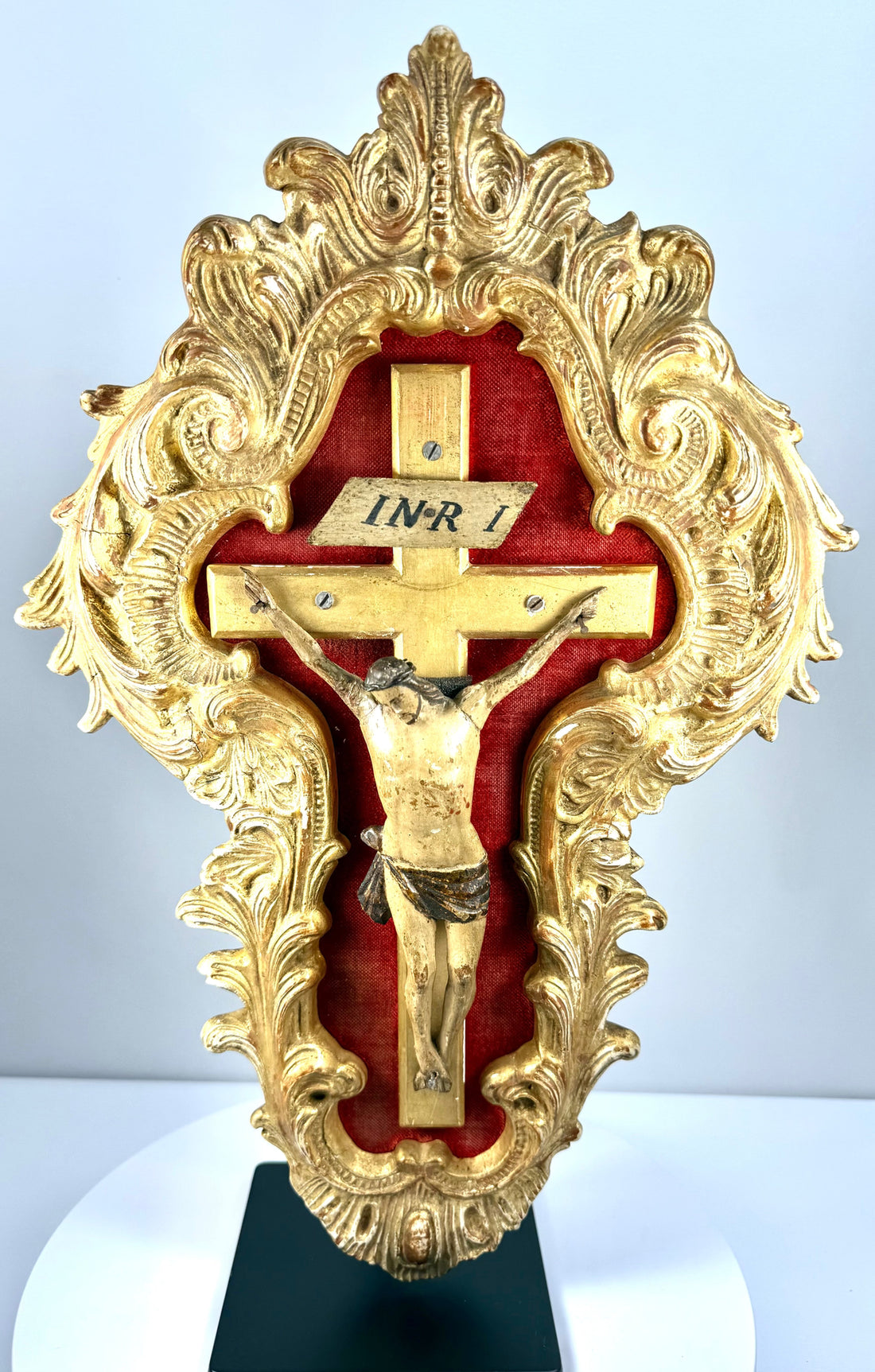
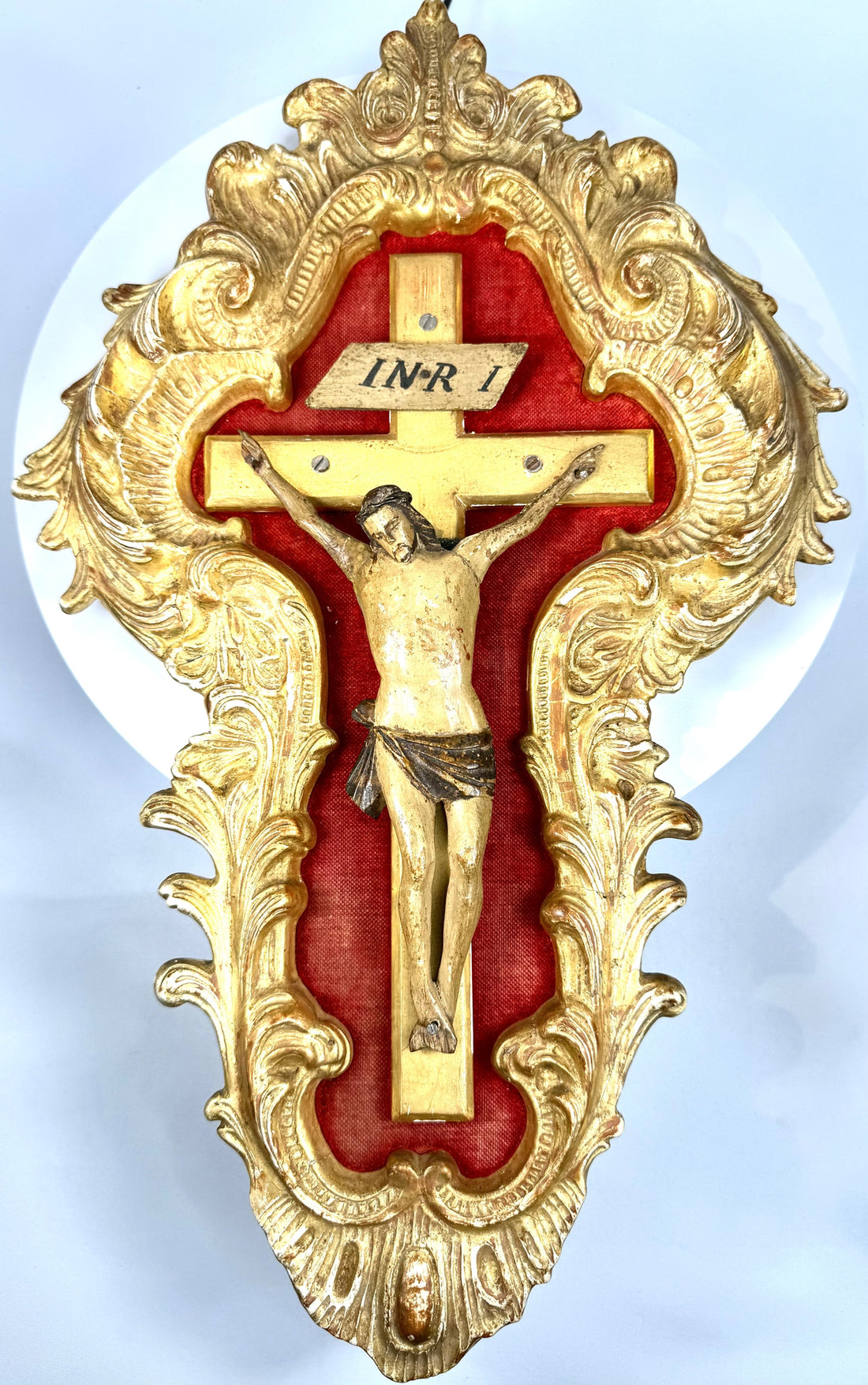
A striking antique European devotional crucifix featuring a sculpted representation of Jesus Christ upon a gilded wooden cross, surrounded by an elaborate Rococo Revival frame displaying richly ornamented scrollwork, flowing acanthus leaves, and decorative shell-inspired motifs.
The composition is distinguished by its dramatic gilded surround, whose deeply modelled curves and symmetrical flourishes reflect the ornamental traditions of European Rococo religious craftsmanship. The elaborate frame encircles a rich crimson-red textile background, creating a striking contrast that emphasizes the central crucifix.
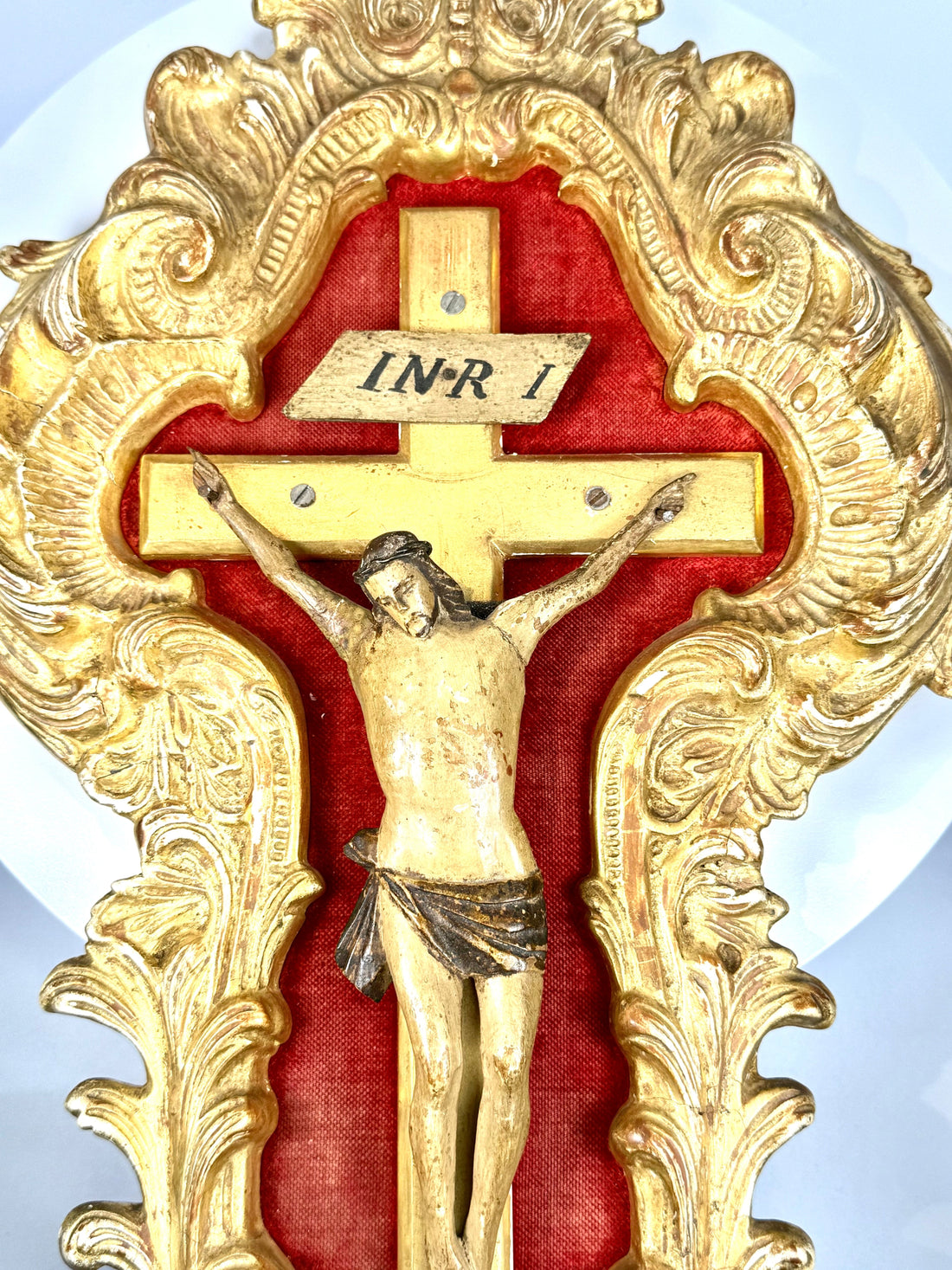
At the centre, Christ is depicted with his head inclined to one side, arms extended upward, and feet crossed beneath a darkly painted loincloth. His figure retains an aged, pale polychrome finish, with darker detailing defining the hair, crown of thorns, facial features, and draped garment.
The softly modelled anatomy and restrained facial expression convey the solemnity of the Crucifixion, while the weathered painted surface preserves the devotional character of the sculpture.
Positioned above the figure is the traditional INRI inscription, an abbreviation of the Latin phrase Iesus Nazarenus Rex Iudaeorum, meaning "Jesus of Nazareth, King of the Jews."
The surrounding carved ornament incorporates bold C-shaped scrolls, curling acanthus foliage, deeply recessed details, and shell-inspired decorative elements. These elaborate forms extend around the central composition, culminating in an ornamental upper crest and decorative lower terminal.
The gilded finish retains areas of natural wear and patination, highlighting the intricate raised surfaces, sculptural depth, and craftsmanship of the frame.
The combination of gilded wood, polychrome religious sculpture, and crimson textile backing reflects the continued popularity of elaborate European devotional decoration during the Rococo Revival period.
Features
- Antique European devotional crucifix with elaborate Rococo Revival ornamentation
- Sculpted Corpus Christi displaying traditional Crucifixion iconography
- Expressive representation of Christ with inclined head, extended arms, and crossed feet
- Pale polychrome figure with darkly painted hair, crown of thorns, and loincloth
- Richly detailed gilded wooden frame with flowing C-shaped scrollwork
- Deeply carved acanthus foliage and shell-inspired decorative elements
- Contrasting crimson-red textile background emphasizing the central crucifix
- Traditional INRI inscription positioned above the figure of Christ
- Ornamental upper crest and elaborate lower terminal
- Surviving gilded and painted surfaces with visible age-related wear and patination
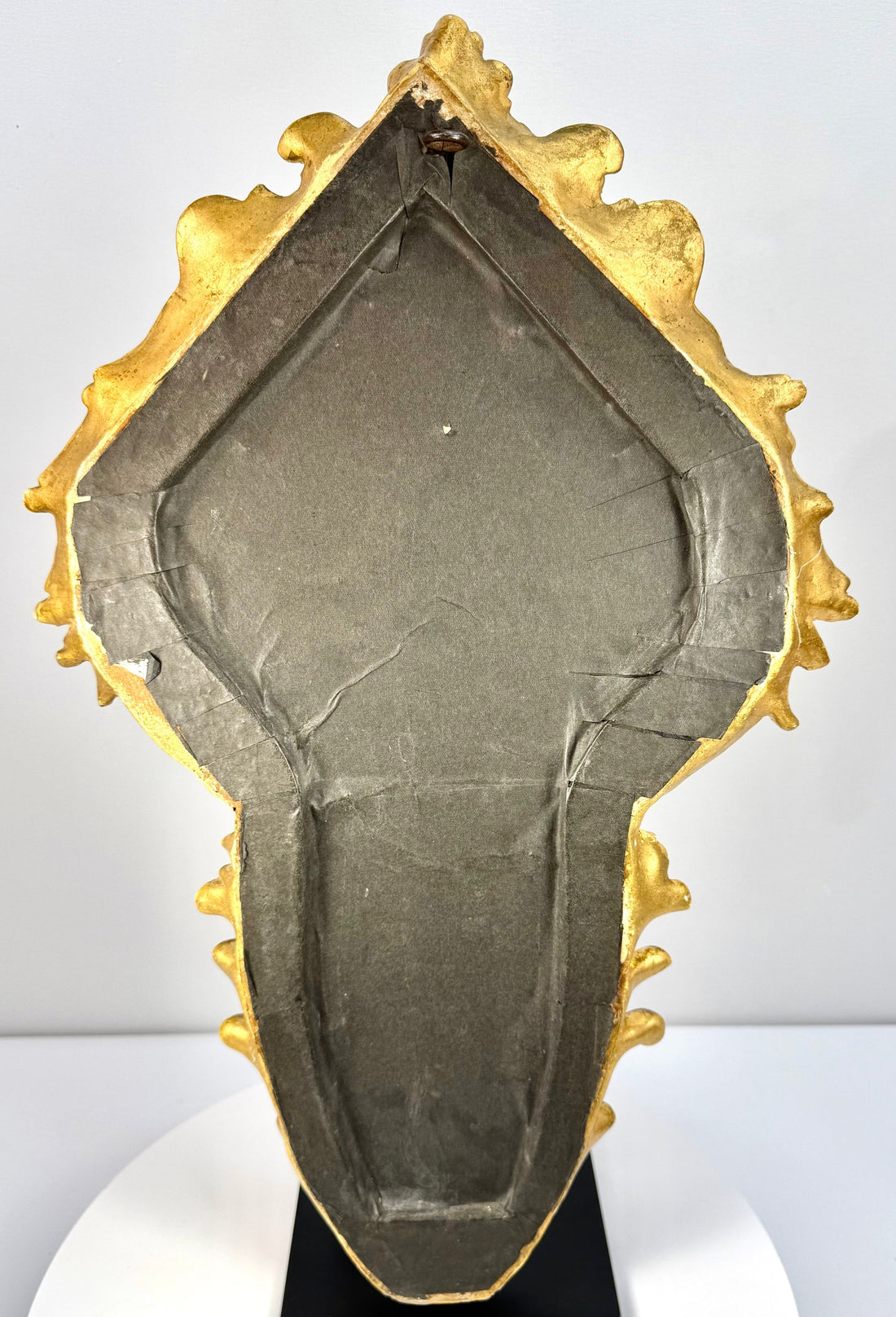
- Dark protective covering on the reverse with visible reinforcement and adhesive material
Cultural Significance
The crucifix occupies a central position within Christian religious art, representing the suffering, sacrifice, and redemption associated with the Crucifixion of Jesus Christ. Throughout European history, such objects served as important expressions of personal faith and were displayed in private residences, chapels, monasteries, and other devotional settings.
The elaborate ornamentation surrounding this example draws upon the Rococo artistic tradition, which emerged in France during the early 18th century and subsequently influenced decorative arts throughout Europe.
Characterized by flowing curves, elaborate gilding, shell-like ornamentation, and intricate botanical motifs, the Rococo style transformed everyday and religious objects into visually expressive works of craftsmanship.
Distinctive C-shaped and S-shaped scrollwork, acanthus leaves, and shell-inspired forms became defining characteristics of Rococo decorative art. These ornamental elements were widely incorporated into furniture, architectural interiors, mirrors, religious furnishings, and carved wooden frames.
Although the original Rococo movement developed during the 18th century, its decorative principles continued to influence European craftsmanship through subsequent revival movements during the 19th and early 20th centuries.
Rococo Revival religious objects frequently combined elaborate gilded ornamentation with traditional Christian imagery, preserving established devotional subjects within richly decorated compositions.
The present crucifix reflects these artistic traditions through its sculpted Corpus Christi, gilded scrolling surround, acanthus-inspired decoration, and contrasting crimson textile background. Together, these elements illustrate the continued influence of Rococo ornamentation upon European devotional craftsmanship.
Condition
The crucifix remains in good antique condition overall, displaying visible surface wear consistent with age and previous handling.
The gilded wooden frame retains its elaborate decorative detailing, with scattered areas of rubbing, minor abrasions, and localized losses to the surface finish. The carved scrollwork, acanthus foliage, and ornamental projections remain clearly recognizable.
The figure of Christ exhibits age-related wear to its polychrome decoration, including small areas of discoloration, flaking, and exposed underlying material. The facial features, extended arms, crossed feet, and draped loincloth remain distinguishable.
The crimson-red textile backing displays surface aging and variations in texture and coloration.
The reverse retains a dark protective covering with visible reinforcement and adhesive material around its edges.
Despite these areas of wear, the crucifix retains its distinctive devotional composition and elaborate Rococo Revival decorative character.
Dimensions (Approximate)
Height: 17.5 in
Width: 10.5 in
Depth: 1 in
Age (Approximate)
100–150 years old
Provenance
Previously held in a private collection in Selborne, United Kingdom.
Learn More
Discover the origins of Rococo ornamentation, including shell-inspired motifs, acanthus foliage, and flowing scrollwork, through the Victoria and Albert Museum
Explore more historical devotional objects, religious sculptures, and sacred artifacts in our Religious & Spiritual Relics Collection
Description
Historical Context & Origin
Region: Continental Europe
Material: Carved wood with gilded and polychrome finishes, red textile backing, and metal fittings
Period: Rococo Revival, circa late 19th–early 20th Century
Description
A striking antique European devotional crucifix featuring a sculpted representation of Jesus Christ upon a gilded wooden cross, surrounded by an elaborate Rococo Revival frame displaying richly ornamented scrollwork, flowing acanthus leaves, and decorative shell-inspired motifs.
The composition is distinguished by its dramatic gilded surround, whose deeply modelled curves and symmetrical flourishes reflect the ornamental traditions of European Rococo religious craftsmanship. The elaborate frame encircles a rich crimson-red textile background, creating a striking contrast that emphasizes the central crucifix.
At the centre, Christ is depicted with his head inclined to one side, arms extended upward, and feet crossed beneath a darkly painted loincloth. His figure retains an aged, pale polychrome finish, with darker detailing defining the hair, crown of thorns, facial features, and draped garment.
The softly modelled anatomy and restrained facial expression convey the solemnity of the Crucifixion, while the weathered painted surface preserves the devotional character of the sculpture.
Positioned above the figure is the traditional INRI inscription, an abbreviation of the Latin phrase Iesus Nazarenus Rex Iudaeorum, meaning "Jesus of Nazareth, King of the Jews."
The surrounding carved ornament incorporates bold C-shaped scrolls, curling acanthus foliage, deeply recessed details, and shell-inspired decorative elements. These elaborate forms extend around the central composition, culminating in an ornamental upper crest and decorative lower terminal.
The gilded finish retains areas of natural wear and patination, highlighting the intricate raised surfaces, sculptural depth, and craftsmanship of the frame.
The combination of gilded wood, polychrome religious sculpture, and crimson textile backing reflects the continued popularity of elaborate European devotional decoration during the Rococo Revival period.
Features
- Antique European devotional crucifix with elaborate Rococo Revival ornamentation
- Sculpted Corpus Christi displaying traditional Crucifixion iconography
- Expressive representation of Christ with inclined head, extended arms, and crossed feet
- Pale polychrome figure with darkly painted hair, crown of thorns, and loincloth
- Richly detailed gilded wooden frame with flowing C-shaped scrollwork
- Deeply carved acanthus foliage and shell-inspired decorative elements
- Contrasting crimson-red textile background emphasizing the central crucifix
- Traditional INRI inscription positioned above the figure of Christ
- Ornamental upper crest and elaborate lower terminal
- Surviving gilded and painted surfaces with visible age-related wear and patination
- Dark protective covering on the reverse with visible reinforcement and adhesive material
Cultural Significance
The crucifix occupies a central position within Christian religious art, representing the suffering, sacrifice, and redemption associated with the Crucifixion of Jesus Christ. Throughout European history, such objects served as important expressions of personal faith and were displayed in private residences, chapels, monasteries, and other devotional settings.
The elaborate ornamentation surrounding this example draws upon the Rococo artistic tradition, which emerged in France during the early 18th century and subsequently influenced decorative arts throughout Europe.
Characterized by flowing curves, elaborate gilding, shell-like ornamentation, and intricate botanical motifs, the Rococo style transformed everyday and religious objects into visually expressive works of craftsmanship.
Distinctive C-shaped and S-shaped scrollwork, acanthus leaves, and shell-inspired forms became defining characteristics of Rococo decorative art. These ornamental elements were widely incorporated into furniture, architectural interiors, mirrors, religious furnishings, and carved wooden frames.
Although the original Rococo movement developed during the 18th century, its decorative principles continued to influence European craftsmanship through subsequent revival movements during the 19th and early 20th centuries.
Rococo Revival religious objects frequently combined elaborate gilded ornamentation with traditional Christian imagery, preserving established devotional subjects within richly decorated compositions.
The present crucifix reflects these artistic traditions through its sculpted Corpus Christi, gilded scrolling surround, acanthus-inspired decoration, and contrasting crimson textile background. Together, these elements illustrate the continued influence of Rococo ornamentation upon European devotional craftsmanship.
Condition
The crucifix remains in good antique condition overall, displaying visible surface wear consistent with age and previous handling.
The gilded wooden frame retains its elaborate decorative detailing, with scattered areas of rubbing, minor abrasions, and localized losses to the surface finish. The carved scrollwork, acanthus foliage, and ornamental projections remain clearly recognizable.
The figure of Christ exhibits age-related wear to its polychrome decoration, including small areas of discoloration, flaking, and exposed underlying material. The facial features, extended arms, crossed feet, and draped loincloth remain distinguishable.
The crimson-red textile backing displays surface aging and variations in texture and coloration.
The reverse retains a dark protective covering with visible reinforcement and adhesive material around its edges.
Despite these areas of wear, the crucifix retains its distinctive devotional composition and elaborate Rococo Revival decorative character.
Dimensions (Approximate)
Height: 17.5 in
Width: 10.5 in
Depth: 1 in
Age (Approximate)
100–150 years old
Provenance
Previously held in a private collection in Selborne, United Kingdom.
Learn More
Discover the origins of Rococo ornamentation, including shell-inspired motifs, acanthus foliage, and flowing scrollwork, through the Victoria and Albert Museum
Explore more historical devotional objects, religious sculptures, and sacred artifacts in our Religious & Spiritual Relics Collection
You May Also Like
