

Roman North African Terracotta Bowl with White Slip | Tunisia | Detailed Provenance | Circa 100–300 CE
Couldn't load pickup availability




Roman North African Terracotta Bowl with White Slip | Tunisia | Detailed Provenance | Circa 100–300 CE
Description
More
Less
Historical Context & Origin
Region: Roman North Africa (modern-day Tunisia)
Material: Earthenware pottery with traces of white slip and mineral deposits
Period: Roman Imperial Period, ca. 100–300 CE
Description
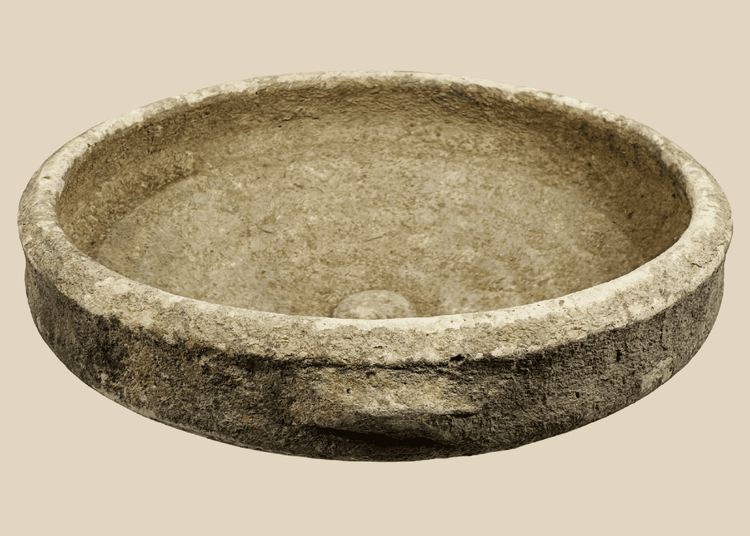
This authentic Roman terracotta bowl originates from North Africa, one of the most important agricultural and ceramic-producing regions of the Roman Empire. The vessel is of broad, shallow form with a thickened rim, gently sloping walls, and a slightly raised central boss within the interior. The exterior retains traces of a pale white slip coating, a surface treatment commonly employed on utilitarian and domestic Roman pottery throughout the Mediterranean world.
Crafted from coarse earthenware clay, the bowl displays a simple yet functional design intended for everyday use. Vessels of this type were commonly employed for food preparation, serving, storage, and domestic household activities. Similar examples have been recovered from Roman settlements, villas, military installations, and urban centers throughout Tunisia and neighboring regions.
The surface exhibits substantial age-related weathering and burial accretions, producing an attractive archaeological appearance. The surviving white slip and extensive mineralization further support its considerable antiquity and long-term burial history.
Roman North Africa became one of the wealthiest provinces of the Empire following the destruction of Carthage and later under Imperial administration. Pottery workshops throughout the region produced vast quantities of utilitarian wares that circulated across the Mediterranean, making ceramic vessels among the most recognizable artifacts of daily Roman life.
Features
- Authentic Roman North African terracotta bowl
- Broad shallow form with thickened rim
- Earthenware body with surviving traces of white slip
- Raised central boss to the interior
- Attractive archaeological weathering and mineral deposits
- Accompanied by collection documentation
- Acquired in Tunisia during the early 1980s
- Excellent display piece illustrating everyday Roman life
Cultural Significance
Pottery vessels formed the backbone of daily life throughout the Roman Empire. Used for food preparation, storage, transport, and serving, ceramic wares provide archaeologists with some of the most important evidence for understanding trade, economy, and domestic life in antiquity.
North Africa, particularly modern Tunisia, became one of Rome's most productive provinces and supplied agricultural goods and ceramics throughout the Mediterranean. Vessels such as this represent the practical household wares used by ordinary Romans nearly two thousand years ago.
Condition
Good archaeological condition. Surface weathering, mineral deposits, abrasions, losses to portions of the white slip, and expected imperfections consistent with age and burial. No major restorations observed. Displays well.
Dimensions (Approximate)
Height: 2.25 in
Diameter: 7 in
Age (Approximate)
1,700–1,900 years old
Provenance
Purchased in Tunisia in 1982 and subsequently retained in the McMillan Collection, Minnesota, USA, for over four decades.
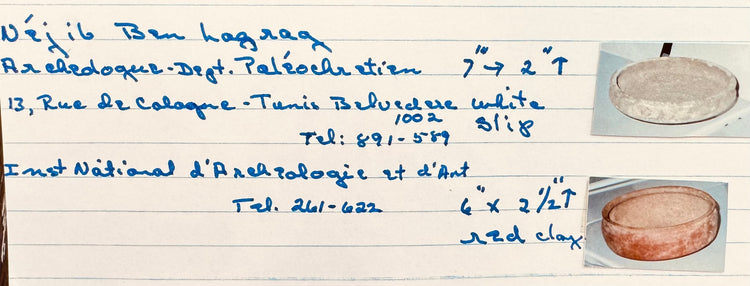
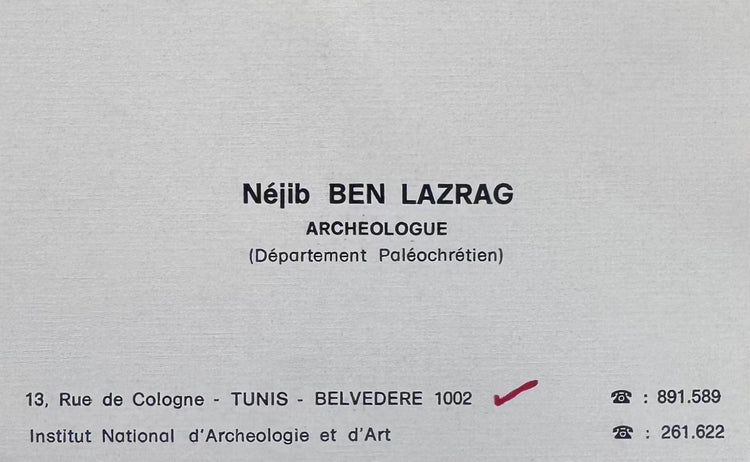
The vessel was acquired from archaeologist Néjib Ben Lazrag, formerly associated with the Institut National d'Archéologie et d'Art in Tunis. Accompanying collection records identify the object and there is a period photograph documenting the bowl.
Additional accompanying documentation includes the original archaeologist's business card, handwritten collection inventory records, and period collection photographs showing the vessel as it appeared in the collection during the early 1980s.
The McMillan Collection was assembled over several decades and contained an extensive range of antiquities acquired directly from dealers, archaeologists, galleries, and antique sources throughout Europe, North Africa, the Near East, and the Mediterranean.
Learn More
Discover the history of Roman North Africa and its importance within the Roman Empire.
Browse Our Collection of Ancient Ceramics & Pottery
Description
Historical Context & Origin
Region: Roman North Africa (modern-day Tunisia)
Material: Earthenware pottery with traces of white slip and mineral deposits
Period: Roman Imperial Period, ca. 100–300 CE
Description
This authentic Roman terracotta bowl originates from North Africa, one of the most important agricultural and ceramic-producing regions of the Roman Empire. The vessel is of broad, shallow form with a thickened rim, gently sloping walls, and a slightly raised central boss within the interior. The exterior retains traces of a pale white slip coating, a surface treatment commonly employed on utilitarian and domestic Roman pottery throughout the Mediterranean world.
Crafted from coarse earthenware clay, the bowl displays a simple yet functional design intended for everyday use. Vessels of this type were commonly employed for food preparation, serving, storage, and domestic household activities. Similar examples have been recovered from Roman settlements, villas, military installations, and urban centers throughout Tunisia and neighboring regions.
The surface exhibits substantial age-related weathering and burial accretions, producing an attractive archaeological appearance. The surviving white slip and extensive mineralization further support its considerable antiquity and long-term burial history.
Roman North Africa became one of the wealthiest provinces of the Empire following the destruction of Carthage and later under Imperial administration. Pottery workshops throughout the region produced vast quantities of utilitarian wares that circulated across the Mediterranean, making ceramic vessels among the most recognizable artifacts of daily Roman life.
Features
- Authentic Roman North African terracotta bowl
- Broad shallow form with thickened rim
- Earthenware body with surviving traces of white slip
- Raised central boss to the interior
- Attractive archaeological weathering and mineral deposits
- Accompanied by collection documentation
- Acquired in Tunisia during the early 1980s
- Excellent display piece illustrating everyday Roman life
Cultural Significance
Pottery vessels formed the backbone of daily life throughout the Roman Empire. Used for food preparation, storage, transport, and serving, ceramic wares provide archaeologists with some of the most important evidence for understanding trade, economy, and domestic life in antiquity.
North Africa, particularly modern Tunisia, became one of Rome's most productive provinces and supplied agricultural goods and ceramics throughout the Mediterranean. Vessels such as this represent the practical household wares used by ordinary Romans nearly two thousand years ago.
Condition
Good archaeological condition. Surface weathering, mineral deposits, abrasions, losses to portions of the white slip, and expected imperfections consistent with age and burial. No major restorations observed. Displays well.
Dimensions (Approximate)
Height: 2.25 in
Diameter: 7 in
Age (Approximate)
1,700–1,900 years old
Provenance
Purchased in Tunisia in 1982 and subsequently retained in the McMillan Collection, Minnesota, USA, for over four decades.
The vessel was acquired from archaeologist Néjib Ben Lazrag, formerly associated with the Institut National d'Archéologie et d'Art in Tunis. Accompanying collection records identify the object and there is a period photograph documenting the bowl.
Additional accompanying documentation includes the original archaeologist's business card, handwritten collection inventory records, and period collection photographs showing the vessel as it appeared in the collection during the early 1980s.
The McMillan Collection was assembled over several decades and contained an extensive range of antiquities acquired directly from dealers, archaeologists, galleries, and antique sources throughout Europe, North Africa, the Near East, and the Mediterranean.
Learn More
Discover the history of Roman North Africa and its importance within the Roman Empire.
Browse Our Collection of Ancient Ceramics & Pottery
You May Also Like
