



Stanley London Brass Natural Sine Surveyor's Compass & Clinometer | Brunton-Style Pocket Transit | 20th Century
Couldn't load pickup availability


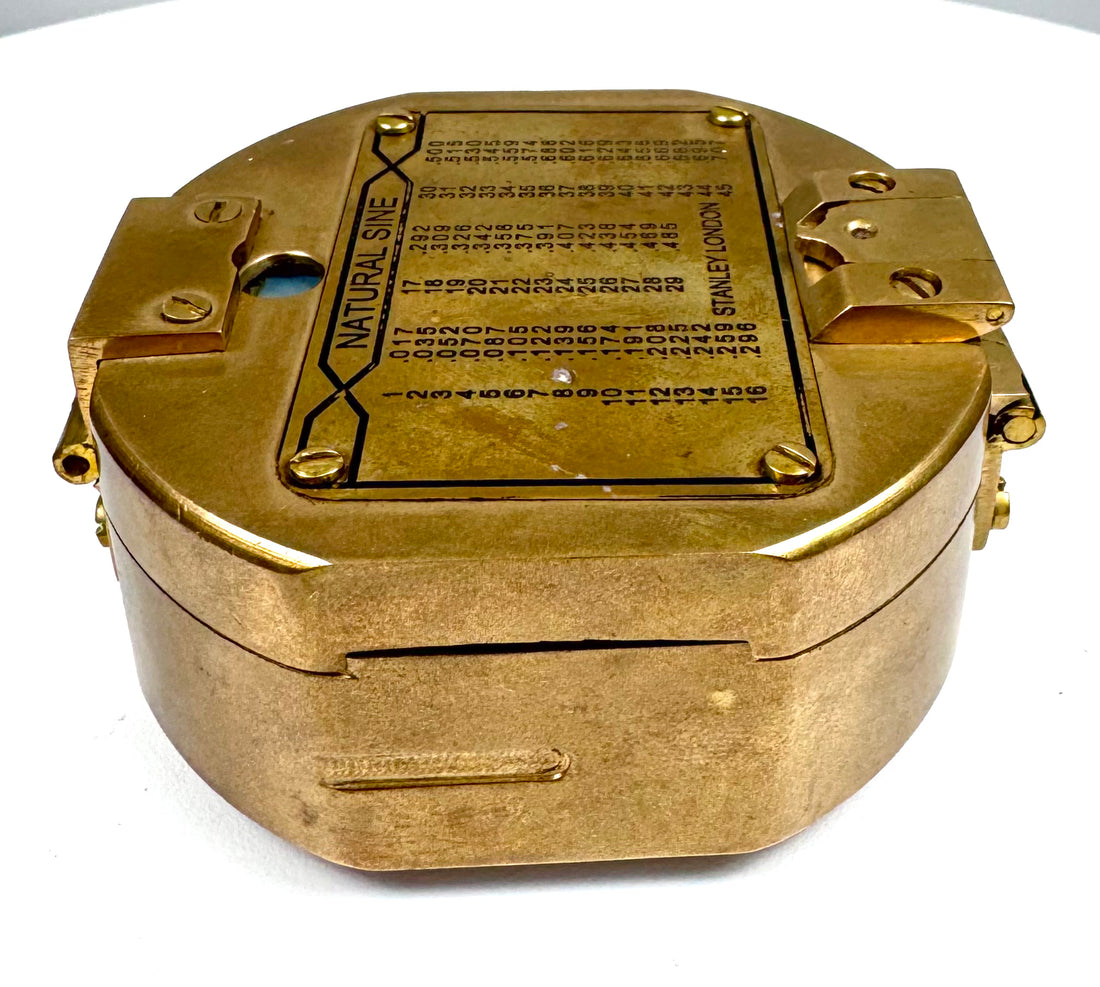


Stanley London Brass Natural Sine Surveyor's Compass & Clinometer | Brunton-Style Pocket Transit | 20th Century
Description
More
Less
Historical Context & Origin
Region: British-inspired scientific instrument design; place of manufacture undetermined
Material: Brass housing and fittings, mirrored glass lid, glass-covered compass dial, and internal metal mechanisms
Period: Modern reproduction of a Brunton-style pocket transit; manufacturing date undetermined
Description
A substantial brass Brunton-style surveying compass and clinometer reproduction bearing the "STANLEY LONDON" inscription. The instrument combines a magnetic compass, folding sighting mechanism, hinged observation mirror, internal levelling components, and an engraved natural sine reference table within a compact brass housing.
The design follows the traditional Brunton pocket transit configuration, a portable field instrument developed for surveying, geological examination, navigation, and the measurement of horizontal bearings and vertical angles. Its distinctive construction reflects the appearance and mechanical arrangement of historical surveying equipment.
The circular brass housing exhibits a warm golden finish, with a broad outer rim surrounding a finely graduated compass dial. The perimeter features a complete 360-degree scale, with individually numbered ten-degree divisions and closely spaced intermediate graduations.
At the centre is a pivot-mounted magnetic compass needle with a silver-toned surface and red-painted directional tip. The needle is surrounded by additional measurement scales, directional markings, and internal components associated with the instrument's compass and clinometer-style design.
The compass dial bears the inscription "STANLEY LONDON," recalling the distinguished tradition of British scientific instrument manufacturing. The marking appears on numerous brass reproductions inspired by historical surveying instruments and should be distinguished from verified instruments manufactured by the original W. F. Stanley company.
Particularly noteworthy is the combination of compass and clinometer-style components, reflecting the traditional surveying arrangement used to measure magnetic bearings and angles of elevation or depression.
The interior incorporates visible levelling components and mechanical adjustments beneath the protective glass. These elements are arranged around the compass assembly, allowing the graduated dial, magnetic needle, and internal components to remain visible.
A hinged circular lid opens to reveal a mounted observation mirror. The mirror incorporates a fine central sighting line and circular reference marking, features traditionally employed to align the instrument with distant landmarks while observing the compass reading.
Opposite the hinged mirror is an elongated folding brass sighting arm. Its slotted construction provides a viewing aperture, while the substantial brass hinge allows the arm to be raised and lowered independently.
The underside features a rectangular engraved mathematical reference plate secured by four brass screws. The plate is prominently marked "NATURAL SINE" and incorporates columns of numerical values corresponding to angles from 1 to 45 degrees. The inscription "STANLEY LONDON" appears beneath the table.
Natural sine tables were historically used by surveyors and engineers to calculate the vertical component of inclined distances. When combined with clinometer readings and known distances, these references assisted in determining differences in elevation between geographical points.
The instrument retains numerous characteristic details of traditional surveying equipment, including fitted brass hinges, slotted screws, graduated scales, folding sighting components, and mechanical adjustments.
The exterior displays a warm polished brass appearance with subtle variations in coloration, localized surface scratches, and handling marks. Its elaborate construction and historical surveying design make it a distinctive decorative example of traditional scientific instrument craftsmanship.
Features
- Substantial circular brass housing with a warm golden finish
- Brunton-style pocket transit configuration incorporating compass and clinometer-style features
- "STANLEY LONDON" inscription on the compass dial
- Complete 360-degree graduated compass scale with numbered directional markings
- Silver-toned magnetic compass needle with red-painted directional tip
- Additional internal measurement scales and visible mechanical components
- Hinged brass lid incorporating an observation mirror
- Fine central sighting line and circular reference marking on the mirror
- Elongated folding brass sighting arm with an open viewing slot
- Visible levelling components and internal mechanical adjustments
- Rectangular mathematical reference plate secured by four brass screws
- Engraved "NATURAL SINE" conversion table covering angles from 1 to 45 degrees
- Additional "STANLEY LONDON" inscription beneath the mathematical reference table
- Decorative reproduction inspired by historical British and American surveying instruments
Cultural Significance
Surveying compasses played an essential role in the development of modern engineering, cartography, geology, military navigation, and land measurement. Before the widespread adoption of electronic surveying equipment and satellite-based positioning systems, surveyors relied on portable mechanical instruments to establish bearings, measure angles, and determine the orientation of geographical features.
One of the most influential developments in portable surveying equipment was the Brunton pocket transit, invented by Canadian-born geologist and mining engineer David W. Brunton and patented in the United States in 1894.
Brunton developed a compact alternative to the larger surveying instruments used during geological and mining fieldwork. Its portable construction made it particularly valuable to professionals working in remote or difficult terrain.
Unlike conventional directional compasses, the Brunton pocket transit incorporated additional measurement capabilities, allowing users to determine both horizontal bearings and vertical inclination. These functions made the instrument especially useful in geological mapping, mineral exploration, civil engineering, and field surveying.
The inclusion of a clinometer permitted the measurement of slopes and angles of elevation or depression. When combined with known distances and trigonometric calculations, these readings could be used to determine differences in terrain elevation.
Natural sine tables provided practical mathematical references for these calculations. Before electronic calculators became commonplace, printed and engraved trigonometric tables allowed surveyors and engineers to perform essential computations directly in the field.
The tradition of British scientific instrument manufacturing also contributed significantly to the development of surveying technology. William Ford Stanley (1829–1909) established his instrument-making business in London in 1853, producing drawing, mathematical, and surveying equipment for professional and educational use.
Stanley's firm became associated with precision instruments and technical equipment used by surveyors, engineers, educational institutions, and other professional organizations.
Brass reproductions bearing the "STANLEY LONDON" name reflect the continuing popularity of historical scientific instruments as decorative and collectible objects. These reproductions borrow recognizable elements from traditional pocket transits, including folding sights, mirrored lids, graduated compass dials, and engraved mathematical tables.
The present instrument illustrates this enduring interest in historical surveying equipment through its elaborate brass construction, compass and clinometer-style components, folding observation mirror, and natural sine reference plate.
Its design preserves the visual character of traditional field surveying instruments, representing the historical relationship between navigation, mathematical measurement, and the development of portable scientific equipment.
Condition
The instrument presents in generally attractive visible condition, retaining its brass housing, hinged observation mirror, folding sighting arm, and internal compass assembly.
The exterior brass displays superficial scratches, minor abrasions, handling marks, and localized discoloration. Its warm golden finish remains prominent throughout the housing and fittings.
The compass dial retains legible numbered graduations and directional markings. The magnetic needle remains present, with some discoloration and apparent oxidation visible on its metallic surface.
The protective glass covering the compass dial appears intact in the supplied photographs, with minor surface reflections and handling marks.
The hinged observation mirror displays fine scratches and localized surface marks. Its central sighting line and circular reference marking remain visible.
The folding brass sighting arm and hinge assemblies remain present, with localized surface wear around the pivot points and mechanical fittings.
The underside retains its engraved natural sine reference table, with legible numerical graduations and the "STANLEY LONDON" inscription.
The instrument has not undergone independent mechanical testing. The accuracy and functionality of the magnetic needle, clinometer-style components, levelling mechanisms, and sighting apparatus have not been verified.
Dimensions (Approximate)
Width: 2.75 in
Length: 3.25 in
Depth: 1.7 in
Provenance
Formerly private collection, Selborne, Hampshire, United Kingdom, originating from an extensive private collection of historical compasses, surveying instruments, and traditional tools.
Learn More
Explore an original Brunton pocket transit and its historical surveying functions in the collection of The Smithsonian National Museum of American History
Discover more historical scientific instruments and exploration artifacts in our Science, Exploration & Curiosities Collection
Description
Historical Context & Origin
Region: British-inspired scientific instrument design; place of manufacture undetermined
Material: Brass housing and fittings, mirrored glass lid, glass-covered compass dial, and internal metal mechanisms
Period: Modern reproduction of a Brunton-style pocket transit; manufacturing date undetermined
Description
A substantial brass Brunton-style surveying compass and clinometer reproduction bearing the "STANLEY LONDON" inscription. The instrument combines a magnetic compass, folding sighting mechanism, hinged observation mirror, internal levelling components, and an engraved natural sine reference table within a compact brass housing.
The design follows the traditional Brunton pocket transit configuration, a portable field instrument developed for surveying, geological examination, navigation, and the measurement of horizontal bearings and vertical angles. Its distinctive construction reflects the appearance and mechanical arrangement of historical surveying equipment.
The circular brass housing exhibits a warm golden finish, with a broad outer rim surrounding a finely graduated compass dial. The perimeter features a complete 360-degree scale, with individually numbered ten-degree divisions and closely spaced intermediate graduations.
At the centre is a pivot-mounted magnetic compass needle with a silver-toned surface and red-painted directional tip. The needle is surrounded by additional measurement scales, directional markings, and internal components associated with the instrument's compass and clinometer-style design.
The compass dial bears the inscription "STANLEY LONDON," recalling the distinguished tradition of British scientific instrument manufacturing. The marking appears on numerous brass reproductions inspired by historical surveying instruments and should be distinguished from verified instruments manufactured by the original W. F. Stanley company.
Particularly noteworthy is the combination of compass and clinometer-style components, reflecting the traditional surveying arrangement used to measure magnetic bearings and angles of elevation or depression.
The interior incorporates visible levelling components and mechanical adjustments beneath the protective glass. These elements are arranged around the compass assembly, allowing the graduated dial, magnetic needle, and internal components to remain visible.
A hinged circular lid opens to reveal a mounted observation mirror. The mirror incorporates a fine central sighting line and circular reference marking, features traditionally employed to align the instrument with distant landmarks while observing the compass reading.
Opposite the hinged mirror is an elongated folding brass sighting arm. Its slotted construction provides a viewing aperture, while the substantial brass hinge allows the arm to be raised and lowered independently.
The underside features a rectangular engraved mathematical reference plate secured by four brass screws. The plate is prominently marked "NATURAL SINE" and incorporates columns of numerical values corresponding to angles from 1 to 45 degrees. The inscription "STANLEY LONDON" appears beneath the table.
Natural sine tables were historically used by surveyors and engineers to calculate the vertical component of inclined distances. When combined with clinometer readings and known distances, these references assisted in determining differences in elevation between geographical points.
The instrument retains numerous characteristic details of traditional surveying equipment, including fitted brass hinges, slotted screws, graduated scales, folding sighting components, and mechanical adjustments.
The exterior displays a warm polished brass appearance with subtle variations in coloration, localized surface scratches, and handling marks. Its elaborate construction and historical surveying design make it a distinctive decorative example of traditional scientific instrument craftsmanship.
Features
- Substantial circular brass housing with a warm golden finish
- Brunton-style pocket transit configuration incorporating compass and clinometer-style features
- "STANLEY LONDON" inscription on the compass dial
- Complete 360-degree graduated compass scale with numbered directional markings
- Silver-toned magnetic compass needle with red-painted directional tip
- Additional internal measurement scales and visible mechanical components
- Hinged brass lid incorporating an observation mirror
- Fine central sighting line and circular reference marking on the mirror
- Elongated folding brass sighting arm with an open viewing slot
- Visible levelling components and internal mechanical adjustments
- Rectangular mathematical reference plate secured by four brass screws
- Engraved "NATURAL SINE" conversion table covering angles from 1 to 45 degrees
- Additional "STANLEY LONDON" inscription beneath the mathematical reference table
- Decorative reproduction inspired by historical British and American surveying instruments
Cultural Significance
Surveying compasses played an essential role in the development of modern engineering, cartography, geology, military navigation, and land measurement. Before the widespread adoption of electronic surveying equipment and satellite-based positioning systems, surveyors relied on portable mechanical instruments to establish bearings, measure angles, and determine the orientation of geographical features.
One of the most influential developments in portable surveying equipment was the Brunton pocket transit, invented by Canadian-born geologist and mining engineer David W. Brunton and patented in the United States in 1894.
Brunton developed a compact alternative to the larger surveying instruments used during geological and mining fieldwork. Its portable construction made it particularly valuable to professionals working in remote or difficult terrain.
Unlike conventional directional compasses, the Brunton pocket transit incorporated additional measurement capabilities, allowing users to determine both horizontal bearings and vertical inclination. These functions made the instrument especially useful in geological mapping, mineral exploration, civil engineering, and field surveying.
The inclusion of a clinometer permitted the measurement of slopes and angles of elevation or depression. When combined with known distances and trigonometric calculations, these readings could be used to determine differences in terrain elevation.
Natural sine tables provided practical mathematical references for these calculations. Before electronic calculators became commonplace, printed and engraved trigonometric tables allowed surveyors and engineers to perform essential computations directly in the field.
The tradition of British scientific instrument manufacturing also contributed significantly to the development of surveying technology. William Ford Stanley (1829–1909) established his instrument-making business in London in 1853, producing drawing, mathematical, and surveying equipment for professional and educational use.
Stanley's firm became associated with precision instruments and technical equipment used by surveyors, engineers, educational institutions, and other professional organizations.
Brass reproductions bearing the "STANLEY LONDON" name reflect the continuing popularity of historical scientific instruments as decorative and collectible objects. These reproductions borrow recognizable elements from traditional pocket transits, including folding sights, mirrored lids, graduated compass dials, and engraved mathematical tables.
The present instrument illustrates this enduring interest in historical surveying equipment through its elaborate brass construction, compass and clinometer-style components, folding observation mirror, and natural sine reference plate.
Its design preserves the visual character of traditional field surveying instruments, representing the historical relationship between navigation, mathematical measurement, and the development of portable scientific equipment.
Condition
The instrument presents in generally attractive visible condition, retaining its brass housing, hinged observation mirror, folding sighting arm, and internal compass assembly.
The exterior brass displays superficial scratches, minor abrasions, handling marks, and localized discoloration. Its warm golden finish remains prominent throughout the housing and fittings.
The compass dial retains legible numbered graduations and directional markings. The magnetic needle remains present, with some discoloration and apparent oxidation visible on its metallic surface.
The protective glass covering the compass dial appears intact in the supplied photographs, with minor surface reflections and handling marks.
The hinged observation mirror displays fine scratches and localized surface marks. Its central sighting line and circular reference marking remain visible.
The folding brass sighting arm and hinge assemblies remain present, with localized surface wear around the pivot points and mechanical fittings.
The underside retains its engraved natural sine reference table, with legible numerical graduations and the "STANLEY LONDON" inscription.
The instrument has not undergone independent mechanical testing. The accuracy and functionality of the magnetic needle, clinometer-style components, levelling mechanisms, and sighting apparatus have not been verified.
Dimensions (Approximate)
Width: 2.75 in
Length: 3.25 in
Depth: 1.7 in
Provenance
Formerly private collection, Selborne, Hampshire, United Kingdom, originating from an extensive private collection of historical compasses, surveying instruments, and traditional tools.
Learn More
Explore an original Brunton pocket transit and its historical surveying functions in the collection of The Smithsonian National Museum of American History
Discover more historical scientific instruments and exploration artifacts in our Science, Exploration & Curiosities Collection
You May Also Like
