



Late Victorian–Edwardian Oval Sepia Portrait Photograph of a Woman | Sears Family Collection | Circa 1895–1915 CE
Couldn't load pickup availability


Late Victorian–Edwardian Oval Sepia Portrait Photograph of a Woman | Sears Family Collection | Circa 1895–1915 CE
Description
More
Less
Historical Context & Origin
Region: Associated with the United States; original photographic studio and location undetermined
Material: Sepia-toned photographic image, oval metal photographic frame, protective glazing, black velvet-covered folding presentation case, cream-coloured satin-like lining, and metal fittings
Period: Late Victorian to Early 20th Century, circa 1895–1915 CE
Description
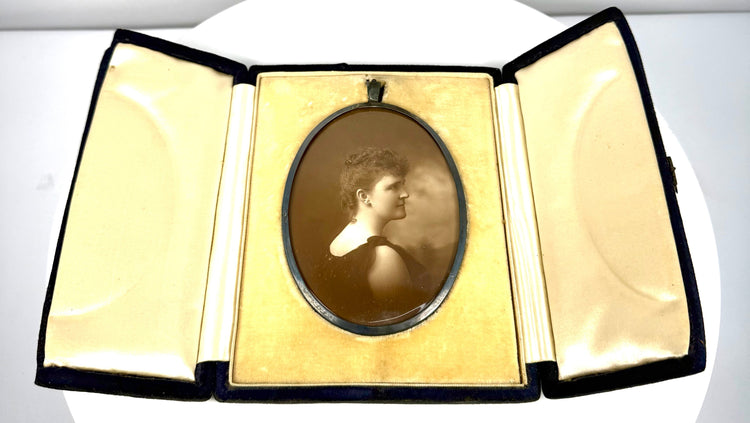
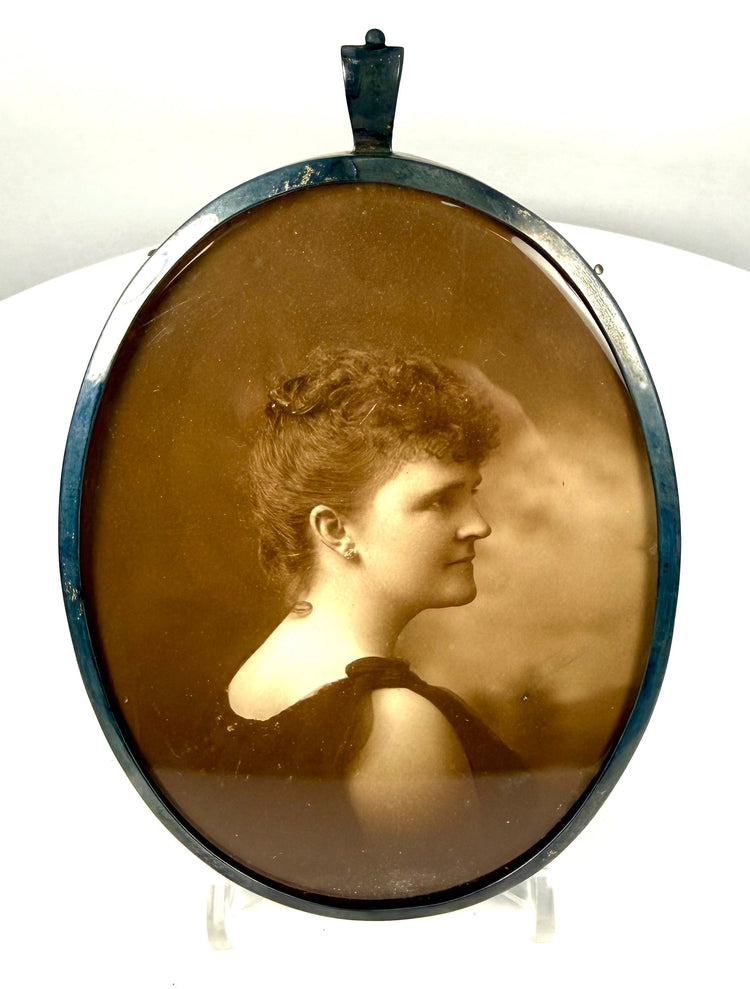
An original late Victorian to early twentieth-century photographic portrait depicting an elegantly dressed woman in a refined side-profile composition. Dating to circa 1895–1915 CE, this beautifully presented photograph captures the sophistication of turn-of-the-century studio portraiture and is preserved within an elaborate folding presentation case designed for both personal display and safekeeping.
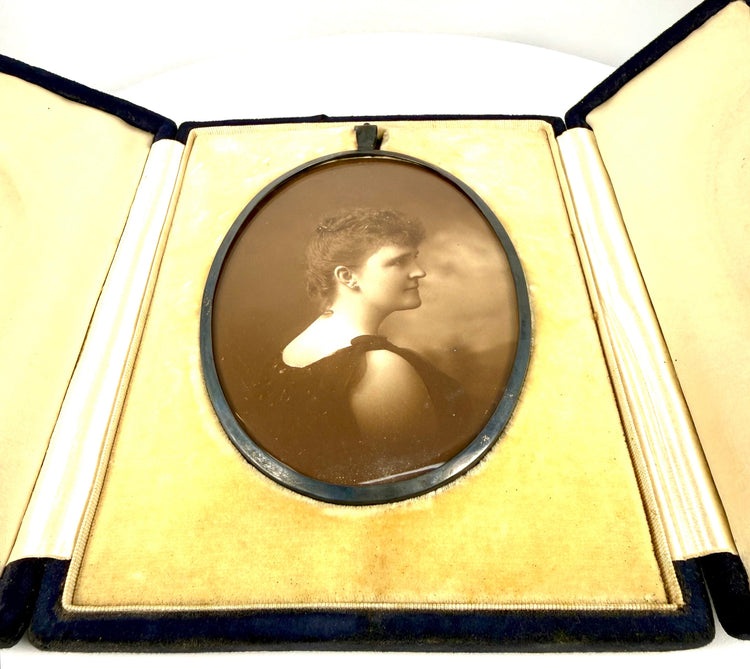
The portrait depicts a woman shown in profile facing right, wearing a dark formal gown with an open neckline and softly draped shoulder detailing. Her hair is arranged in an elaborate upswept style, characteristic of fashionable women's hairstyles around the turn of the twentieth century. A small decorative earring provides a subtle accent, while the sitter's composed expression and graceful profile create an elegant and intimate photographic composition.
The image displays warm sepia tones with carefully controlled lighting, emphasizing the contours of the sitter's face, hairstyle, and shoulders. The softly graduated studio background provides depth and contrast, drawing attention to the subject's refined appearance.
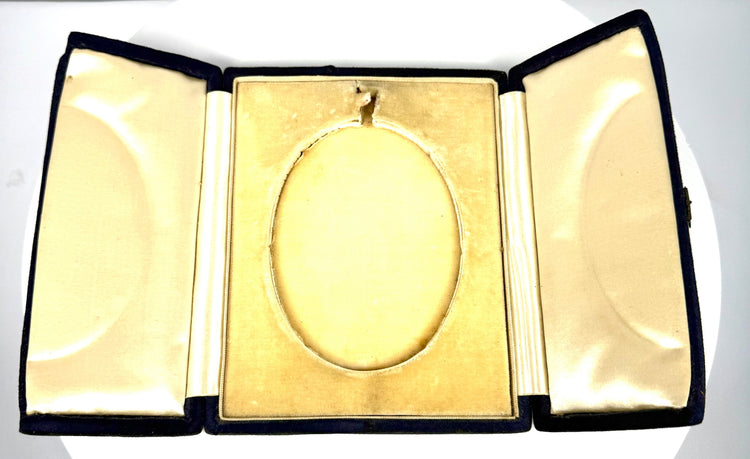
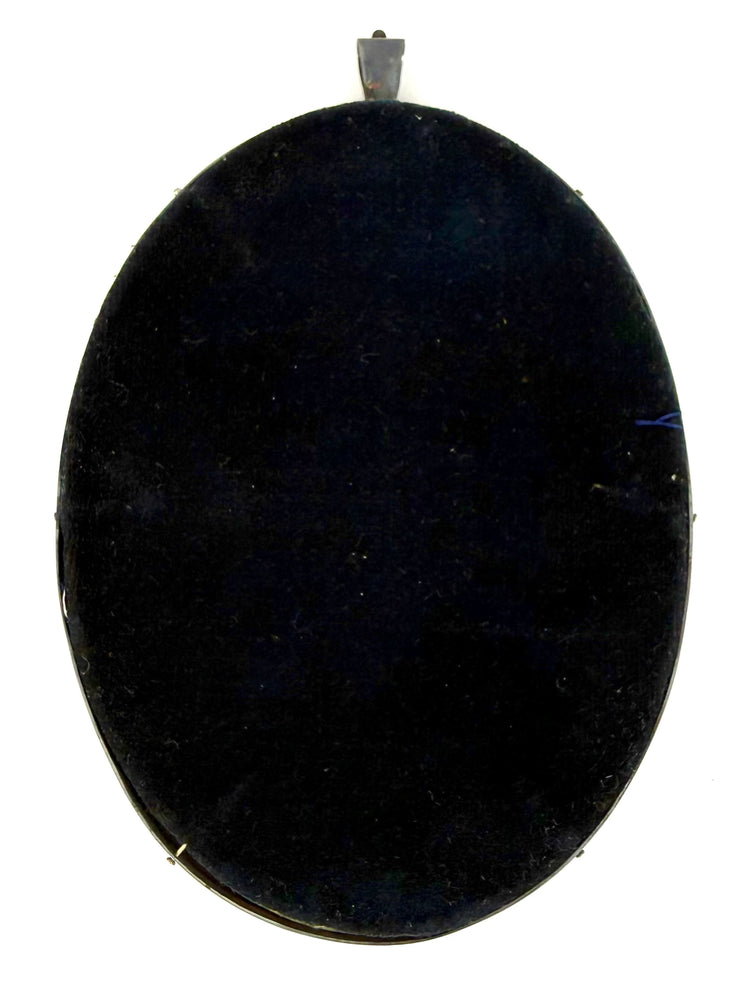
The portrait is housed within an oval metal frame featuring a darkened finish and a small suspension fitting at the upper edge. The frame is removable from its larger presentation case, allowing the photograph to be displayed independently or preserved within its protective enclosure.
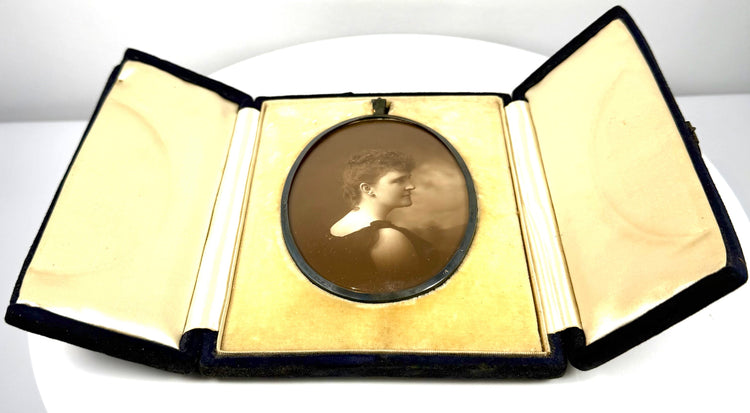
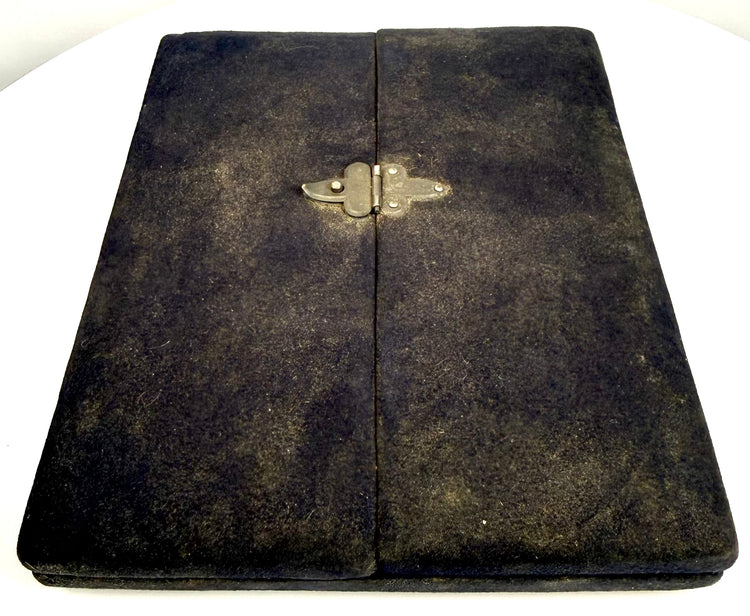
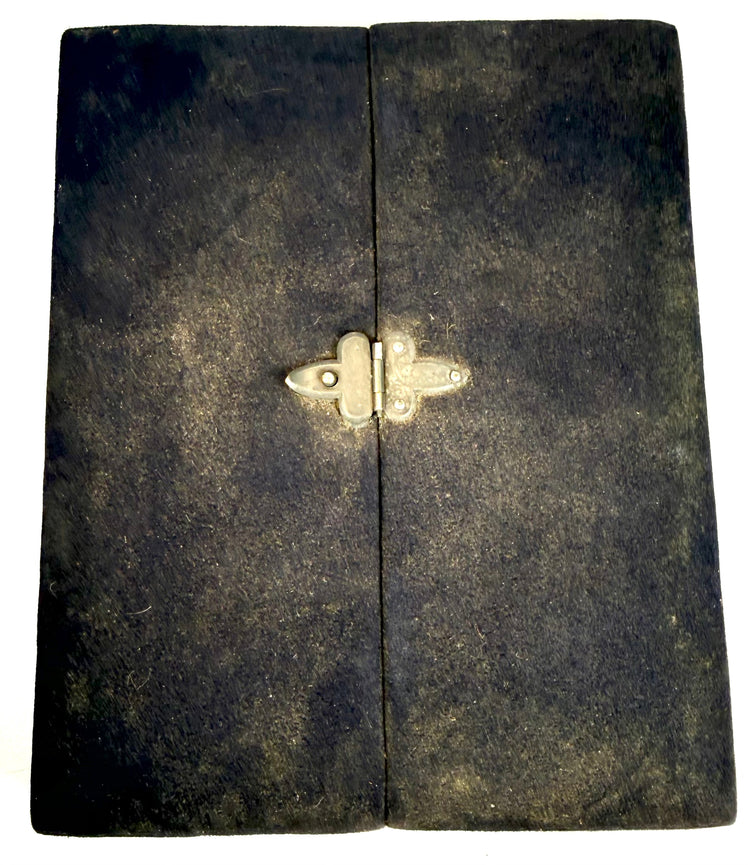
Particularly noteworthy is the accompanying black velvet-covered folding presentation case. The case features two hinged outer panels that open outward to reveal an elegant cream-coloured satin-like interior surrounding the oval photographic portrait.
When opened, the case creates a symmetrical three-panel display, with the central photographic image positioned between two protective doors. The interior retains its decorative textile lining, which contrasts beautifully with the darker exterior covering and sepia photographic image.
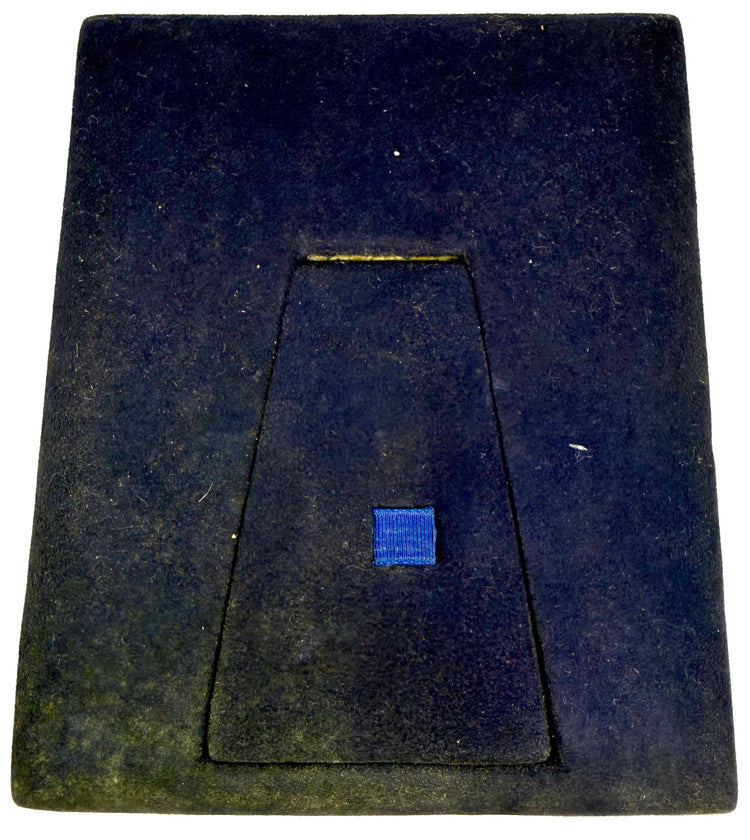
A small metal fastening secures the folding panels when closed, while an integrated folding easel support on the reverse allows the case to stand upright for display. This versatile arrangement reflects the thoughtful design of late Victorian and Edwardian photographic presentation accessories.
Unlike earlier daguerreotypes and ambrotypes, which were commonly housed in small embossed protective cases, this example represents the later tradition of professionally produced photographic portraits presented as treasured personal keepsakes and decorative household objects.
Of additional historical interest, the photograph formed part of a collection of nine historical photographic portraits associated with the Sears family, including individuals identified as Henry Sears, Paul Sears, and Clarissa Sears Bishop. The identity of the woman depicted in this individual portrait has not been established.
Features
- Original late Victorian to early twentieth-century photographic portrait, circa 1895–1915 CE
- Elegant side-profile portrait of a woman facing right
- Fashionable upswept hairstyle characteristic of the period
- Dark formal gown with open neckline and draped shoulder detailing
- Small decorative earring and carefully composed facial profile
- Warm sepia-toned photographic image with softly graduated studio background
- Removable oval photographic frame with dark metal surround
- Small metal suspension fitting at the top of the oval frame
- Black velvet-covered folding presentation case
- Three-panel design with two outward-opening protective doors
- Cream-coloured satin-like interior lining
- Decorative metal fastening on the exterior
- Integrated folding easel support for upright display
- Photographic image retaining excellent facial and hairstyle detail
- Associated with a historically documented Sears family photographic collection
- Provenance from the estate of Joseph W. Haley, Pride's Crossing, Massachusetts
Cultural Significance
The period spanning the late nineteenth and early twentieth centuries witnessed remarkable developments in photography, transforming portraiture from an expensive specialist service into an increasingly accessible means of preserving personal and family histories.
The introduction of gelatin silver photographic processes, improvements in photographic printing technology, and the expansion of professional photographic studios allowed photographers to produce portraits exhibiting greater tonal range, improved detail, and increasingly sophisticated artistic compositions.
By the 1890s, professional studio portraiture had become an important aspect of middle- and upper-class social culture throughout Europe and North America. Individuals commissioned formal photographic portraits to commemorate significant occasions, document family relationships, and preserve images for future generations.
Portraits of women from this period frequently emphasized fashionable hairstyles, elegant clothing, and carefully controlled studio lighting. Profile compositions, such as the example presented here, were particularly effective in emphasizing facial contours, elaborate hair arrangements, and the silhouette of contemporary dress.
The woman's softly illuminated features and carefully arranged hairstyle reflect the aesthetic ideals associated with the late Victorian and Edwardian periods, when photographic portraiture increasingly incorporated techniques inspired by traditional painted portraiture.
The inclusion of an elaborate folding presentation case further illustrates the importance attached to such photographs. These protective cases served both decorative and practical purposes, allowing treasured photographic images to be displayed in domestic interiors while remaining protected when not in use.
Condition
The photographic portrait survives in very good antique condition relative to its age, retaining excellent image clarity and well-defined detail throughout the sitter's face, hairstyle, clothing, and surrounding studio composition.
The original sepia tones remain attractive and generally consistent, with minor age-related surface marks, faint abrasions, and subtle variations in the photographic finish. The portrait's principal details remain exceptionally clear.
The oval metal frame displays expected signs of age, including minor surface wear, rubbing, light scratches, and areas of discolouration or patination. The upper suspension fitting remains present.
The accompanying black velvet-covered presentation case exhibits age-related wear, including variations in the fabric's surface texture, minor rubbing, accumulated dust or lint, and localized areas of fading or discolouration.
The cream-coloured interior lining displays expected age-related yellowing, minor spotting, and faint impressions associated with prolonged contact with the oval photographic frame.
The hinged folding panels and exterior metal fastening remain present. The reverse retains its integrated easel support with a small blue textile pull tab visible in the accompanying photographs.
The photographic image is removable from the presentation case, as demonstrated in the accompanying photographs.
Dimensions (Approximate)
Height: 6.25 in
Width: 5 in
Depth: 0.75 in
(case closed)
Age (Approximate)
111–131 years old
Provenance
Formerly part of the estate of the late Joseph W. Haley of Pride's Crossing, Massachusetts, United States, whose extensive collection included American and European antiques, fine and decorative arts, historical documents, early books, and objects reflecting a lifelong interest in history, travel, and collecting.
The photograph formed part of a collection of nine historical photographs and daguerreotypes associated with members of the Sears family. The original auction catalogue identified individuals including Henry Sears, Paul Sears, and an individual described as Grandmother.
Sears Family Historical Research
Genealogical research connects the Sears family members identified in the original collection to the descendants of Dr. Nathan Sears (1791–1848), a Massachusetts-born physician who subsequently practised medicine in Ohio, Michigan, and Illinois.
His wife was Grace Loper Sears, and their children included Paul Sears, Clarissa Sears Bishop, and Nathan Henry Sears.
An important historical connection is preserved in The Ranney Letters: Family Correspondence During the Yankee Migration, which includes an original letter dated January 8, 1850, written by Lyman Ranney from Van Buren, Arkansas.
The correspondence independently identifies Paul Sears, Clarissa Sears Bishop, and Henry Sears as members of the same family.
Paul Sears was described as a successful physician practising in Mount Carmel, Illinois, while Clarissa had married Ephraim Brown Bishop, a merchant operating businesses in Arkansas. Their younger brother Henry was attending school in Arkansas at the time.
The close correspondence between these historically documented family members and the names recorded in the original photographic auction catalogue provides support for the proposed Sears family association.
Historical Connection to Westover Plantation
The Sears family also possesses a noteworthy historical association with Clarise Sears Risley Harrold Ramsey (1867–1922), a descendant of Clarissa Sears Bishop and a later owner of historic Westover Plantation in Charles City County, Virginia.
Westover is one of Virginia's celebrated surviving colonial estates, historically associated with the prominent Byrd family and eighteenth-century plantation architecture along the James River.
Clarise Sears Ramsey acquired the property in 1899 and retained ownership until 1921. During her ownership, she undertook improvements to the historic residence, including restoration and modernization work intended to preserve the estate.
Learn More
See a similar Edwardian profile portrait of Jean Leckie, featuring an elegant upswept hairstyle and oval photographic composition, in the Arthur Conan Doyle Collection
Find more historical photographic keepsakes and decorative objects in our Victorian Artifacts & Historic Relics Collection
Description
Historical Context & Origin
Region: Associated with the United States; original photographic studio and location undetermined
Material: Sepia-toned photographic image, oval metal photographic frame, protective glazing, black velvet-covered folding presentation case, cream-coloured satin-like lining, and metal fittings
Period: Late Victorian to Early 20th Century, circa 1895–1915 CE
Description
An original late Victorian to early twentieth-century photographic portrait depicting an elegantly dressed woman in a refined side-profile composition. Dating to circa 1895–1915 CE, this beautifully presented photograph captures the sophistication of turn-of-the-century studio portraiture and is preserved within an elaborate folding presentation case designed for both personal display and safekeeping.
The portrait depicts a woman shown in profile facing right, wearing a dark formal gown with an open neckline and softly draped shoulder detailing. Her hair is arranged in an elaborate upswept style, characteristic of fashionable women's hairstyles around the turn of the twentieth century. A small decorative earring provides a subtle accent, while the sitter's composed expression and graceful profile create an elegant and intimate photographic composition.
The image displays warm sepia tones with carefully controlled lighting, emphasizing the contours of the sitter's face, hairstyle, and shoulders. The softly graduated studio background provides depth and contrast, drawing attention to the subject's refined appearance.
The portrait is housed within an oval metal frame featuring a darkened finish and a small suspension fitting at the upper edge. The frame is removable from its larger presentation case, allowing the photograph to be displayed independently or preserved within its protective enclosure.
Particularly noteworthy is the accompanying black velvet-covered folding presentation case. The case features two hinged outer panels that open outward to reveal an elegant cream-coloured satin-like interior surrounding the oval photographic portrait.
When opened, the case creates a symmetrical three-panel display, with the central photographic image positioned between two protective doors. The interior retains its decorative textile lining, which contrasts beautifully with the darker exterior covering and sepia photographic image.
A small metal fastening secures the folding panels when closed, while an integrated folding easel support on the reverse allows the case to stand upright for display. This versatile arrangement reflects the thoughtful design of late Victorian and Edwardian photographic presentation accessories.
Unlike earlier daguerreotypes and ambrotypes, which were commonly housed in small embossed protective cases, this example represents the later tradition of professionally produced photographic portraits presented as treasured personal keepsakes and decorative household objects.
Of additional historical interest, the photograph formed part of a collection of nine historical photographic portraits associated with the Sears family, including individuals identified as Henry Sears, Paul Sears, and Clarissa Sears Bishop. The identity of the woman depicted in this individual portrait has not been established.
Features
- Original late Victorian to early twentieth-century photographic portrait, circa 1895–1915 CE
- Elegant side-profile portrait of a woman facing right
- Fashionable upswept hairstyle characteristic of the period
- Dark formal gown with open neckline and draped shoulder detailing
- Small decorative earring and carefully composed facial profile
- Warm sepia-toned photographic image with softly graduated studio background
- Removable oval photographic frame with dark metal surround
- Small metal suspension fitting at the top of the oval frame
- Black velvet-covered folding presentation case
- Three-panel design with two outward-opening protective doors
- Cream-coloured satin-like interior lining
- Decorative metal fastening on the exterior
- Integrated folding easel support for upright display
- Photographic image retaining excellent facial and hairstyle detail
- Associated with a historically documented Sears family photographic collection
- Provenance from the estate of Joseph W. Haley, Pride's Crossing, Massachusetts
Cultural Significance
The period spanning the late nineteenth and early twentieth centuries witnessed remarkable developments in photography, transforming portraiture from an expensive specialist service into an increasingly accessible means of preserving personal and family histories.
The introduction of gelatin silver photographic processes, improvements in photographic printing technology, and the expansion of professional photographic studios allowed photographers to produce portraits exhibiting greater tonal range, improved detail, and increasingly sophisticated artistic compositions.
By the 1890s, professional studio portraiture had become an important aspect of middle- and upper-class social culture throughout Europe and North America. Individuals commissioned formal photographic portraits to commemorate significant occasions, document family relationships, and preserve images for future generations.
Portraits of women from this period frequently emphasized fashionable hairstyles, elegant clothing, and carefully controlled studio lighting. Profile compositions, such as the example presented here, were particularly effective in emphasizing facial contours, elaborate hair arrangements, and the silhouette of contemporary dress.
The woman's softly illuminated features and carefully arranged hairstyle reflect the aesthetic ideals associated with the late Victorian and Edwardian periods, when photographic portraiture increasingly incorporated techniques inspired by traditional painted portraiture.
The inclusion of an elaborate folding presentation case further illustrates the importance attached to such photographs. These protective cases served both decorative and practical purposes, allowing treasured photographic images to be displayed in domestic interiors while remaining protected when not in use.
Condition
The photographic portrait survives in very good antique condition relative to its age, retaining excellent image clarity and well-defined detail throughout the sitter's face, hairstyle, clothing, and surrounding studio composition.
The original sepia tones remain attractive and generally consistent, with minor age-related surface marks, faint abrasions, and subtle variations in the photographic finish. The portrait's principal details remain exceptionally clear.
The oval metal frame displays expected signs of age, including minor surface wear, rubbing, light scratches, and areas of discolouration or patination. The upper suspension fitting remains present.
The accompanying black velvet-covered presentation case exhibits age-related wear, including variations in the fabric's surface texture, minor rubbing, accumulated dust or lint, and localized areas of fading or discolouration.
The cream-coloured interior lining displays expected age-related yellowing, minor spotting, and faint impressions associated with prolonged contact with the oval photographic frame.
The hinged folding panels and exterior metal fastening remain present. The reverse retains its integrated easel support with a small blue textile pull tab visible in the accompanying photographs.
The photographic image is removable from the presentation case, as demonstrated in the accompanying photographs.
Dimensions (Approximate)
Height: 6.25 in
Width: 5 in
Depth: 0.75 in
(case closed)
Age (Approximate)
111–131 years old
Provenance
Formerly part of the estate of the late Joseph W. Haley of Pride's Crossing, Massachusetts, United States, whose extensive collection included American and European antiques, fine and decorative arts, historical documents, early books, and objects reflecting a lifelong interest in history, travel, and collecting.
The photograph formed part of a collection of nine historical photographs and daguerreotypes associated with members of the Sears family. The original auction catalogue identified individuals including Henry Sears, Paul Sears, and an individual described as Grandmother.
Sears Family Historical Research
Genealogical research connects the Sears family members identified in the original collection to the descendants of Dr. Nathan Sears (1791–1848), a Massachusetts-born physician who subsequently practised medicine in Ohio, Michigan, and Illinois.
His wife was Grace Loper Sears, and their children included Paul Sears, Clarissa Sears Bishop, and Nathan Henry Sears.
An important historical connection is preserved in The Ranney Letters: Family Correspondence During the Yankee Migration, which includes an original letter dated January 8, 1850, written by Lyman Ranney from Van Buren, Arkansas.
The correspondence independently identifies Paul Sears, Clarissa Sears Bishop, and Henry Sears as members of the same family.
Paul Sears was described as a successful physician practising in Mount Carmel, Illinois, while Clarissa had married Ephraim Brown Bishop, a merchant operating businesses in Arkansas. Their younger brother Henry was attending school in Arkansas at the time.
The close correspondence between these historically documented family members and the names recorded in the original photographic auction catalogue provides support for the proposed Sears family association.
Historical Connection to Westover Plantation
The Sears family also possesses a noteworthy historical association with Clarise Sears Risley Harrold Ramsey (1867–1922), a descendant of Clarissa Sears Bishop and a later owner of historic Westover Plantation in Charles City County, Virginia.
Westover is one of Virginia's celebrated surviving colonial estates, historically associated with the prominent Byrd family and eighteenth-century plantation architecture along the James River.
Clarise Sears Ramsey acquired the property in 1899 and retained ownership until 1921. During her ownership, she undertook improvements to the historic residence, including restoration and modernization work intended to preserve the estate.
Learn More
See a similar Edwardian profile portrait of Jean Leckie, featuring an elegant upswept hairstyle and oval photographic composition, in the Arthur Conan Doyle Collection
Find more historical photographic keepsakes and decorative objects in our Victorian Artifacts & Historic Relics Collection
You May Also Like
