

Victorian Era Daguerreotype Keepsake Case with Dual Portraits | Circa 1855–1870
Couldn't load pickup availability




Victorian Era Daguerreotype Keepsake Case with Dual Portraits | Circa 1855–1870
Description
More
Less
Historical Context & Origin
Region: New England, United States
Material: Thermoplastic union case with gilt interior frames and ambrotype photographic plates
Period: Circa 1855–1870, Civil War–era American photography
Description
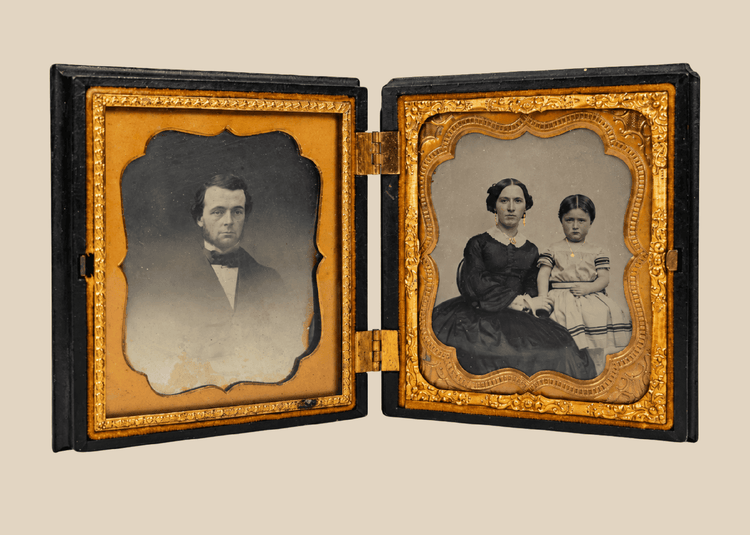
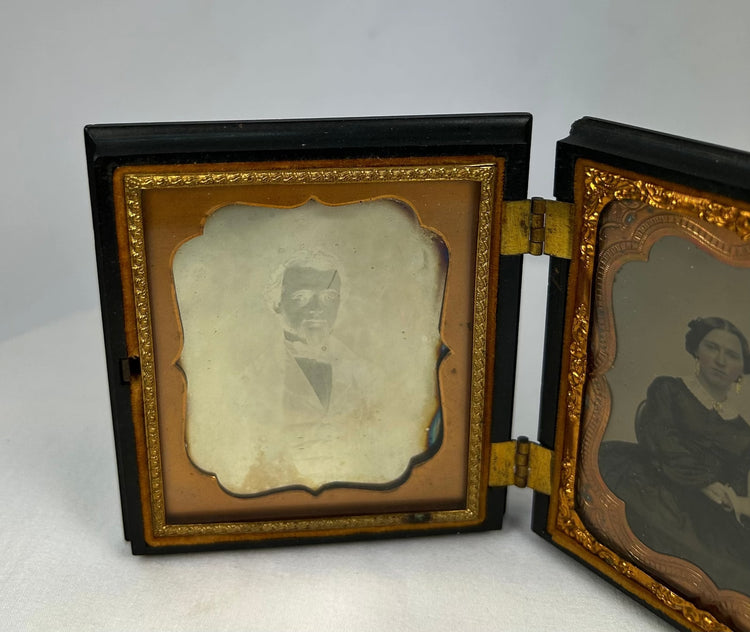
A beautifully preserved mid-19th-century dual ambrotype portrait presented within an ornate hinged thermoplastic union case typical of early American photographic production. The right panel depicts a seated woman holding a young child, while the left panel contains a portrait of a gentleman, likely belonging to the same family lineage.
The consignor has identified the female subject as Ida Pearl Reade Noyes, a New England resident connected to regional domestic photography traditions of the period. While this attribution remains family-based and unverified, the imagery and case style firmly situate the piece within the Civil War–era boom of personal portrait photography in America. The case retains its original gilt interior frames, velvet lining, and functional brass hinges, all characteristic of union cases produced between 1854 and 1870.
Features
- Dual ambrotype portraits housed within a period thermoplastic union case
- Original gilt-edged interior frames with beveled viewing windows
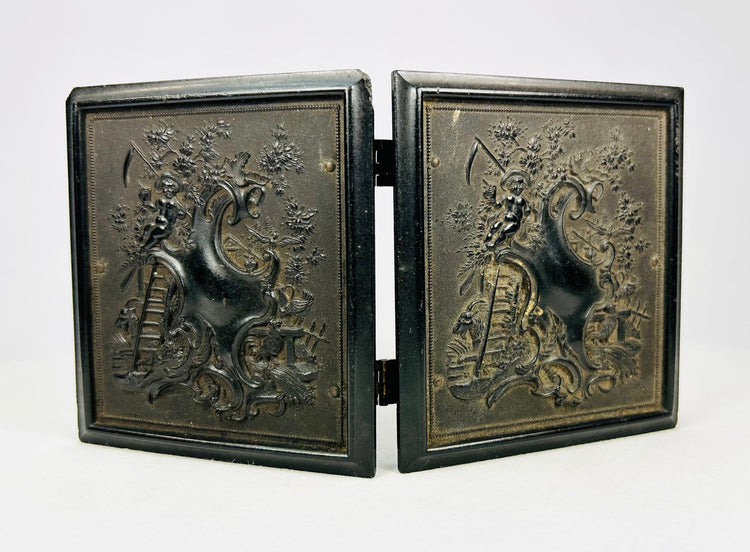
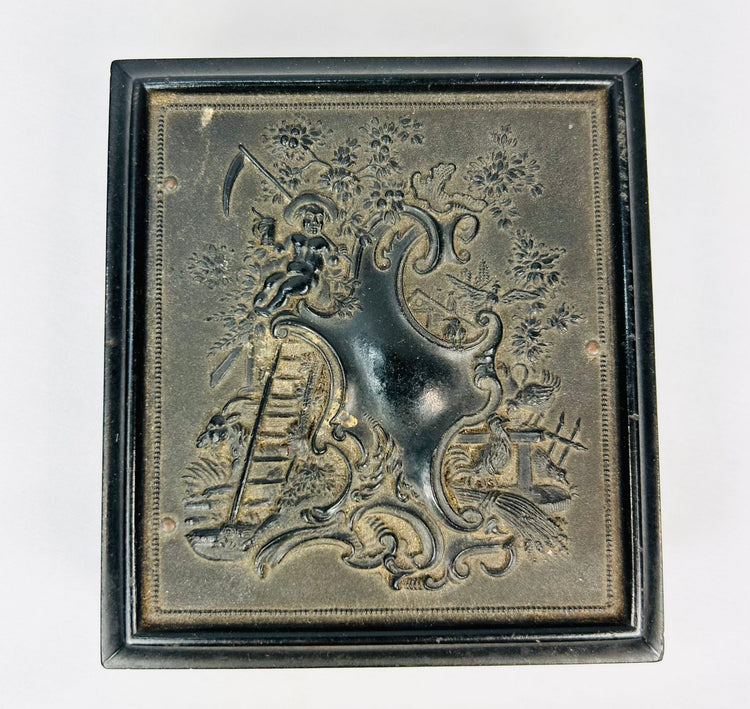
- Ornate molded exterior featuring classical and floral decorative motifs
- Hinged construction allowing both portraits to be displayed together
- Attractive patina and age-consistent wear typical of authentic mid-19th-century photographic objects
Cultural Significance
Ambrotypes represent one of the earliest widely accessible forms of portrait photography in the United States. Prior to the popularity of paper prints, such images were treasured family heirlooms and often the only visual record of loved ones. Union cases combined technological innovation with decorative craftsmanship, protecting fragile glass plates while serving as display pieces within the home.
Examples connected to New England families are especially desirable, reflecting the region’s deep association with early American photography and Civil War–era domestic history, and offering collectors a direct, personal connection to 19th-century family life.
Condition
Excellent condition for age. The ambrotype images remain clear, showing moderate expected silvering and age toning. Hinges remain intact and functional. The exterior case exhibits minor surface wear typical of thermoplastic items from this period, while velvet lining and gilt frames retain strong color and detail.
Dimensions (Approximate)
Closed Case:
Height: 3.75 in
Width: 3.5 in
Age (Approximate)
155–170 years old
Provenance
Formerly held in a private collection in Sarasota, Florida, USA, specializing in antique and historical photographs.
Learn More
Learn about early American photography through the Metropolitan Museum of Art
Explore our curated Victorian Artifacts & Historic Relics Collection
Description
Historical Context & Origin
Region: New England, United States
Material: Thermoplastic union case with gilt interior frames and ambrotype photographic plates
Period: Circa 1855–1870, Civil War–era American photography
Description
A beautifully preserved mid-19th-century dual ambrotype portrait presented within an ornate hinged thermoplastic union case typical of early American photographic production. The right panel depicts a seated woman holding a young child, while the left panel contains a portrait of a gentleman, likely belonging to the same family lineage.
The consignor has identified the female subject as Ida Pearl Reade Noyes, a New England resident connected to regional domestic photography traditions of the period. While this attribution remains family-based and unverified, the imagery and case style firmly situate the piece within the Civil War–era boom of personal portrait photography in America. The case retains its original gilt interior frames, velvet lining, and functional brass hinges, all characteristic of union cases produced between 1854 and 1870.
Features
- Dual ambrotype portraits housed within a period thermoplastic union case
- Original gilt-edged interior frames with beveled viewing windows
- Ornate molded exterior featuring classical and floral decorative motifs
- Hinged construction allowing both portraits to be displayed together
- Attractive patina and age-consistent wear typical of authentic mid-19th-century photographic objects
Cultural Significance
Ambrotypes represent one of the earliest widely accessible forms of portrait photography in the United States. Prior to the popularity of paper prints, such images were treasured family heirlooms and often the only visual record of loved ones. Union cases combined technological innovation with decorative craftsmanship, protecting fragile glass plates while serving as display pieces within the home.
Examples connected to New England families are especially desirable, reflecting the region’s deep association with early American photography and Civil War–era domestic history, and offering collectors a direct, personal connection to 19th-century family life.
Condition
Excellent condition for age. The ambrotype images remain clear, showing moderate expected silvering and age toning. Hinges remain intact and functional. The exterior case exhibits minor surface wear typical of thermoplastic items from this period, while velvet lining and gilt frames retain strong color and detail.
Dimensions (Approximate)
Closed Case:
Height: 3.75 in
Width: 3.5 in
Age (Approximate)
155–170 years old
Provenance
Formerly held in a private collection in Sarasota, Florida, USA, specializing in antique and historical photographs.
Learn More
Learn about early American photography through the Metropolitan Museum of Art
Explore our curated Victorian Artifacts & Historic Relics Collection
You May Also Like
