

Vintage Chinese Carved Green Hardstone Budai Laughing Buddha on Hardwood Stand | Circa Mid-20th Century
Couldn't load pickup availability



Vintage Chinese Carved Green Hardstone Budai Laughing Buddha on Hardwood Stand | Circa Mid-20th Century
Description
More
Less
Historical Context & Origin
Region: China, East Asia
Material: Carved dark-green hardstone, possibly serpentine or nephrite, with fitted hardwood stand
Period: Mid-to-late 20th century
Description
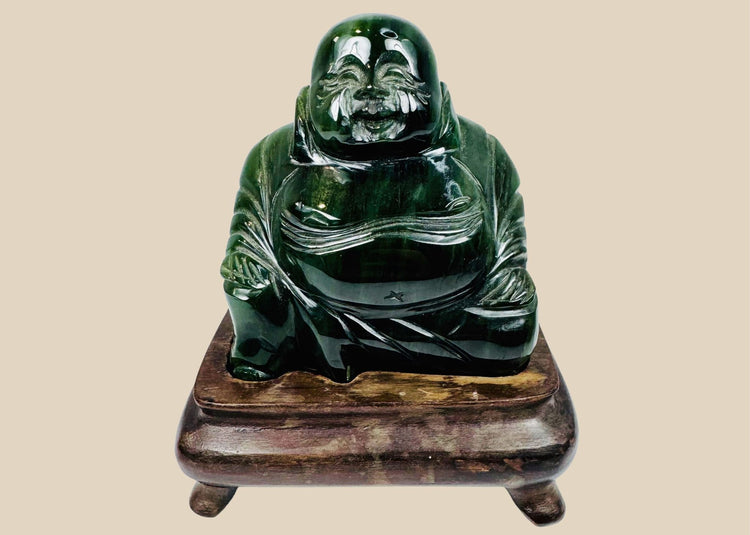
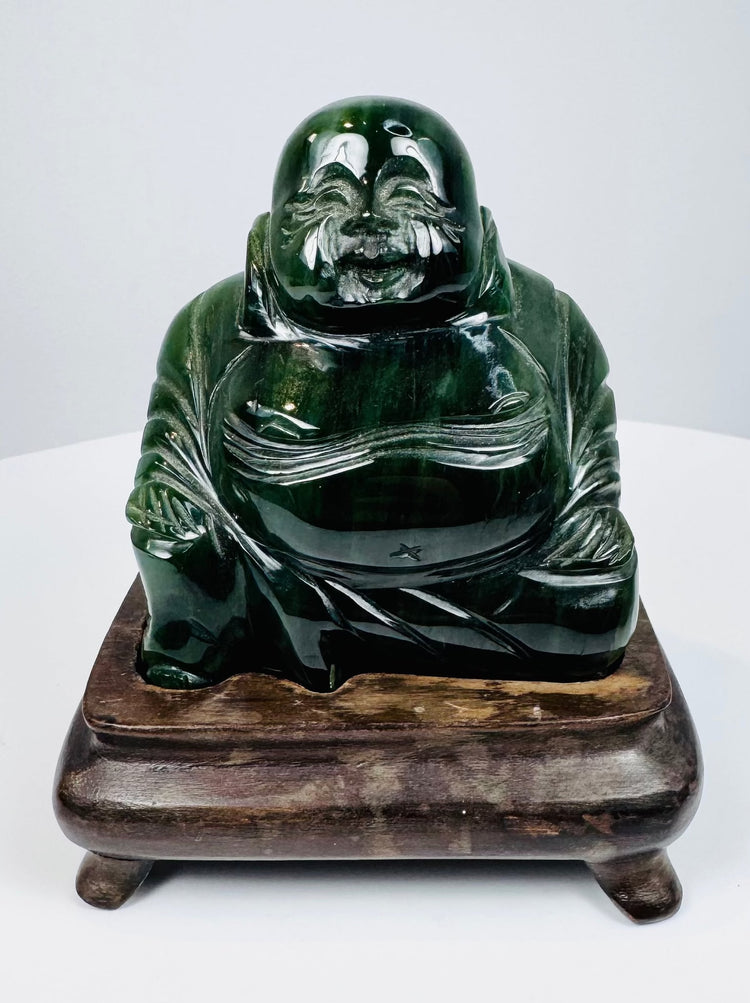
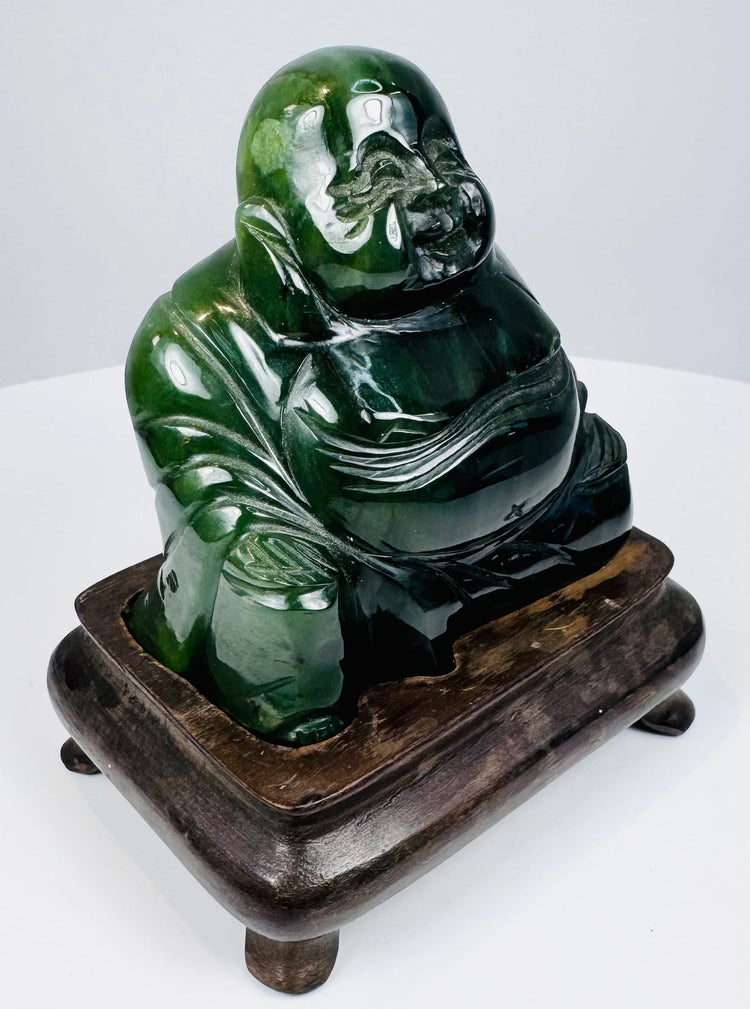
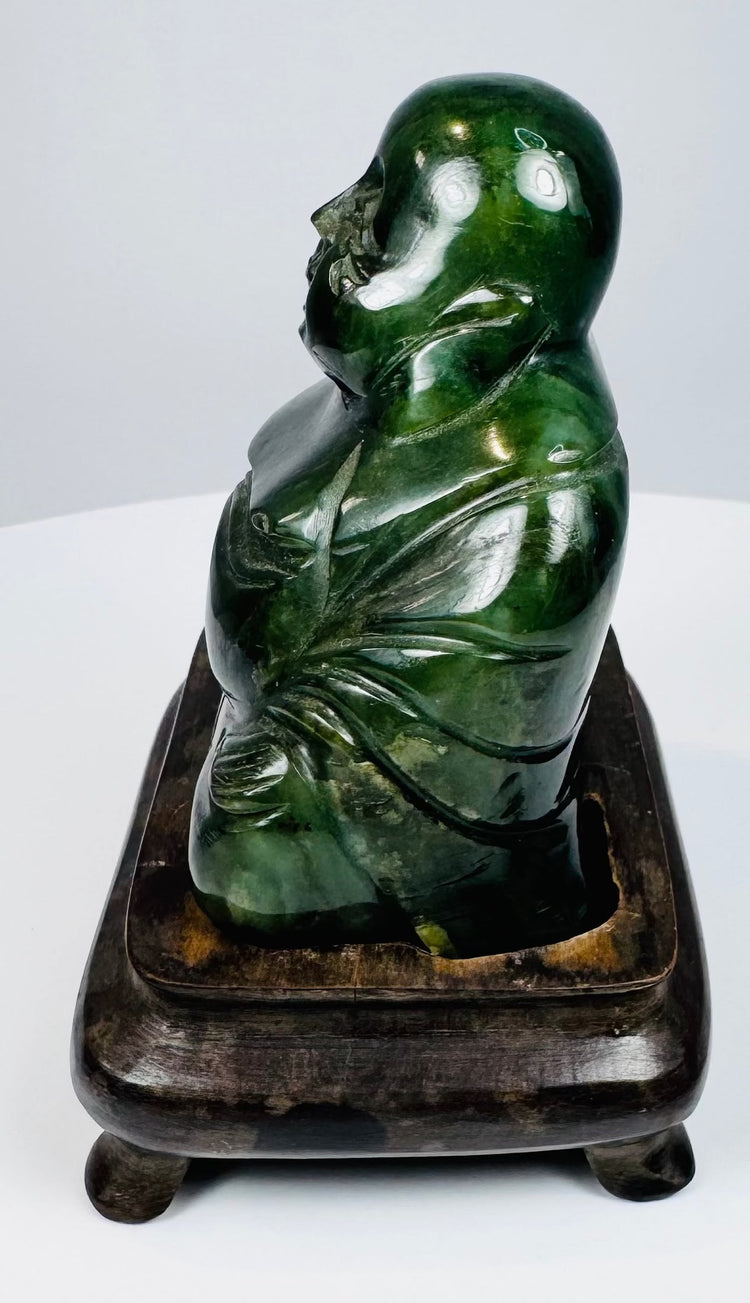
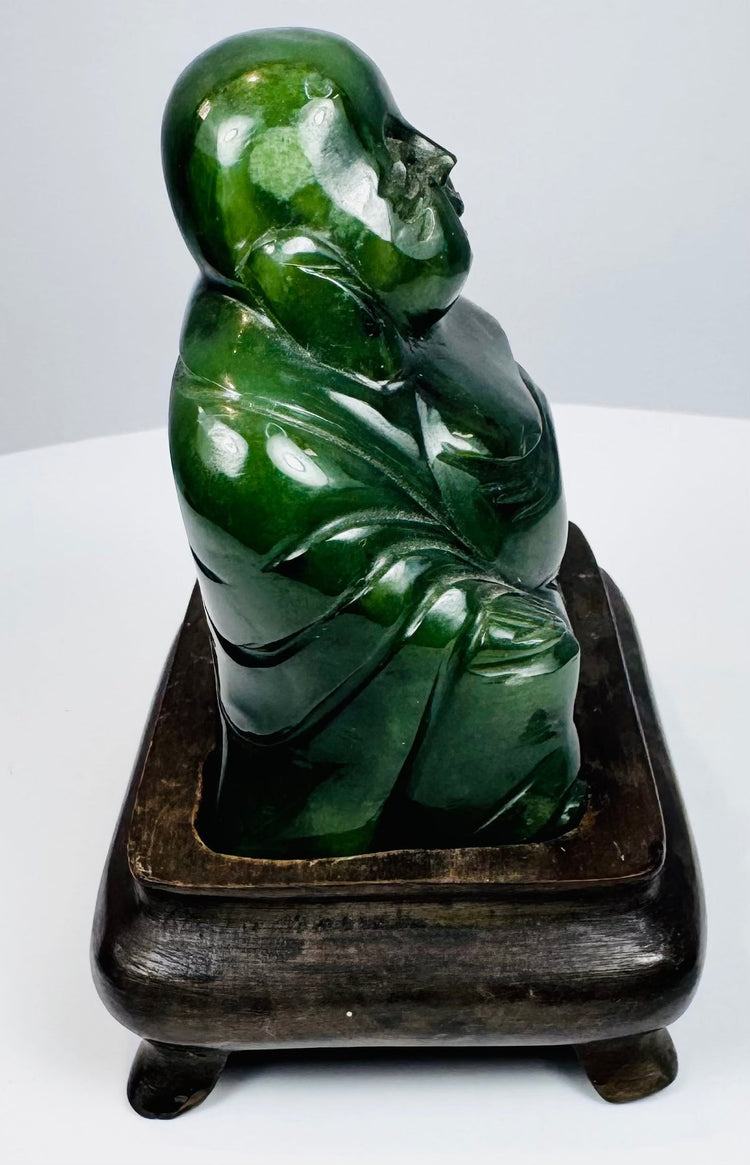
A Chinese carved hardstone figure representing Budai, the cheerful monk popularly known in the West as the “Laughing Buddha.”
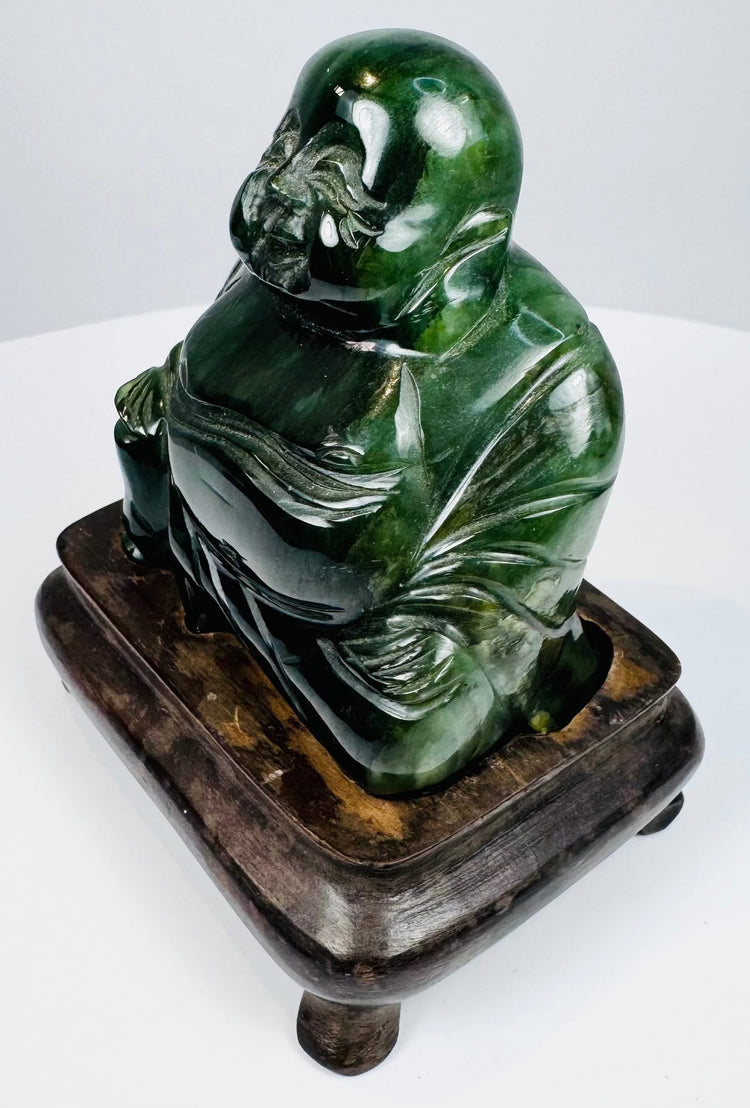
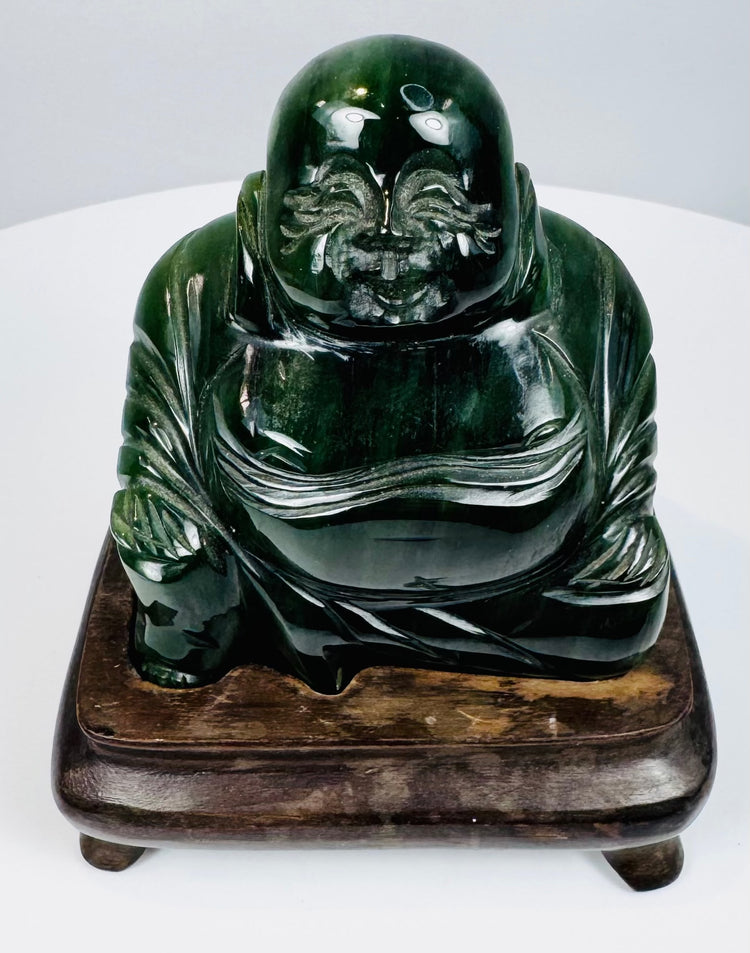
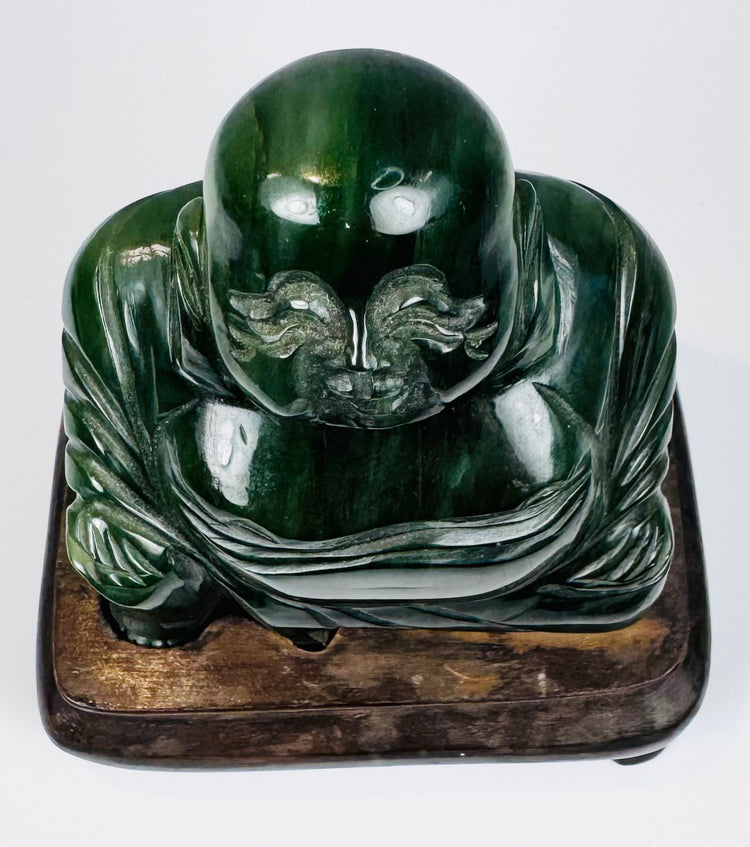
Budai is portrayed seated with his voluminous robes falling open to reveal his prominent abdomen. His rounded face is animated by deeply carved, smiling eyes, pronounced cheeks, and an open mouth. One hand rests upon a raised knee while the other gathers the flowing folds of his robe across the body.
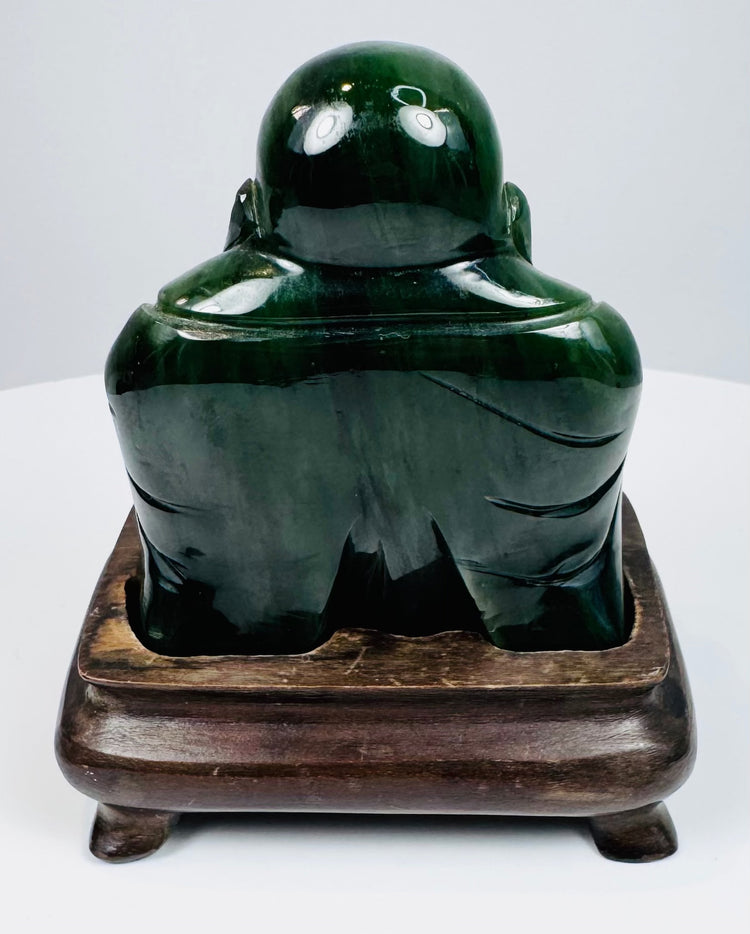
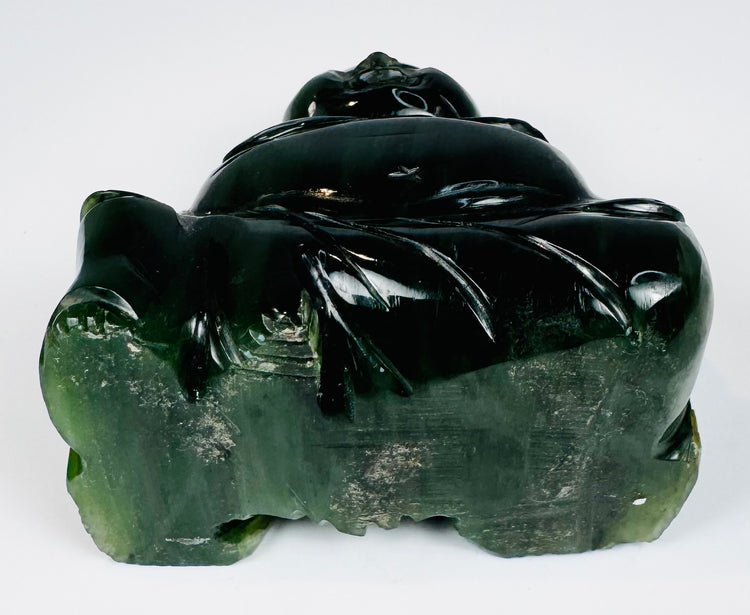
The stone displays a deep forest-green colour with lighter mottling and subtle translucency visible along thinner areas and carved edges. Its highly polished surface contrasts with the textured carving used to articulate the facial features, fingers, toes, and layered folds of the garment.
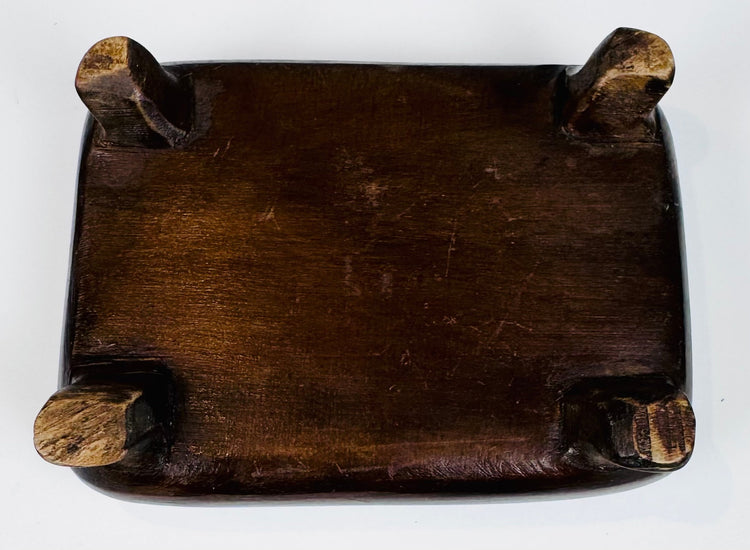
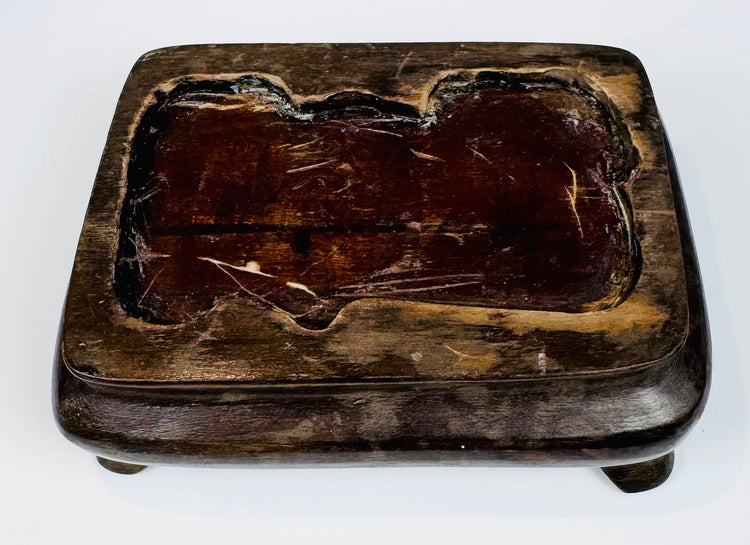
The figure rests upon a separately carved, four-footed hardwood display stand. Although the material resembles jade, it should be catalogued conservatively as dark-green hardstone unless confirmed through gemological testing.
Features
- Representation of Budai, or the Laughing Buddha
- Deep forest-green colour with lighter natural variation
- Highly polished surface
- Expressive smiling face and prominent abdomen
- Detailed cascading robe folds
- Compact seated sculptural form
- Subtle translucency along thinner carved areas
- Separately carved fitted hardwood stand
- Decorative symbol of happiness, abundance, and contentment
Cultural Significance
Budai is a beloved figure in Chinese Buddhist and popular tradition. Based upon an eccentric wandering monk, he became associated with Maitreya, the Buddha of the future, and is commonly represented as a jovial, generously proportioned figure carrying or accompanied by a cloth sack.
His broad smile and prominent abdomen came to symbolize happiness, generosity, prosperity, and freedom from worldly concerns. Figures of Budai are frequently displayed in homes and businesses as auspicious emblems of abundance, hospitality, and good fortune.
Dark-green hardstones have long been favoured by Chinese carvers for their rich colour, durability, and visual resemblance to prized nephrite jade. During the 20th century, polished hardstone figures such as this were produced both for domestic display and for the international decorative-arts market.
Condition
Good vintage condition with light surface scratches, handling wear, minor abrasions, and small edge imperfections consistent with age and display. Natural colour variation and inclusions are present within the stone. The underside retains visible carving and finishing marks. The separate hardwood stand exhibits noticeable surface wear, scratches, finish loss, and abrasions.
Dimensions (Approximate)
Overall Height with Stand: 4.5 in
Width: 3.5 in
Depth: 2.5 in
Age (Approximate)
40–70 years old
Provenance
From a private collection in Toronto, Ontario, Canada, assembled with a particular focus on Chinese and broader Asian sculpture and traditional decorative arts.
Subsequently sold through Waddington’s Auctioneers & Appraisers, Toronto, Ontario, Canada. Established in 1850, Waddington’s describes itself as Canada’s original auction house and has long maintained specialist departments devoted to Asian and international art.
Learn More
Discover the history and symbolism of Budai through a comparable carved jade Figure of Budai at the Smithsonian’s National Museum of Asian Art.
Explore our Collection of Buddhist and Hindu Relics and Sacred Statues.
Description
Historical Context & Origin
Region: China, East Asia
Material: Carved dark-green hardstone, possibly serpentine or nephrite, with fitted hardwood stand
Period: Mid-to-late 20th century
Description
A Chinese carved hardstone figure representing Budai, the cheerful monk popularly known in the West as the “Laughing Buddha.”
Budai is portrayed seated with his voluminous robes falling open to reveal his prominent abdomen. His rounded face is animated by deeply carved, smiling eyes, pronounced cheeks, and an open mouth. One hand rests upon a raised knee while the other gathers the flowing folds of his robe across the body.
The stone displays a deep forest-green colour with lighter mottling and subtle translucency visible along thinner areas and carved edges. Its highly polished surface contrasts with the textured carving used to articulate the facial features, fingers, toes, and layered folds of the garment.
The figure rests upon a separately carved, four-footed hardwood display stand. Although the material resembles jade, it should be catalogued conservatively as dark-green hardstone unless confirmed through gemological testing.
Features
- Representation of Budai, or the Laughing Buddha
- Deep forest-green colour with lighter natural variation
- Highly polished surface
- Expressive smiling face and prominent abdomen
- Detailed cascading robe folds
- Compact seated sculptural form
- Subtle translucency along thinner carved areas
- Separately carved fitted hardwood stand
- Decorative symbol of happiness, abundance, and contentment
Cultural Significance
Budai is a beloved figure in Chinese Buddhist and popular tradition. Based upon an eccentric wandering monk, he became associated with Maitreya, the Buddha of the future, and is commonly represented as a jovial, generously proportioned figure carrying or accompanied by a cloth sack.
His broad smile and prominent abdomen came to symbolize happiness, generosity, prosperity, and freedom from worldly concerns. Figures of Budai are frequently displayed in homes and businesses as auspicious emblems of abundance, hospitality, and good fortune.
Dark-green hardstones have long been favoured by Chinese carvers for their rich colour, durability, and visual resemblance to prized nephrite jade. During the 20th century, polished hardstone figures such as this were produced both for domestic display and for the international decorative-arts market.
Condition
Good vintage condition with light surface scratches, handling wear, minor abrasions, and small edge imperfections consistent with age and display. Natural colour variation and inclusions are present within the stone. The underside retains visible carving and finishing marks. The separate hardwood stand exhibits noticeable surface wear, scratches, finish loss, and abrasions.
Dimensions (Approximate)
Overall Height with Stand: 4.5 in
Width: 3.5 in
Depth: 2.5 in
Age (Approximate)
40–70 years old
Provenance
From a private collection in Toronto, Ontario, Canada, assembled with a particular focus on Chinese and broader Asian sculpture and traditional decorative arts.
Subsequently sold through Waddington’s Auctioneers & Appraisers, Toronto, Ontario, Canada. Established in 1850, Waddington’s describes itself as Canada’s original auction house and has long maintained specialist departments devoted to Asian and international art.
Learn More
Discover the history and symbolism of Budai through a comparable carved jade Figure of Budai at the Smithsonian’s National Museum of Asian Art.
Explore our Collection of Buddhist and Hindu Relics and Sacred Statues.
You May Also Like
