



William Tecumseh Sherman Civil War Letter Facsimile & Engraved Portrait | Battle of Allatoona | Dated 1875
Couldn't load pickup availability


William Tecumseh Sherman Civil War Letter Facsimile & Engraved Portrait | Battle of Allatoona | Dated 1875
Description
More
Less
Historical Context & Origin
Region: United States – St. Louis, Missouri; Historical Subject: Allatoona Pass, Georgia
Material: Paper, reproduced manuscript correspondence, engraved-style portrait print, decorative matting, glass, and gilt-finished frame
Period: Reconstruction Era, 19th Century; original correspondence dated June 22, 1875
Description
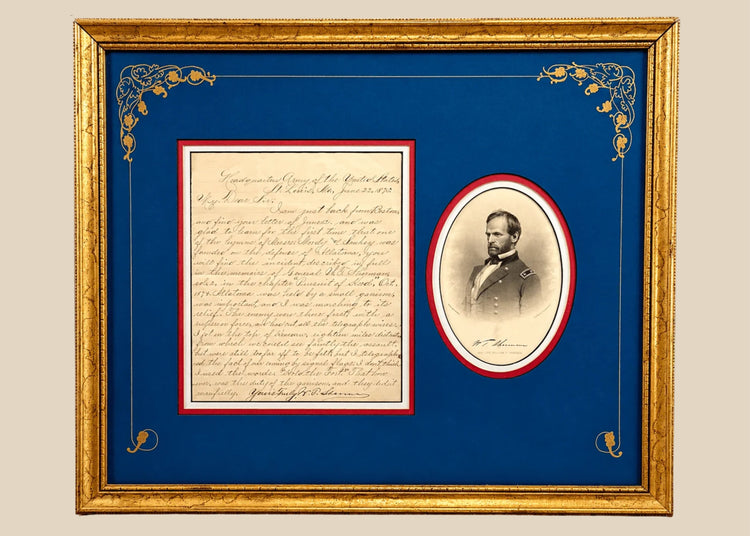
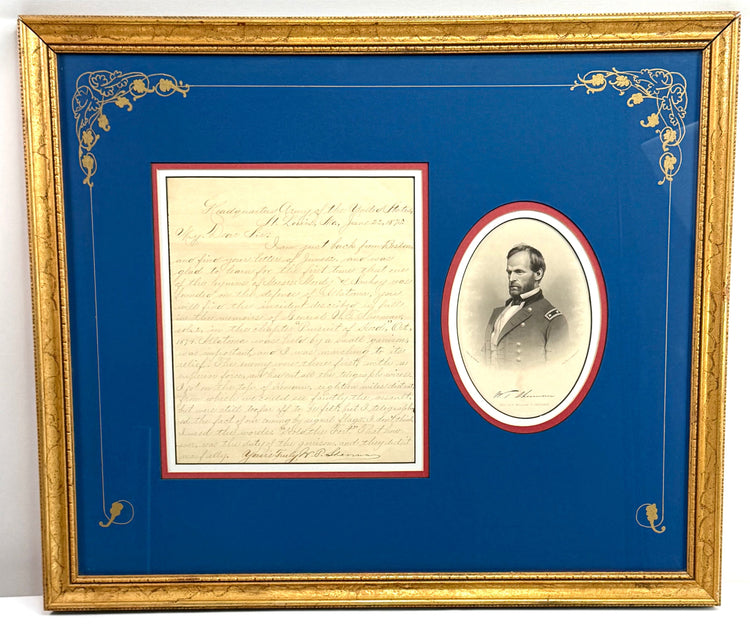
An elegantly framed historical presentation commemorating Union General William Tecumseh Sherman (1820–1891), one of the most influential American military commanders of the nineteenth century. The display combines a reproduction of Sherman's correspondence dated June 22, 1875, with an engraved-style portrait of the celebrated Civil War general, arranged within a decorative gilt-finished frame.
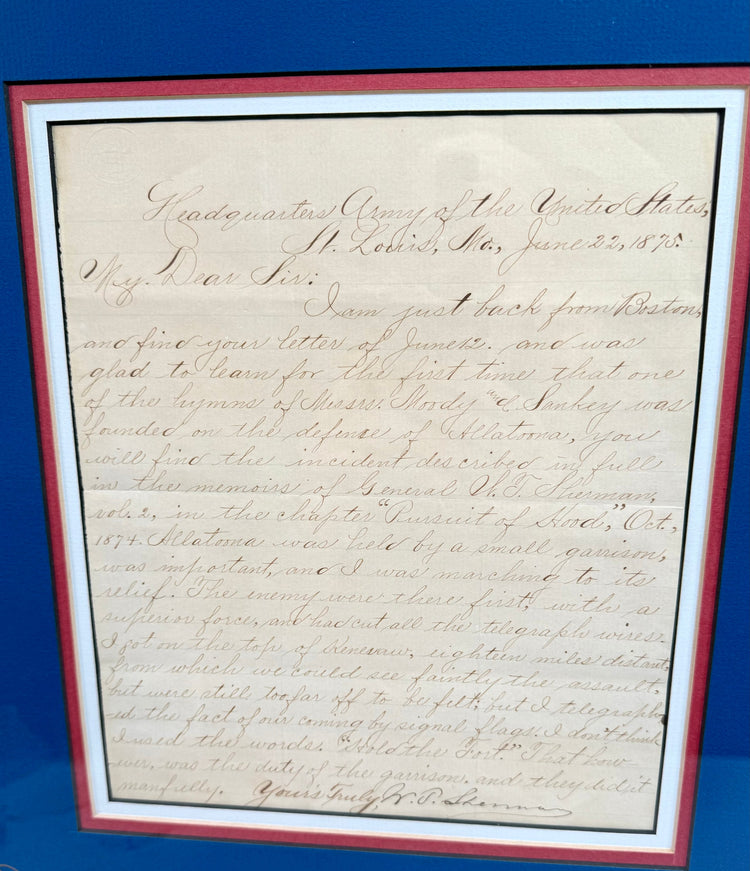
The correspondence bears the heading "Headquarters Army of the United States" and is dated from St. Louis, Missouri. Its contents concern the Battle of Allatoona Pass, fought on October 5, 1864, during the American Civil War. The letter was originally addressed to William E. Dodge and discusses the military events that inspired the famous gospel hymn Hold the Fort, associated with evangelists Dwight L. Moody and Ira D. Sankey.
In the letter, Sherman recounts observing Confederate attacks from Kennesaw Mountain, approximately eighteen miles from the threatened Union position at Allatoona. With telegraph communications disrupted, Union forces relied upon signal flags to communicate across the battlefield. Sherman describes the effort to inform the defenders that assistance was approaching and reflects upon the determination of the garrison to maintain its position against Confederate forces.
Particularly interesting is Sherman's discussion of the expression "Hold the Fort." Although the phrase became closely associated with the battle, Sherman expressed doubt that he had used those precise words during the engagement. The correspondence offers an illuminating perspective on the relationship between documented military events and the stories that subsequently entered American popular culture.
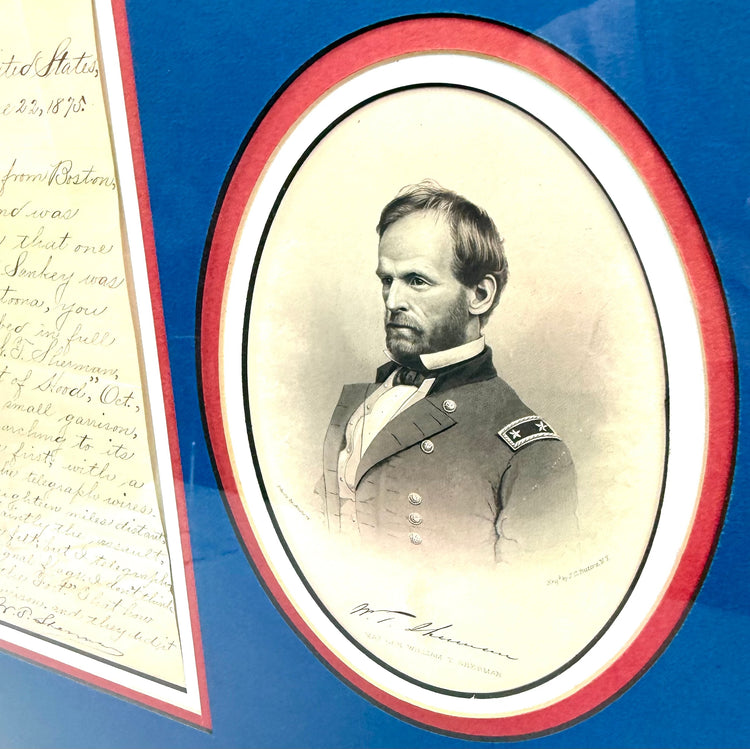
Accompanying the letter is an oval portrait depicting Sherman in his Union military uniform, with shoulder insignia and formal nineteenth-century attire. The image follows the style of historical engravings associated with John Chester Buttre (1821–1893), an American engraver whose work included portraits of prominent military and political figures.
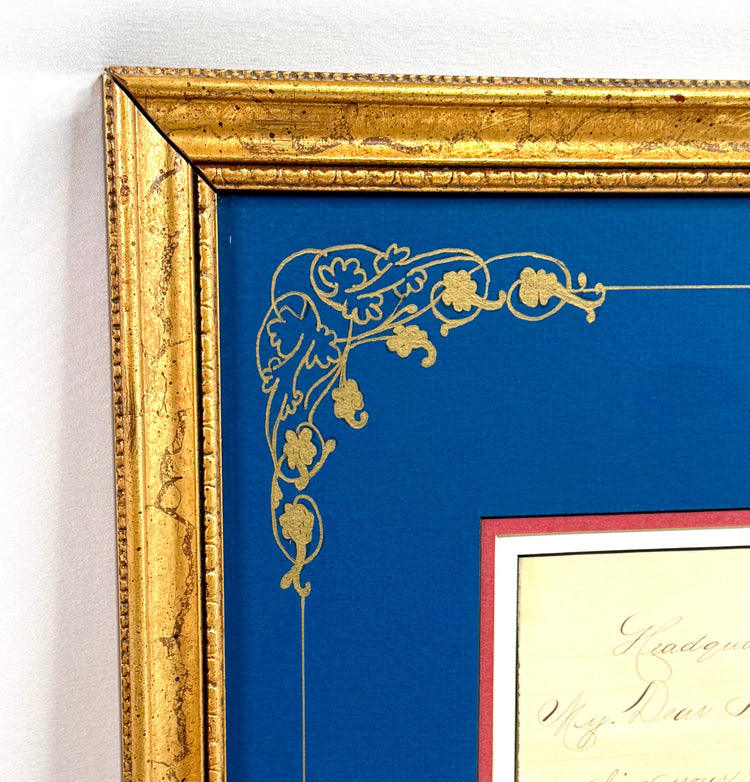
The entire presentation is mounted against a rich royal-blue background decorated with gold floral ornamentation and delicate linear borders. Contrasting red, white, and black surrounds frame the manuscript and portrait individually, while an ornate gilt-finished outer frame provides a distinguished presentation suitable for a historical collection, private study, library, or military-themed display.
The displayed letter closely follows documented 1875 Sherman correspondence preserved in historical research. Comparison with a published photograph of the original manuscript reveals differences in handwriting and layout. Accordingly, the framed document is presented as a historical reproduction or transcription rather than an original autograph manuscript.
Features
- Framed reproduction of correspondence by Union General William Tecumseh Sherman, originally dated June 22, 1875
- Letter headed "Headquarters Army of the United States," St. Louis, Missouri
- Historical account of the October 5, 1864, Battle of Allatoona Pass
- References military signal flags and communications from Kennesaw Mountain
- Discusses the origins of the celebrated gospel hymn Hold the Fort
- Includes Sherman's reflections on the famous military expression
- Reproduced signature appearing beneath the correspondence
- Oval engraved-style portrait depicting General Sherman in military uniform
- Rich royal-blue background with decorative gold floral ornamentation
- Contrasting red, white, and black matting surrounding the portrait and manuscript
- Ornate gilt-finished frame with protective glazing
Cultural Significance
William Tecumseh Sherman occupies a central place in American Civil War history. A graduate of the United States Military Academy at West Point, he became one of the Union's most prominent commanders and a close military associate of Ulysses S. Grant. His campaigns through Georgia and the Carolinas helped undermine Confederate military resources and contributed significantly to the Union victory in 1865.
Following the Civil War, Sherman remained an influential military figure, serving as Commanding General of the United States Army from 1869 to 1883. His Memoirs, first published in 1875, became an important firsthand account of the conflict, preserving his recollections of military operations, command decisions, and wartime experiences.
The Battle of Allatoona Pass, fought on October 5, 1864, centred on a strategically important railroad position north of Atlanta. Confederate forces attempted to capture the fortified Union supply position, but its defenders successfully resisted repeated attacks. Communication between distant Union positions using signal flags became one of the engagement's most memorable features.
The battle also acquired an unexpected cultural legacy through the hymn Hold the Fort, written by American gospel composer Philip Paul Bliss. Inspired by accounts of the Union defence, the hymn became popular in evangelical religious gatherings and was subsequently adapted for use in political and labour movements.
Sherman's 1875 correspondence is particularly meaningful because it addresses the historical origins of this widely repeated story. Rather than confirming the celebrated phrase attributed to him, Sherman questioned whether he had actually employed those words. This distinction illustrates how historical events can evolve into enduring cultural narratives that differ from the precise language of their original participants.
The framed presentation brings together military history, documentary heritage, nineteenth-century portraiture, and American cultural traditions, making it an engaging historical display for collectors of Civil War memorabilia and Americana.
Condition
Good overall display condition, with the reproduced document and portrait presented beneath protective glazing. The manuscript reproduction displays a warm cream-coloured appearance, with clearly arranged cursive text and the reproduced signature visible at the bottom. The accompanying portrait retains clear facial features, uniform details, and decorative inscriptions.
The blue matting remains visually vibrant, with surviving gold ornamental detailing throughout. The contrasting borders around both display elements remain intact and well defined.
The outer gilt-finished frame exhibits minor surface wear, small marks, and areas of finish variation consistent with handling and display. Reflections are present in the protective glazing. The individual paper components have not been examined outside the frame.
Dimensions (Approximate)
Overall framed display:
Height: 19.25 in
Width: 22.75 in
Depth: 1 in
Age (Approximate)
Original correspondence dated 1875 (151 years ago); date of the framed reproduction is undetermined.
Provenance
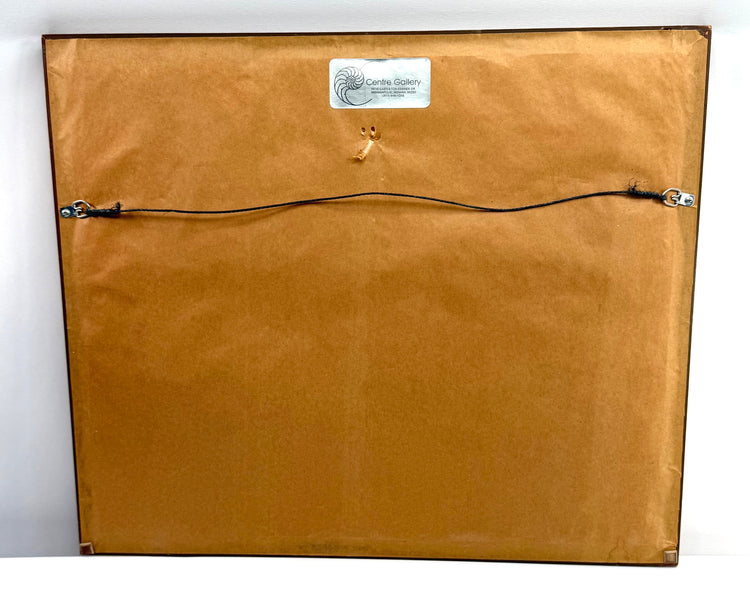
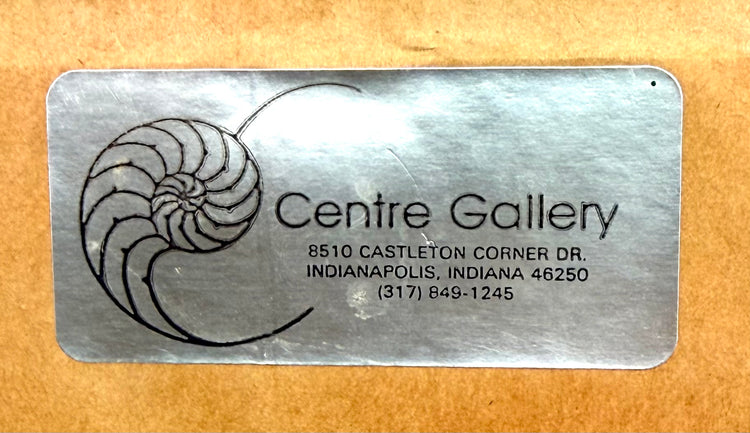
Reportedly previously associated with Centre Gallery, Carmel, Indiana, United States.
Centre Gallery was an established regional art gallery associated with art dealer Mark E. Weintraut (1931–2019). Weintraut developed his art business from an Indianapolis gallery into an operation comprising four galleries, including Centre Gallery in Carmel, which was known for exhibiting and presenting fine art to collectors.
Learn More
Discover a photograph of Sherman's original June 22, 1875 letter in the Smithsonian Institution's historical study, Hold the Fort!
Explore our Collection of 19th Century (1800–1899) Artifacts
Description
Historical Context & Origin
Region: United States – St. Louis, Missouri; Historical Subject: Allatoona Pass, Georgia
Material: Paper, reproduced manuscript correspondence, engraved-style portrait print, decorative matting, glass, and gilt-finished frame
Period: Reconstruction Era, 19th Century; original correspondence dated June 22, 1875
Description
An elegantly framed historical presentation commemorating Union General William Tecumseh Sherman (1820–1891), one of the most influential American military commanders of the nineteenth century. The display combines a reproduction of Sherman's correspondence dated June 22, 1875, with an engraved-style portrait of the celebrated Civil War general, arranged within a decorative gilt-finished frame.
The correspondence bears the heading "Headquarters Army of the United States" and is dated from St. Louis, Missouri. Its contents concern the Battle of Allatoona Pass, fought on October 5, 1864, during the American Civil War. The letter was originally addressed to William E. Dodge and discusses the military events that inspired the famous gospel hymn Hold the Fort, associated with evangelists Dwight L. Moody and Ira D. Sankey.
In the letter, Sherman recounts observing Confederate attacks from Kennesaw Mountain, approximately eighteen miles from the threatened Union position at Allatoona. With telegraph communications disrupted, Union forces relied upon signal flags to communicate across the battlefield. Sherman describes the effort to inform the defenders that assistance was approaching and reflects upon the determination of the garrison to maintain its position against Confederate forces.
Particularly interesting is Sherman's discussion of the expression "Hold the Fort." Although the phrase became closely associated with the battle, Sherman expressed doubt that he had used those precise words during the engagement. The correspondence offers an illuminating perspective on the relationship between documented military events and the stories that subsequently entered American popular culture.
Accompanying the letter is an oval portrait depicting Sherman in his Union military uniform, with shoulder insignia and formal nineteenth-century attire. The image follows the style of historical engravings associated with John Chester Buttre (1821–1893), an American engraver whose work included portraits of prominent military and political figures.
The entire presentation is mounted against a rich royal-blue background decorated with gold floral ornamentation and delicate linear borders. Contrasting red, white, and black surrounds frame the manuscript and portrait individually, while an ornate gilt-finished outer frame provides a distinguished presentation suitable for a historical collection, private study, library, or military-themed display.
The displayed letter closely follows documented 1875 Sherman correspondence preserved in historical research. Comparison with a published photograph of the original manuscript reveals differences in handwriting and layout. Accordingly, the framed document is presented as a historical reproduction or transcription rather than an original autograph manuscript.
Features
- Framed reproduction of correspondence by Union General William Tecumseh Sherman, originally dated June 22, 1875
- Letter headed "Headquarters Army of the United States," St. Louis, Missouri
- Historical account of the October 5, 1864, Battle of Allatoona Pass
- References military signal flags and communications from Kennesaw Mountain
- Discusses the origins of the celebrated gospel hymn Hold the Fort
- Includes Sherman's reflections on the famous military expression
- Reproduced signature appearing beneath the correspondence
- Oval engraved-style portrait depicting General Sherman in military uniform
- Rich royal-blue background with decorative gold floral ornamentation
- Contrasting red, white, and black matting surrounding the portrait and manuscript
- Ornate gilt-finished frame with protective glazing
Cultural Significance
William Tecumseh Sherman occupies a central place in American Civil War history. A graduate of the United States Military Academy at West Point, he became one of the Union's most prominent commanders and a close military associate of Ulysses S. Grant. His campaigns through Georgia and the Carolinas helped undermine Confederate military resources and contributed significantly to the Union victory in 1865.
Following the Civil War, Sherman remained an influential military figure, serving as Commanding General of the United States Army from 1869 to 1883. His Memoirs, first published in 1875, became an important firsthand account of the conflict, preserving his recollections of military operations, command decisions, and wartime experiences.
The Battle of Allatoona Pass, fought on October 5, 1864, centred on a strategically important railroad position north of Atlanta. Confederate forces attempted to capture the fortified Union supply position, but its defenders successfully resisted repeated attacks. Communication between distant Union positions using signal flags became one of the engagement's most memorable features.
The battle also acquired an unexpected cultural legacy through the hymn Hold the Fort, written by American gospel composer Philip Paul Bliss. Inspired by accounts of the Union defence, the hymn became popular in evangelical religious gatherings and was subsequently adapted for use in political and labour movements.
Sherman's 1875 correspondence is particularly meaningful because it addresses the historical origins of this widely repeated story. Rather than confirming the celebrated phrase attributed to him, Sherman questioned whether he had actually employed those words. This distinction illustrates how historical events can evolve into enduring cultural narratives that differ from the precise language of their original participants.
The framed presentation brings together military history, documentary heritage, nineteenth-century portraiture, and American cultural traditions, making it an engaging historical display for collectors of Civil War memorabilia and Americana.
Condition
Good overall display condition, with the reproduced document and portrait presented beneath protective glazing. The manuscript reproduction displays a warm cream-coloured appearance, with clearly arranged cursive text and the reproduced signature visible at the bottom. The accompanying portrait retains clear facial features, uniform details, and decorative inscriptions.
The blue matting remains visually vibrant, with surviving gold ornamental detailing throughout. The contrasting borders around both display elements remain intact and well defined.
The outer gilt-finished frame exhibits minor surface wear, small marks, and areas of finish variation consistent with handling and display. Reflections are present in the protective glazing. The individual paper components have not been examined outside the frame.
Dimensions (Approximate)
Overall framed display:
Height: 19.25 in
Width: 22.75 in
Depth: 1 in
Age (Approximate)
Original correspondence dated 1875 (151 years ago); date of the framed reproduction is undetermined.
Provenance
Reportedly previously associated with Centre Gallery, Carmel, Indiana, United States.
Centre Gallery was an established regional art gallery associated with art dealer Mark E. Weintraut (1931–2019). Weintraut developed his art business from an Indianapolis gallery into an operation comprising four galleries, including Centre Gallery in Carmel, which was known for exhibiting and presenting fine art to collectors.
Learn More
Discover a photograph of Sherman's original June 22, 1875 letter in the Smithsonian Institution's historical study, Hold the Fort!
Explore our Collection of 19th Century (1800–1899) Artifacts
You May Also Like
