

Ancient Roman North African Ribbed Terracotta Pitcher | Tunisia | Detailed Provenance | Circa 100–500 CE
Couldn't load pickup availability





Ancient Roman North African Ribbed Terracotta Pitcher | Tunisia | Detailed Provenance | Circa 100–500 CE
Description
More
Less
Historical Context & Origin
Region: Roman North Africa (Modern Tunisia)
Material: Terracotta / Earthenware Clay
Period: Roman Imperial Period, ca. 100–500 CE
Description
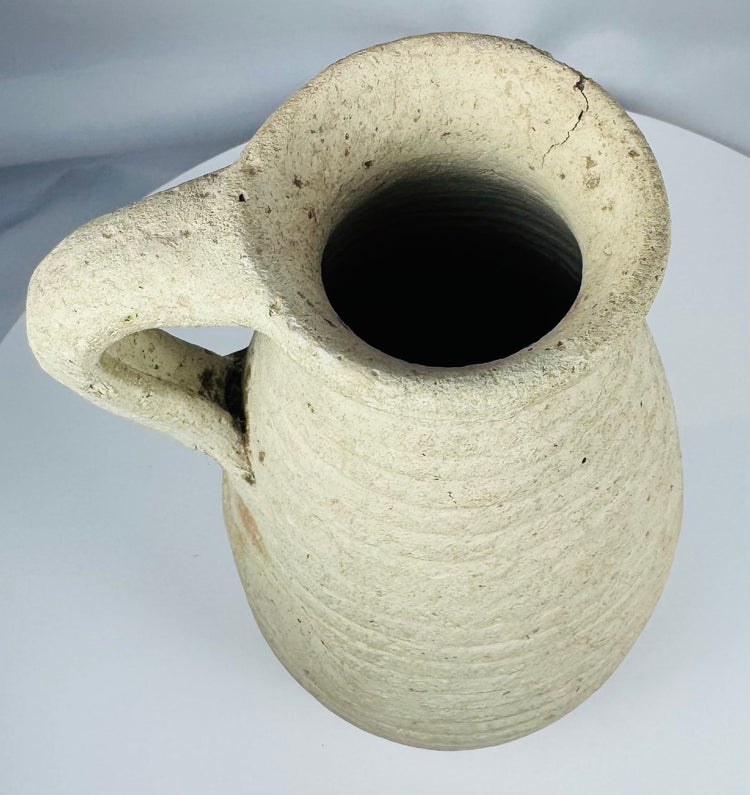
This ancient Roman North African terracotta pitcher is a well-preserved example of utilitarian pottery produced in the Roman provinces of present-day Tunisia. The vessel features a rounded body tapering toward a recessed neck, a broad flaring rim, and a sturdy loop handle extending from the rim to the shoulder. Distinctive horizontal ribbing encircles the body, creating a subtle decorative effect while reinforcing the vessel's structure.
Pottery of this type was widely used throughout Roman North Africa for the storage, transport, and serving of water, wine, oil, and other household commodities. During the Roman Imperial period, Tunisia formed the prosperous province of Africa Proconsularis, one of the Empire's most important agricultural and commercial centers. Workshops throughout the region produced large quantities of ceramic wares that supplied both local populations and extensive Mediterranean trade networks.
The vessel displays an attractive archaeological surface with areas of mineral accretion, weathering, and age-related wear that reflect its considerable antiquity.
Features
- Authentic Roman North African terracotta pitcher
- Recessed neck with broad flaring rim
- Distinctive horizontal ribbed decoration
- Sturdy loop handle connecting rim and shoulder
- Attractive archaeological surface and mineral deposits
- Classical utilitarian form typical of Roman domestic pottery
- Accompanied by extensive collection documentation
Historical Significance
Roman North Africa was among the most productive regions of the Roman Empire, supplying grain, olive oil, and other commodities throughout the Mediterranean world. Pottery vessels such as this formed an essential part of daily life, serving domestic, agricultural, and commercial purposes.
Examples recovered from Tunisia demonstrate the influence of both indigenous North African ceramic traditions and broader Roman manufacturing practices. Their widespread distribution illustrates the economic importance of the region and the interconnected nature of Roman trade networks.
Condition
Good ancient condition overall. Surface wear, mineral deposits, firing imperfections, and scattered losses consistent with age. A stable crack is present along the rim. General archaeological weathering and handling wear throughout. No significant modern restoration observed.
Dimensions (Approximate)
Height: 7 in
Width: 4 in
Diameter: 4 in
Age (Approximate)
1,500–1,900 years old
Provenance
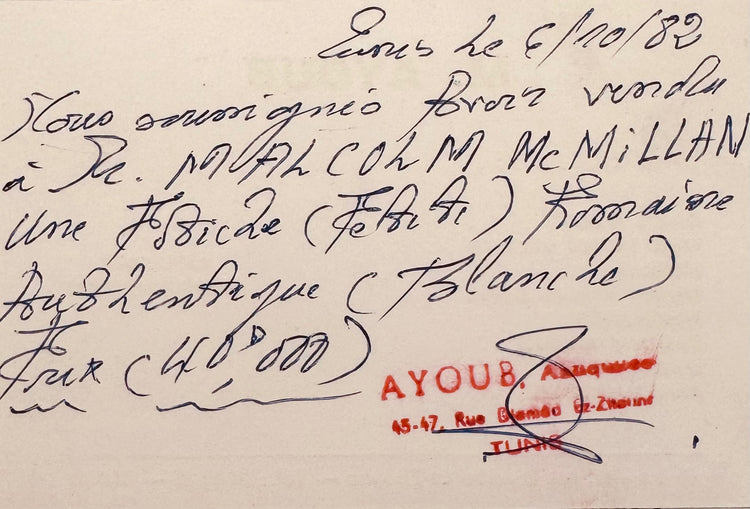
Purchased in Tunisia in 1982 from M. Ayoub Antiquités, Tunis, Tunisia, and subsequently retained in the McMillan Collection, Minnesota, USA, for more than four decades.
The vessel is accompanied by its original McMillan Collection inventory card identifying the piece as a Roman natural clay pitcher from Tunisia and recording its acquisition in 1982. The inventory card includes an original period photograph of the vessel as it appeared within the collection in the 1980s.
Additional accompanying documentation includes the original M. Ayoub Antiquités business card from Tunis, original handwritten dealer notes relating to the object, the original McMillan Collection inventory records listing the vessel as Item No. 138, and collection archive materials documenting the vessel within the broader collection.
Learn More
Learn about the significance of Roman North Africa and its role as one of the Roman Empire's leading centers of trade, agriculture, and ceramic production.
Explore Our Collection of Ancient Ceramics & Pottery
Description
Historical Context & Origin
Region: Roman North Africa (Modern Tunisia)
Material: Terracotta / Earthenware Clay
Period: Roman Imperial Period, ca. 100–500 CE
Description
This ancient Roman North African terracotta pitcher is a well-preserved example of utilitarian pottery produced in the Roman provinces of present-day Tunisia. The vessel features a rounded body tapering toward a recessed neck, a broad flaring rim, and a sturdy loop handle extending from the rim to the shoulder. Distinctive horizontal ribbing encircles the body, creating a subtle decorative effect while reinforcing the vessel's structure.
Pottery of this type was widely used throughout Roman North Africa for the storage, transport, and serving of water, wine, oil, and other household commodities. During the Roman Imperial period, Tunisia formed the prosperous province of Africa Proconsularis, one of the Empire's most important agricultural and commercial centers. Workshops throughout the region produced large quantities of ceramic wares that supplied both local populations and extensive Mediterranean trade networks.
The vessel displays an attractive archaeological surface with areas of mineral accretion, weathering, and age-related wear that reflect its considerable antiquity.
Features
- Authentic Roman North African terracotta pitcher
- Recessed neck with broad flaring rim
- Distinctive horizontal ribbed decoration
- Sturdy loop handle connecting rim and shoulder
- Attractive archaeological surface and mineral deposits
- Classical utilitarian form typical of Roman domestic pottery
- Accompanied by extensive collection documentation
Historical Significance
Roman North Africa was among the most productive regions of the Roman Empire, supplying grain, olive oil, and other commodities throughout the Mediterranean world. Pottery vessels such as this formed an essential part of daily life, serving domestic, agricultural, and commercial purposes.
Examples recovered from Tunisia demonstrate the influence of both indigenous North African ceramic traditions and broader Roman manufacturing practices. Their widespread distribution illustrates the economic importance of the region and the interconnected nature of Roman trade networks.
Condition
Good ancient condition overall. Surface wear, mineral deposits, firing imperfections, and scattered losses consistent with age. A stable crack is present along the rim. General archaeological weathering and handling wear throughout. No significant modern restoration observed.
Dimensions (Approximate)
Height: 7 in
Width: 4 in
Diameter: 4 in
Age (Approximate)
1,500–1,900 years old
Provenance
Purchased in Tunisia in 1982 from M. Ayoub Antiquités, Tunis, Tunisia, and subsequently retained in the McMillan Collection, Minnesota, USA, for more than four decades.
The vessel is accompanied by its original McMillan Collection inventory card identifying the piece as a Roman natural clay pitcher from Tunisia and recording its acquisition in 1982. The inventory card includes an original period photograph of the vessel as it appeared within the collection in the 1980s.
Additional accompanying documentation includes the original M. Ayoub Antiquités business card from Tunis, original handwritten dealer notes relating to the object, the original McMillan Collection inventory records listing the vessel as Item No. 138, and collection archive materials documenting the vessel within the broader collection.
Learn More
Learn about the significance of Roman North Africa and its role as one of the Roman Empire's leading centers of trade, agriculture, and ceramic production.
Explore Our Collection of Ancient Ceramics & Pottery
You May Also Like
