

Middle Eastern Glass Covered Cosmetic Jar | 2-3rd Century AD
Couldn't load pickup availability


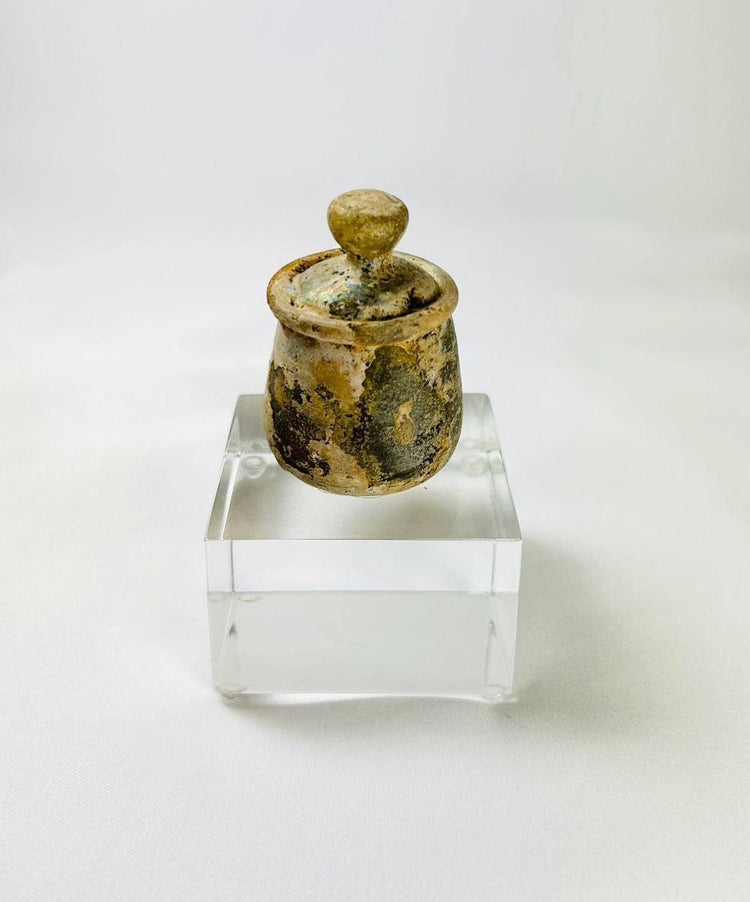
Middle Eastern Glass Covered Cosmetic Jar | 2-3rd Century AD
Description
More
Less
Historical Context & Origin
Region: Middle East (Roman or Parthian world)
Material: Iridescent glass with fitted lid
Period: 2nd–3rd Century CE
Description
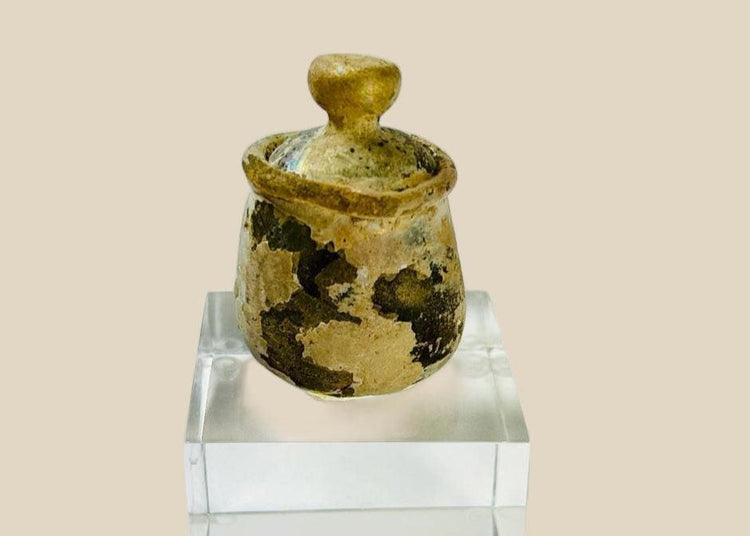
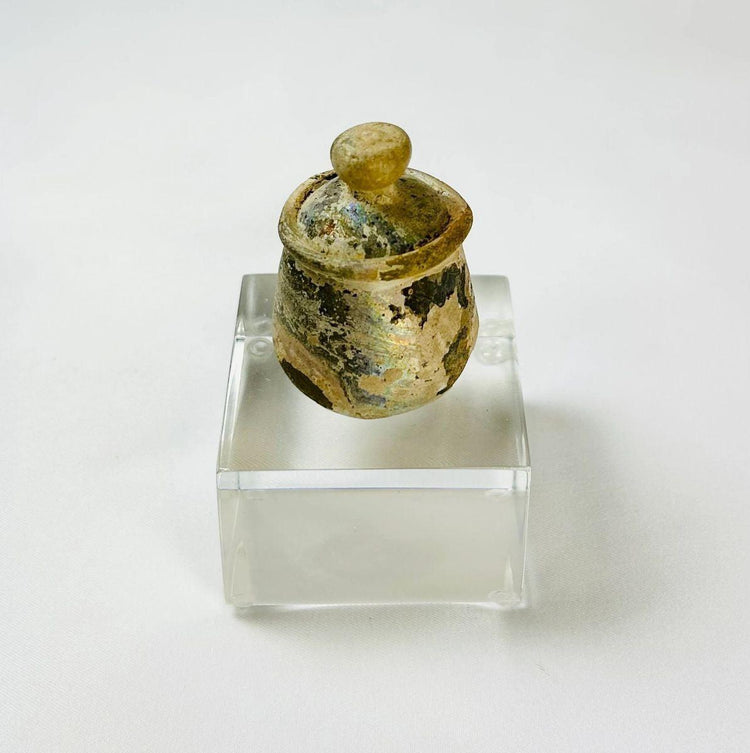
This remarkable cosmetic jar, crafted from high-quality glass, dates to the 2nd–3rd century CE and represents the refined artistry of ancient Roman and Parthian glassmakers. With its smooth rounded body and fitted lid topped with a knob-like finial, the vessel combines elegance with functionality. Over centuries, its surface has developed a luminous iridescent patina produced by natural weathering, enhancing both its beauty and historical character.
Features
- Compact jar with a rounded form and original fitted lid
- Knob finial allowing secure closure and easy handling
- Natural iridescence developed through centuries of burial
- Designed for storing cosmetics, ointments, or perfumes
- Well-preserved example with both body and lid intact
Cultural Significance
Cosmetic containers such as this were prized personal objects in the Roman and Parthian worlds. Used to store perfumes, oils, and beauty preparations, they illustrate the importance of personal grooming and luxury goods in antiquity. These vessels also demonstrate the advanced glassmaking techniques developed in Middle Eastern workshops, where artisans produced elegant functional objects traded across the ancient Mediterranean.
Condition
The jar remains in excellent condition with its original lid intact. Subtle iridescence and natural surface weathering confirm its antiquity and add visual depth to the glass.
Dimensions (Approximate)
Height: 3.5 in
Width: 2 in
Depth: 2 in
Age (Approximate)
1,700–1,900 years old
Learn More
Discover the History of Ancient Glassmaking
Browse our Collection of Ancient Glass Artifacts
Description
Historical Context & Origin
Region: Middle East (Roman or Parthian world)
Material: Iridescent glass with fitted lid
Period: 2nd–3rd Century CE
Description
This remarkable cosmetic jar, crafted from high-quality glass, dates to the 2nd–3rd century CE and represents the refined artistry of ancient Roman and Parthian glassmakers. With its smooth rounded body and fitted lid topped with a knob-like finial, the vessel combines elegance with functionality. Over centuries, its surface has developed a luminous iridescent patina produced by natural weathering, enhancing both its beauty and historical character.
Features
- Compact jar with a rounded form and original fitted lid
- Knob finial allowing secure closure and easy handling
- Natural iridescence developed through centuries of burial
- Designed for storing cosmetics, ointments, or perfumes
- Well-preserved example with both body and lid intact
Cultural Significance
Cosmetic containers such as this were prized personal objects in the Roman and Parthian worlds. Used to store perfumes, oils, and beauty preparations, they illustrate the importance of personal grooming and luxury goods in antiquity. These vessels also demonstrate the advanced glassmaking techniques developed in Middle Eastern workshops, where artisans produced elegant functional objects traded across the ancient Mediterranean.
Condition
The jar remains in excellent condition with its original lid intact. Subtle iridescence and natural surface weathering confirm its antiquity and add visual depth to the glass.
Dimensions (Approximate)
Height: 3.5 in
Width: 2 in
Depth: 2 in
Age (Approximate)
1,700–1,900 years old
Learn More
Discover the History of Ancient Glassmaking
Browse our Collection of Ancient Glass Artifacts
You May Also Like
