


Vintage RAF Aviation Navigation Computer with Original Carry Case | Circa 1953
Couldn't load pickup availability




Vintage RAF Aviation Navigation Computer with Original Carry Case | Circa 1953
Description
More
Less
Historical Context & Origin
Region: Great Britain
Material: Metal, Bakelite, printed celluloid/plastic navigation scales, canvas
Period: Early Post-War RAF, WWII-era design
Description
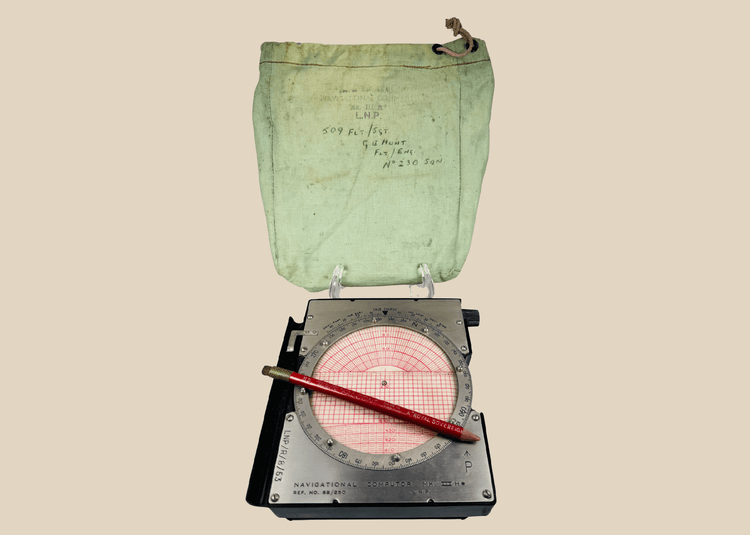
This Royal Air Force navigational computer is an original Navigational Computor Mk. III H*, Air Ministry reference 6B/250, manufactured by L.N.P. for use by British military aircrew.
The front plate is clearly marked:
NAVIGATIONAL COMPUTOR MK. III H*
REF. NO. 6B/250
L.N.P.
LNP/R/8/53
alongside the British military broad-arrow property mark.
Developed from the mechanical flight computers employed by RAF navigators during the Second World War, this sophisticated analogue instrument allowed aircrew to rapidly calculate and compensate for variables including true course, wind drift, airspeed, altitude, distance and estimated flight time. Comparable RAF navigational computers were specifically designed to solve wind-triangle and ground-speed calculations during flight.
The front incorporates a large circular 360-degree course and drift scale surrounding a movable red-and-white plotting grid. A side-mounted adjustment knob controls the internal plotting mechanism, while an integral pencil channel retains an accompanying British H.B. Morris “Falcon” Royal Sovereign pencil.
The reverse carries a second circular calculating assembly marked I.C.A.N. Calibration, providing scales for indicated and true airspeed, altitude, temperature, distance and time calculations. I.C.A.N. refers to the International Commission/Convention for Air Navigation calibration system employed in aviation before the modern ICAO framework.
Especially noteworthy is the original green canvas carrying pouch accompanying the computer. Period handwritten markings appear to read G. E. Hunt, Flt/Eng, No. 230 Sqn, suggesting association with a Flight Engineer serving with RAF No. 230 Squadron. The squadron had a long maritime aviation history and operated Short Sunderland flying boats, including extensive wartime operations in the Mediterranean and Far East.
Features
- British military broad-arrow property marking
- I.C.A.N. calibration computer to reverse
- 360-degree true-course and drift scale
- Adjustable internal navigation plotting grid
- Airspeed, altitude, distance and time calculation scales
- Original-style integral pencil holder
- Accompanied by H.B. Morris “Falcon” Royal Sovereign British pencil
- Original green canvas carrying pouch
- Period handwritten RAF personnel and squadron markings to pouch
Cultural Significance
Mechanical navigational computers were essential tools of mid-20th-century military aviation. Before electronic flight-management systems and digital navigation equipment, RAF pilots and navigators relied upon instruments such as this to manually resolve the mathematical relationship between heading, wind direction, drift, airspeed and ground speed.
The Mk. III series descended directly from navigational equipment developed for wartime flying and represents an important transitional technology between traditional plotting methods and increasingly sophisticated electronic aircraft-navigation systems.
The apparent association of this example with No. 230 Squadron RAF adds particular historical interest. No. 230 Squadron served as a maritime reconnaissance and flying-boat unit and operated the Short Sunderland during both the Second World War and the early post-war period.
Condition
Good vintage military condition with expected age-related surface wear, light scratching, oxidation, staining and handling marks consistent with service and storage. Printed scales and markings remain clearly legible. The internal plotting grid and rear calculation scales are present.
The accompanying canvas carrying pouch displays age-related staining, discoloration and wear while retaining its drawcord and period handwritten markings. The pencil shows expected wear from age and use.
Dimensions (Approximate)
Height: 6.25 in
Width: 5.5 in
Depth: 1 in
Age (Approximate)
73 years old (as of the year of listing, 2026)
Provenance
From a private collection in Newcastle, United Kingdom, formed with a focus on military artifacts and militaria.
Learn More
Compare this instrument with a Navigational Computor Mk. III H* catalogued by the Imperial War Museums.
Discover more through our Collection of WWI and WWII Military Artifacts.
Description
Historical Context & Origin
Region: Great Britain
Material: Metal, Bakelite, printed celluloid/plastic navigation scales, canvas
Period: Early Post-War RAF, WWII-era design
Description
This Royal Air Force navigational computer is an original Navigational Computor Mk. III H*, Air Ministry reference 6B/250, manufactured by L.N.P. for use by British military aircrew.
The front plate is clearly marked:
NAVIGATIONAL COMPUTOR MK. III H*
REF. NO. 6B/250
L.N.P.
LNP/R/8/53
alongside the British military broad-arrow property mark.
Developed from the mechanical flight computers employed by RAF navigators during the Second World War, this sophisticated analogue instrument allowed aircrew to rapidly calculate and compensate for variables including true course, wind drift, airspeed, altitude, distance and estimated flight time. Comparable RAF navigational computers were specifically designed to solve wind-triangle and ground-speed calculations during flight.
The front incorporates a large circular 360-degree course and drift scale surrounding a movable red-and-white plotting grid. A side-mounted adjustment knob controls the internal plotting mechanism, while an integral pencil channel retains an accompanying British H.B. Morris “Falcon” Royal Sovereign pencil.
The reverse carries a second circular calculating assembly marked I.C.A.N. Calibration, providing scales for indicated and true airspeed, altitude, temperature, distance and time calculations. I.C.A.N. refers to the International Commission/Convention for Air Navigation calibration system employed in aviation before the modern ICAO framework.
Especially noteworthy is the original green canvas carrying pouch accompanying the computer. Period handwritten markings appear to read G. E. Hunt, Flt/Eng, No. 230 Sqn, suggesting association with a Flight Engineer serving with RAF No. 230 Squadron. The squadron had a long maritime aviation history and operated Short Sunderland flying boats, including extensive wartime operations in the Mediterranean and Far East.
Features
- British military broad-arrow property marking
- I.C.A.N. calibration computer to reverse
- 360-degree true-course and drift scale
- Adjustable internal navigation plotting grid
- Airspeed, altitude, distance and time calculation scales
- Original-style integral pencil holder
- Accompanied by H.B. Morris “Falcon” Royal Sovereign British pencil
- Original green canvas carrying pouch
- Period handwritten RAF personnel and squadron markings to pouch
Cultural Significance
Mechanical navigational computers were essential tools of mid-20th-century military aviation. Before electronic flight-management systems and digital navigation equipment, RAF pilots and navigators relied upon instruments such as this to manually resolve the mathematical relationship between heading, wind direction, drift, airspeed and ground speed.
The Mk. III series descended directly from navigational equipment developed for wartime flying and represents an important transitional technology between traditional plotting methods and increasingly sophisticated electronic aircraft-navigation systems.
The apparent association of this example with No. 230 Squadron RAF adds particular historical interest. No. 230 Squadron served as a maritime reconnaissance and flying-boat unit and operated the Short Sunderland during both the Second World War and the early post-war period.
Condition
Good vintage military condition with expected age-related surface wear, light scratching, oxidation, staining and handling marks consistent with service and storage. Printed scales and markings remain clearly legible. The internal plotting grid and rear calculation scales are present.
The accompanying canvas carrying pouch displays age-related staining, discoloration and wear while retaining its drawcord and period handwritten markings. The pencil shows expected wear from age and use.
Dimensions (Approximate)
Height: 6.25 in
Width: 5.5 in
Depth: 1 in
Age (Approximate)
73 years old (as of the year of listing, 2026)
Provenance
From a private collection in Newcastle, United Kingdom, formed with a focus on military artifacts and militaria.
Learn More
Compare this instrument with a Navigational Computor Mk. III H* catalogued by the Imperial War Museums.
Discover more through our Collection of WWI and WWII Military Artifacts.
You May Also Like
