

WWII German Kriegsmarine Sailor’s Cap Eagle & Cockade Insignia | Circa 1935 – 1945
Couldn't load pickup availability





WWII German Kriegsmarine Sailor’s Cap Eagle & Cockade Insignia | Circa 1935 – 1945
Description
More
Less
Historical Context & Origin
Region: Germany
Material: Gilt metal / bronze alloy, blackened metal, red felt, steel pin
Period: Second World War, circa 1935–1945
Description
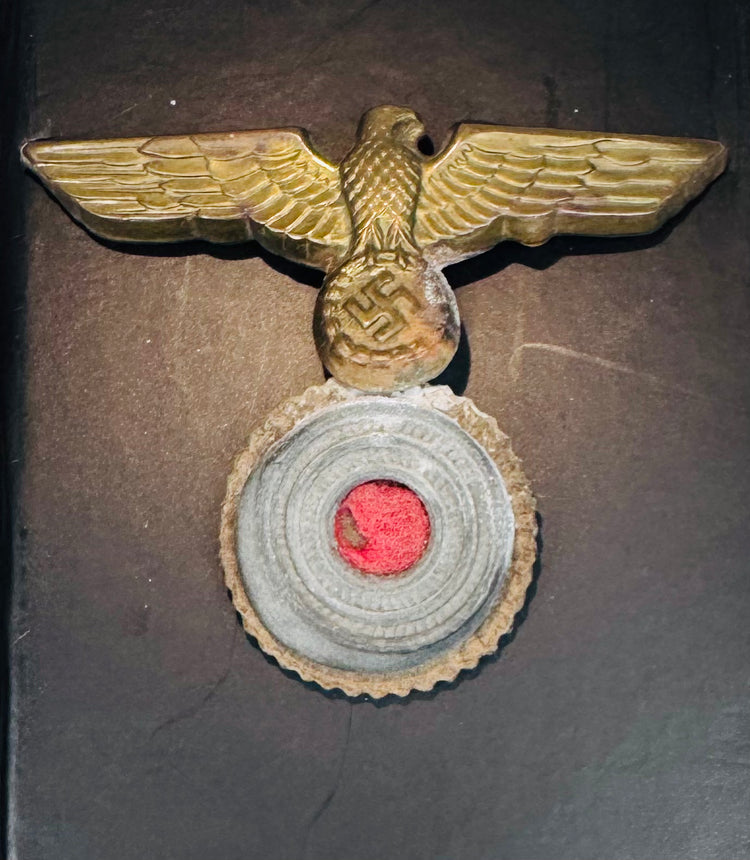
This German naval cap insignia is an example of the combined eagle and national cockade worn by enlisted personnel and junior NCOs of the Kriegsmarine during the Second World War.
The upper portion takes the form of the German national eagle with fully outstretched wings, finely rendered feather detail, and a swastika displayed beneath the body. The eagle retains a warm gilt or golden surface characteristic of Kriegsmarine insignia, in contrast to the predominantly silver-colored insignia associated with the German Army. Contemporary German military regulations differentiated the naval national emblem through its gold coloration.
Suspended immediately below the eagle is a circular national cockade composed of concentric raised rings surrounding a red textile center. This represented the black-white-red national colors employed on German military headgear during the period.
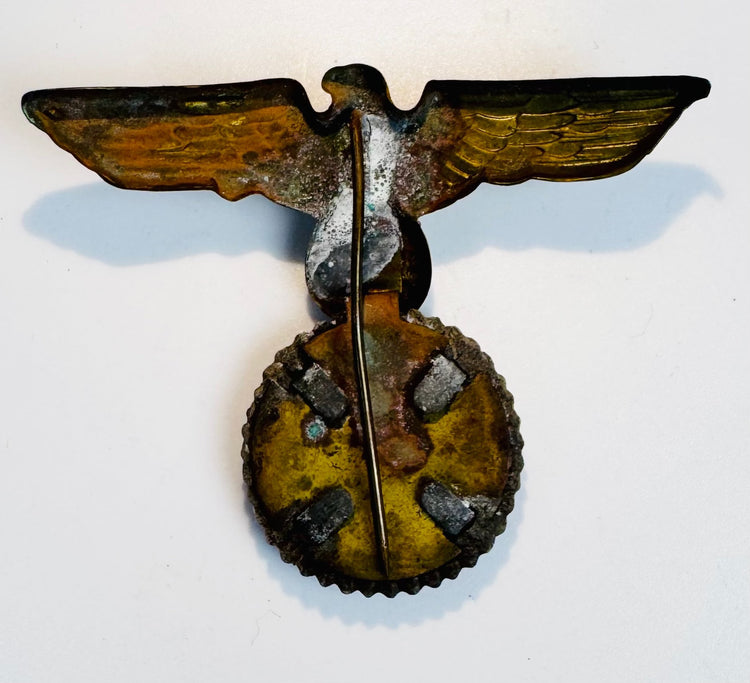
The reverse retains the long vertical needle pin used to secure the complete insignia directly to the front of the sailor’s cap. Specialist examples identify this precise combined eagle-and-cockade construction as an enlisted Kriegsmarine cap insignia for the Tellermütze.
Features
- Combined national eagle and cockade construction
- Gilt eagle with outstretched wings
- Swastika beneath the eagle
- Circular black-white-red national cockade
- Surviving red felt center
- Multi-piece metal construction
- Long vertical attachment pin retained on reverse
Cultural Significance
Headgear insignia formed an important component of German military uniforms during the Second World War, immediately identifying branch of service and national affiliation. Kriegsmarine enlisted sailors commonly wore peakless naval caps, with the cap badge positioned prominently at the front. Surviving curatorial documentation identifies this combined eagle-and-cockade type as having been worn by enlisted sailors and junior NCOs of the Kriegsmarine.
Unlike Army insignia, which generally employed silver-colored national eagles, Kriegsmarine insignia characteristically used gold or gilt-colored eagles, providing a distinctive naval identity.
Condition
Good vintage condition with age-related wear throughout. The gilt eagle displays rubbing, oxidation, discoloration, surface variation, and areas of patina. Fine feather and swastika details remain clearly defined.
The circular cockade exhibits oxidation, gray and brown surface deposits, edge wear, and discoloration. The red felt center remains present but shows wear, compression, and minor loss.
The reverse retains its long attachment pin together with the multi-piece construction of the cockade. Areas of oxidation, residue, and surface deterioration are visible on the reverse.
Dimensions (Approximate)
Height: 1.5 in
Width: 2 in
Age (Approximate)
80–90 years old
Provenance
From a private collection in Peterborough, Ontario, Canada, assembled with an extensive focus on military artifacts and militaria.
Learn More
Compare this insignia with an M1935 Kriegsmarine sailor’s cap preserved by the Imperial War Museums.
Browse our Collection of WWI and WWII Military Artifacts.
Description
Historical Context & Origin
Region: Germany
Material: Gilt metal / bronze alloy, blackened metal, red felt, steel pin
Period: Second World War, circa 1935–1945
Description
This German naval cap insignia is an example of the combined eagle and national cockade worn by enlisted personnel and junior NCOs of the Kriegsmarine during the Second World War.
The upper portion takes the form of the German national eagle with fully outstretched wings, finely rendered feather detail, and a swastika displayed beneath the body. The eagle retains a warm gilt or golden surface characteristic of Kriegsmarine insignia, in contrast to the predominantly silver-colored insignia associated with the German Army. Contemporary German military regulations differentiated the naval national emblem through its gold coloration.
Suspended immediately below the eagle is a circular national cockade composed of concentric raised rings surrounding a red textile center. This represented the black-white-red national colors employed on German military headgear during the period.
The reverse retains the long vertical needle pin used to secure the complete insignia directly to the front of the sailor’s cap. Specialist examples identify this precise combined eagle-and-cockade construction as an enlisted Kriegsmarine cap insignia for the Tellermütze.
Features
- Combined national eagle and cockade construction
- Gilt eagle with outstretched wings
- Swastika beneath the eagle
- Circular black-white-red national cockade
- Surviving red felt center
- Multi-piece metal construction
- Long vertical attachment pin retained on reverse
Cultural Significance
Headgear insignia formed an important component of German military uniforms during the Second World War, immediately identifying branch of service and national affiliation. Kriegsmarine enlisted sailors commonly wore peakless naval caps, with the cap badge positioned prominently at the front. Surviving curatorial documentation identifies this combined eagle-and-cockade type as having been worn by enlisted sailors and junior NCOs of the Kriegsmarine.
Unlike Army insignia, which generally employed silver-colored national eagles, Kriegsmarine insignia characteristically used gold or gilt-colored eagles, providing a distinctive naval identity.
Condition
Good vintage condition with age-related wear throughout. The gilt eagle displays rubbing, oxidation, discoloration, surface variation, and areas of patina. Fine feather and swastika details remain clearly defined.
The circular cockade exhibits oxidation, gray and brown surface deposits, edge wear, and discoloration. The red felt center remains present but shows wear, compression, and minor loss.
The reverse retains its long attachment pin together with the multi-piece construction of the cockade. Areas of oxidation, residue, and surface deterioration are visible on the reverse.
Dimensions (Approximate)
Height: 1.5 in
Width: 2 in
Age (Approximate)
80–90 years old
Provenance
From a private collection in Peterborough, Ontario, Canada, assembled with an extensive focus on military artifacts and militaria.
Learn More
Compare this insignia with an M1935 Kriegsmarine sailor’s cap preserved by the Imperial War Museums.
Browse our Collection of WWI and WWII Military Artifacts.
You May Also Like
