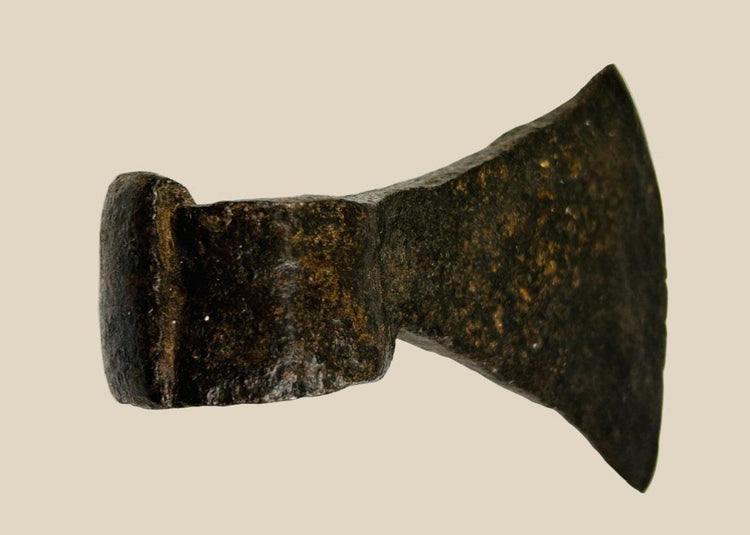
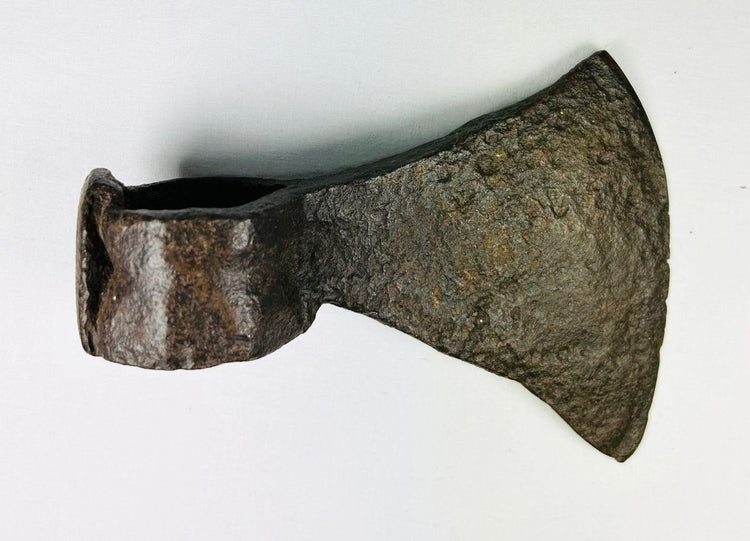
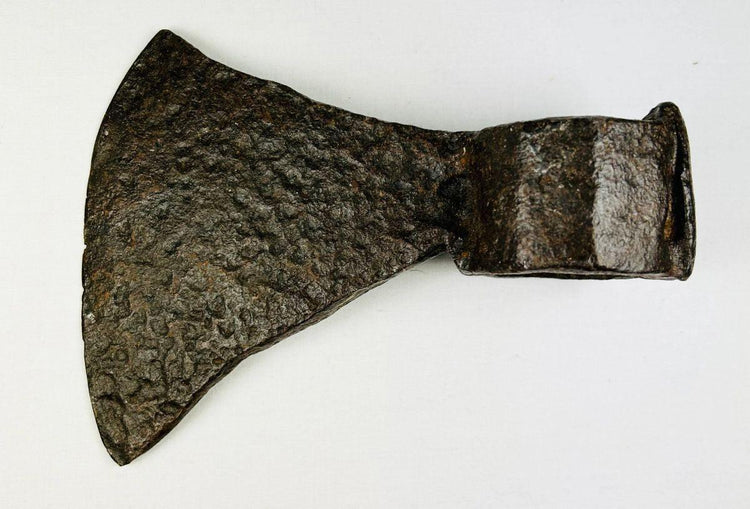
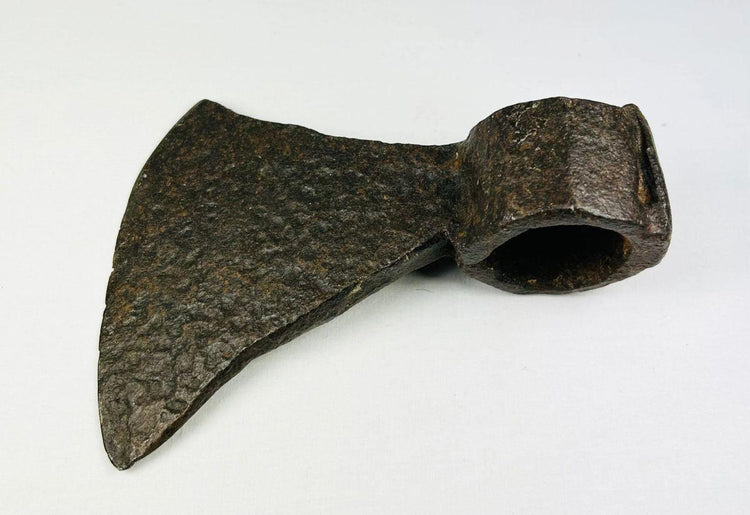
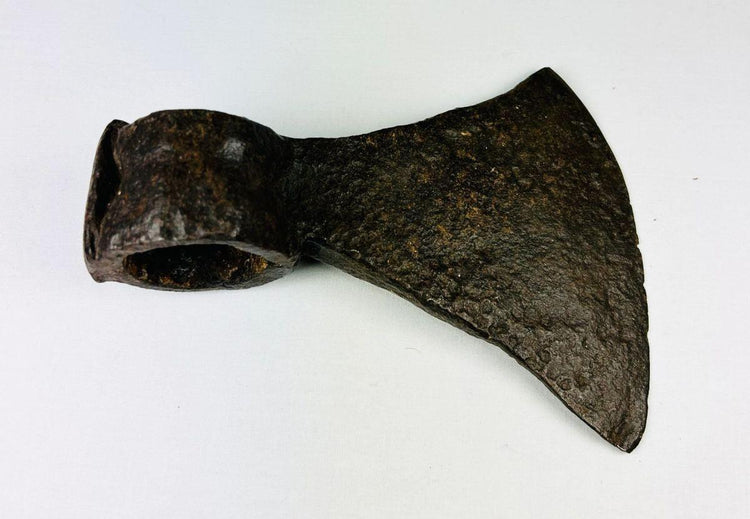
Forged Iron Axe Head | Early American Settler’s Tool | 19th Century CE
Historical Context & Origin
Region: United States
Material: Forged iron
Period: 19th Century CE
Description
This forged iron axe head reflects the durability, practicality, and ingenuity of early American craftsmanship. Dating to the 19th century, during a period of expansion and settlement, axes such as this were essential tools of frontier life. Compact yet powerful, it was designed for chopping wood, cutting timber, and assisting in the construction of homes and settlements, playing a vital role in daily survival and community development.
Features
- Wide forged blade suited for heavy-duty timber work
- Robust socket designed to secure a wooden haft
- Rich patina and textured surface consistent with age and prolonged use
- Compact yet sturdy form exemplifying practical 19th-century design
Cultural Significance
The axe was one of the most important tools in early American life, symbolizing resilience, resourcefulness, and expansion. Essential for clearing land, building homes, and providing fuel, it was more than a utilitarian object—it was a cornerstone of survival and progress in a demanding environment. This axe head reflects the pioneering spirit of early settlers and their reliance on well-crafted, durable implements.
Condition
The axe head shows a stable, age-darkened patina with natural wear from extensive use, affirming its authenticity and working history. Despite this, the piece remains structurally intact, a testament to the robust craftsmanship of 19th-century blacksmiths.
Dimensions (Approximate)
Length: 5.75 in
Age (Approximate)
125–225 years old
Learn More
Discover the history and evolution of the axe at Gränsfors Bruk
Explore Our Collection of Historic Axes
Historical Context & Origin
Region: United States
Material: Forged iron
Period: 19th Century CE
Description
This forged iron axe head reflects the durability, practicality, and ingenuity of early American craftsmanship. Dating to the 19th century, during a period of expansion and settlement, axes such as this were essential tools of frontier life. Compact yet powerful, it was designed for chopping wood, cutting timber, and assisting in the construction of homes and settlements, playing a vital role in daily survival and community development.
Features
- Wide forged blade suited for heavy-duty timber work
- Robust socket designed to secure a wooden haft
- Rich patina and textured surface consistent with age and prolonged use
- Compact yet sturdy form exemplifying practical 19th-century design
Cultural Significance
The axe was one of the most important tools in early American life, symbolizing resilience, resourcefulness, and expansion. Essential for clearing land, building homes, and providing fuel, it was more than a utilitarian object—it was a cornerstone of survival and progress in a demanding environment. This axe head reflects the pioneering spirit of early settlers and their reliance on well-crafted, durable implements.
Condition
The axe head shows a stable, age-darkened patina with natural wear from extensive use, affirming its authenticity and working history. Despite this, the piece remains structurally intact, a testament to the robust craftsmanship of 19th-century blacksmiths.
Dimensions (Approximate)
Length: 5.75 in
Age (Approximate)
125–225 years old
Learn More
Discover the history and evolution of the axe at Gränsfors Bruk
Explore Our Collection of Historic Axes

You May Also Like