


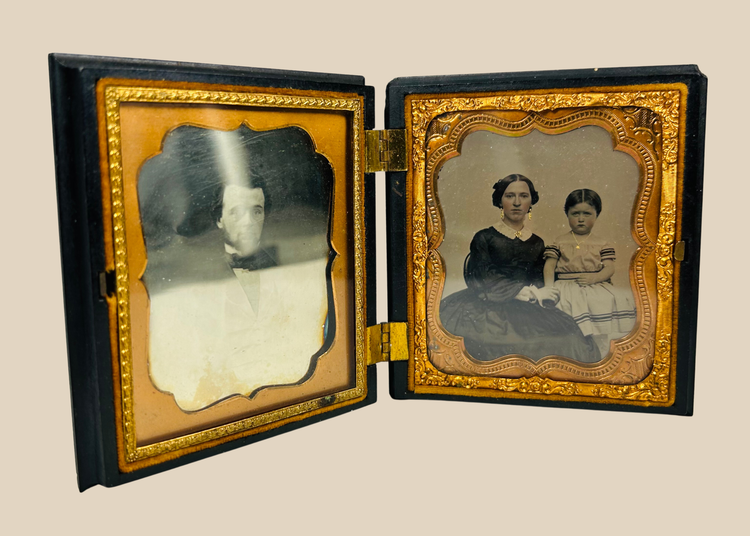
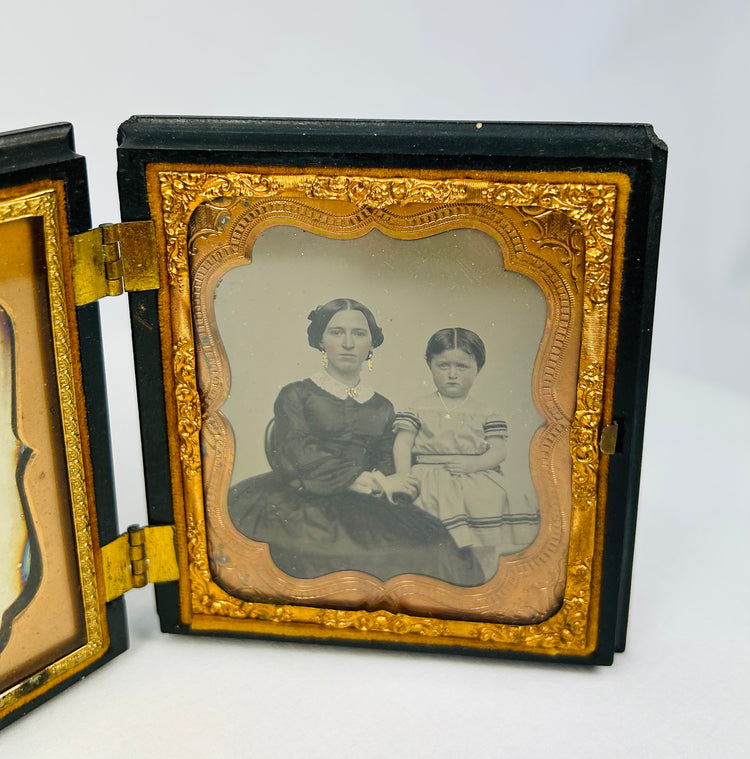
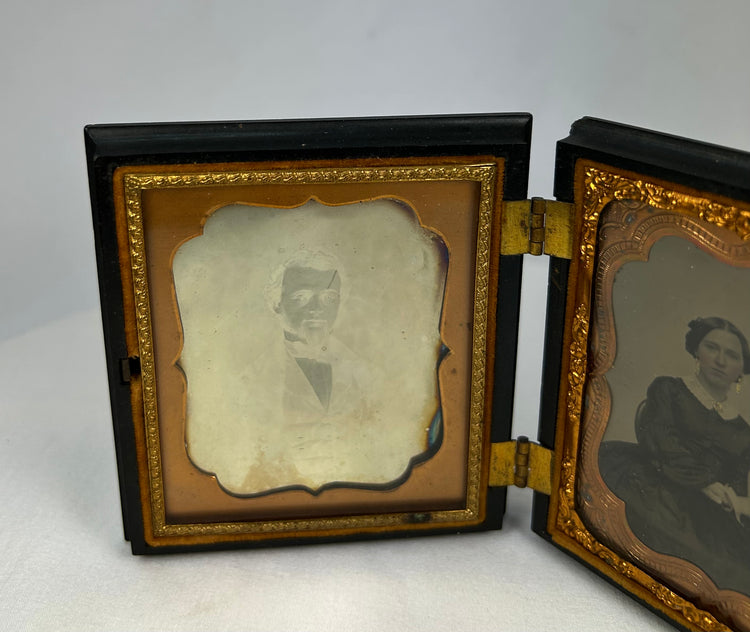
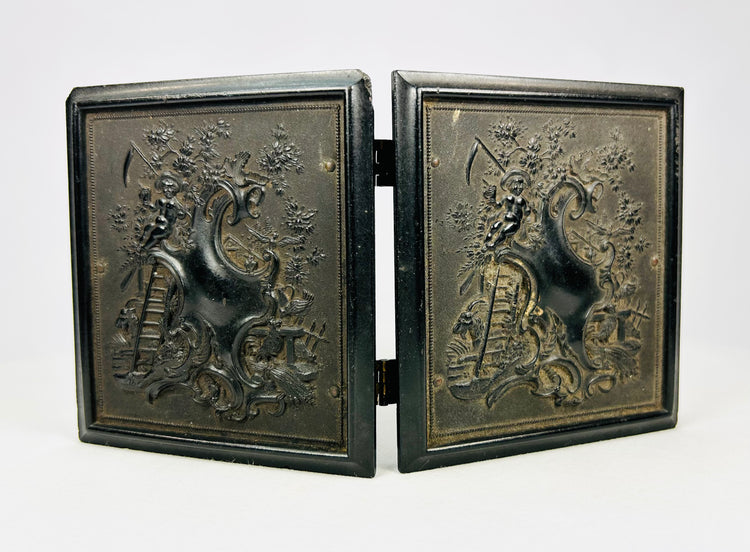
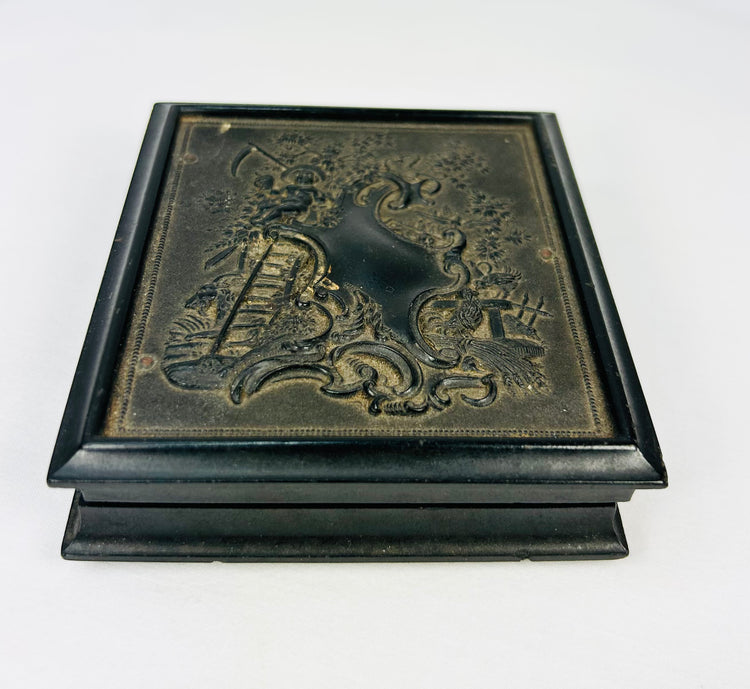
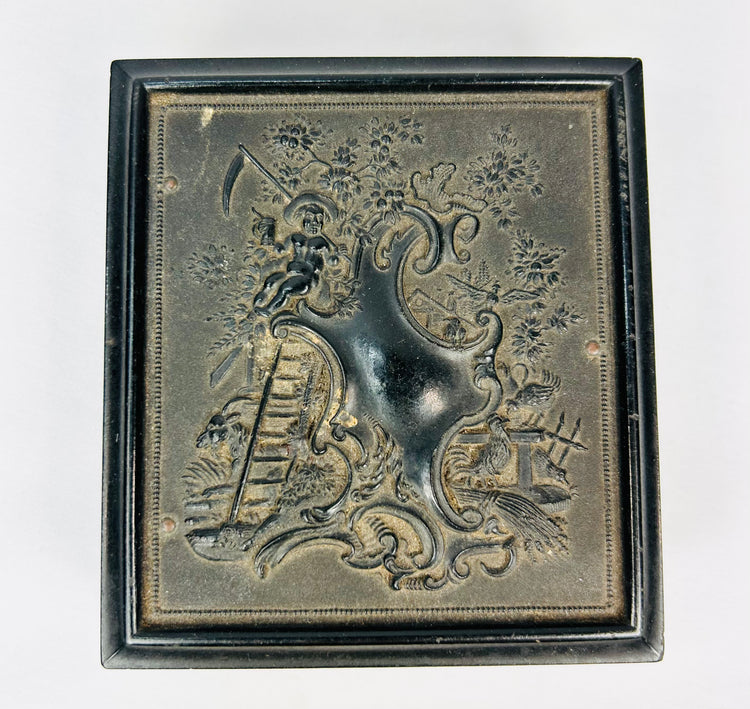
Victorian Era Daguerreotype Keepsake Case with Dual Portraits | Circa 1850–1860
Description
More
Less
Historical Context & Origin
Region: England or Northern Europe
Material: Hand-carved solid oak
Period: 16th–17th Century (circa 1550–1650)
Description
This finely carved Gothic/Tudor oak relief panel exemplifies early modern European craftsmanship at the transitional moment between medieval Gothic design and the emerging Renaissance aesthetic. Carved from a single solid oak board, the panel features two robed figures rendered in high relief, framed within a deep architectural niche. Their expressive faces, sharply folded drapery, and dramatic undercutting are hallmarks of 16th–17th century English and Northern European woodcarving.
Originally part of a larger architectural furnishing—likely a church pew end, coffer front, or paneled room interior—the panel blends religious, allegorical, or domestic themes with the bold stylistic language of the Tudor era. Its warm, untouched patina, developed naturally over centuries, enhances the depth and visual richness of the carving.
Features
- Authentic 16th–17th century Gothic/Tudor carved oak panel
- Deeply undercut high-relief figures with sculptural drapery
- Naturally aged surface patina developed over several centuries
- Likely part of a church furnishing or early Tudor paneled interior
- Carved from a single heavy oak board
- Strong decorative presence suitable for wall display
Cultural Significance
Throughout the Gothic and Tudor periods, carved oak panels were essential components of both ecclesiastical and domestic architecture. Artisans created intricate relief scenes for pews, choir stalls, chests, and paneled interiors, merging religious iconography with folklore and early Renaissance influences. Surviving examples provide valuable insight into regional craftsmanship, devotional practices, and the artistic evolution of 1500s–1600s Europe. Their rarity and historical depth make them highly desirable among collectors.
Condition
Excellent condition for its age. Stable surface with rich, untouched patina. Minor wear, shrinkage lines, and small losses consistent with more than 400 years of age. No modern refinishing; carving remains crisp and well preserved.
Dimensions (Approximate)
Height: 13.5 in
Width: 4.25 in
Depth: 1.2 in
Age
Circa 1550–1650
Learn More
Learn more about the origins of 19th-century photography and the evolution of early American portrait techniques: Early American Photography – The Met Museum
Explore additional Victorian-era artifacts and historical relics in our curated collection: Victorian Artifacts & Historic Relics – Relic And Rarity
Description
Historical Context & Origin
Region: England or Northern Europe
Material: Hand-carved solid oak
Period: 16th–17th Century (circa 1550–1650)
Description
This finely carved Gothic/Tudor oak relief panel exemplifies early modern European craftsmanship at the transitional moment between medieval Gothic design and the emerging Renaissance aesthetic. Carved from a single solid oak board, the panel features two robed figures rendered in high relief, framed within a deep architectural niche. Their expressive faces, sharply folded drapery, and dramatic undercutting are hallmarks of 16th–17th century English and Northern European woodcarving.
Originally part of a larger architectural furnishing—likely a church pew end, coffer front, or paneled room interior—the panel blends religious, allegorical, or domestic themes with the bold stylistic language of the Tudor era. Its warm, untouched patina, developed naturally over centuries, enhances the depth and visual richness of the carving.
Features
- Authentic 16th–17th century Gothic/Tudor carved oak panel
- Deeply undercut high-relief figures with sculptural drapery
- Naturally aged surface patina developed over several centuries
- Likely part of a church furnishing or early Tudor paneled interior
- Carved from a single heavy oak board
- Strong decorative presence suitable for wall display
Cultural Significance
Throughout the Gothic and Tudor periods, carved oak panels were essential components of both ecclesiastical and domestic architecture. Artisans created intricate relief scenes for pews, choir stalls, chests, and paneled interiors, merging religious iconography with folklore and early Renaissance influences. Surviving examples provide valuable insight into regional craftsmanship, devotional practices, and the artistic evolution of 1500s–1600s Europe. Their rarity and historical depth make them highly desirable among collectors.
Condition
Excellent condition for its age. Stable surface with rich, untouched patina. Minor wear, shrinkage lines, and small losses consistent with more than 400 years of age. No modern refinishing; carving remains crisp and well preserved.
Dimensions (Approximate)
Height: 13.5 in
Width: 4.25 in
Depth: 1.2 in
Age
Circa 1550–1650
Learn More
Learn more about the origins of 19th-century photography and the evolution of early American portrait techniques: Early American Photography – The Met Museum
Explore additional Victorian-era artifacts and historical relics in our curated collection: Victorian Artifacts & Historic Relics – Relic And Rarity
You May Also Like
