

Victorian | Brass Field Microscope in Original Mahogany Case | Circa 1870
Couldn't load pickup availability


Victorian | Brass Field Microscope in Original Mahogany Case | Circa 1870
Description
More
Less
Historical Context & Origin
Region: Europe (likely England or France)
Material: Lacquered brass, optical glass, mahogany case
Period: 19th Century (Victorian Era)
Description
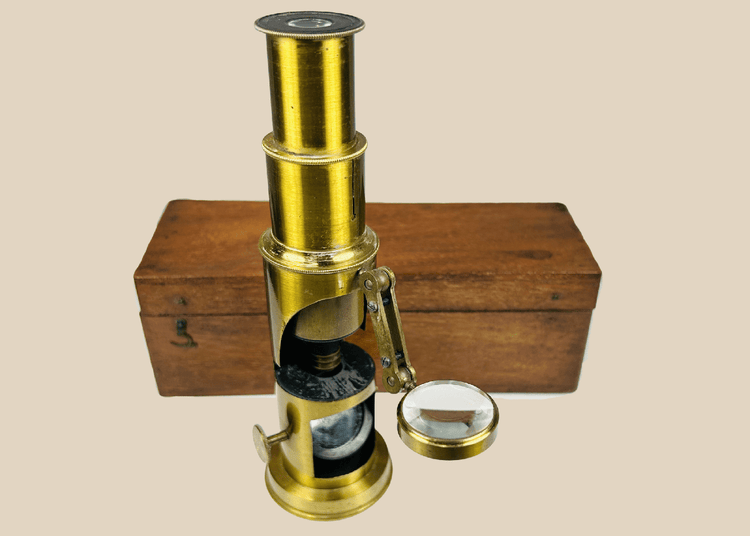
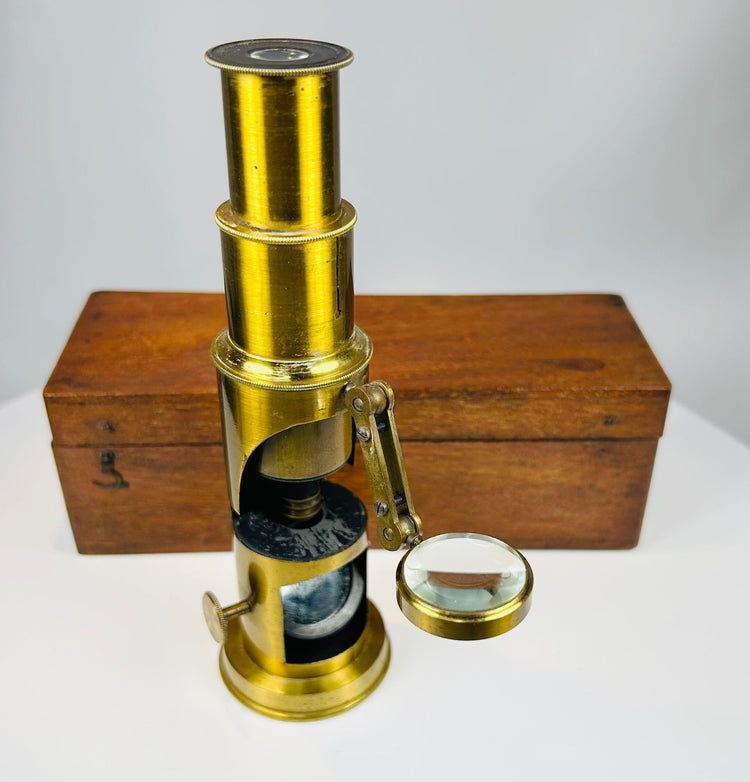
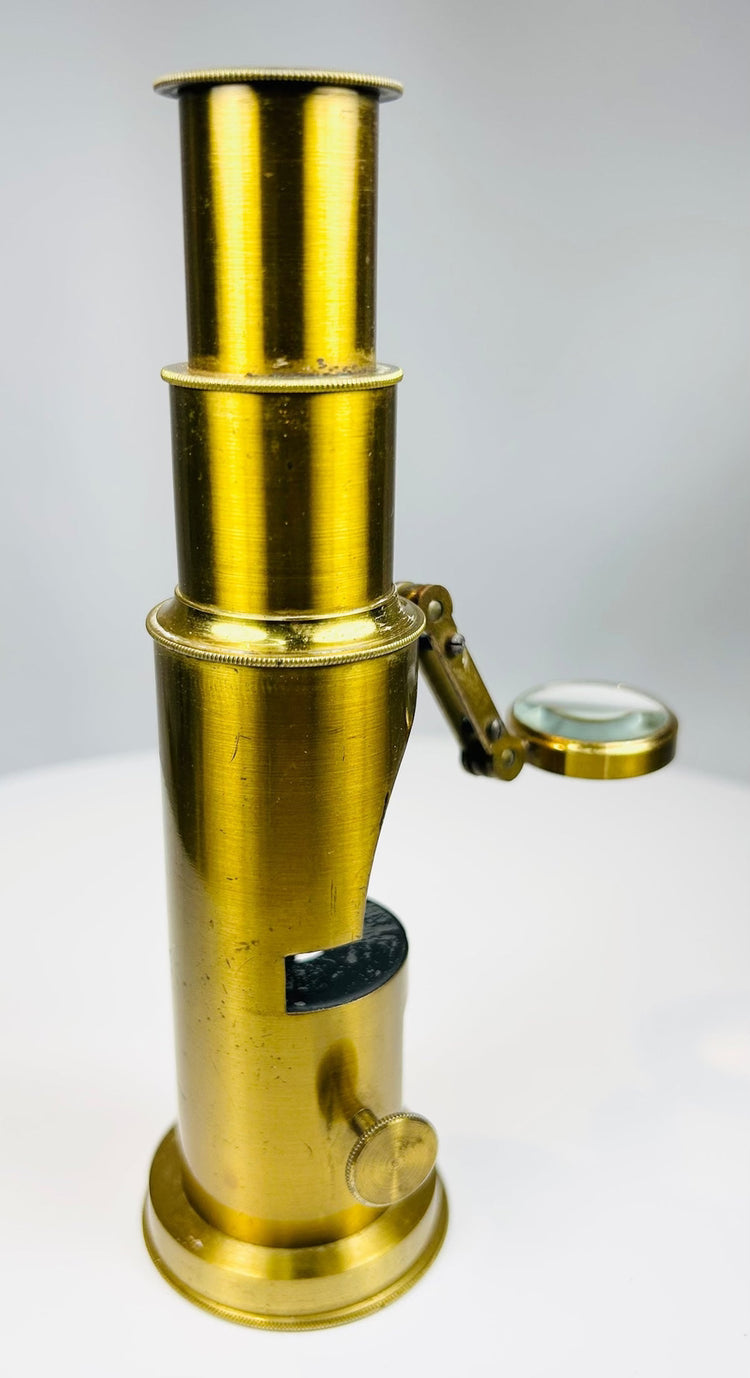
This elegant Victorian-era monocular field microscope represents a fine example of 19th-century portable scientific instrumentation. Crafted in lacquered brass with a compact cylindrical body, the instrument was designed for naturalists, students, and early scientific enthusiasts who required a microscope that could easily travel into the field.
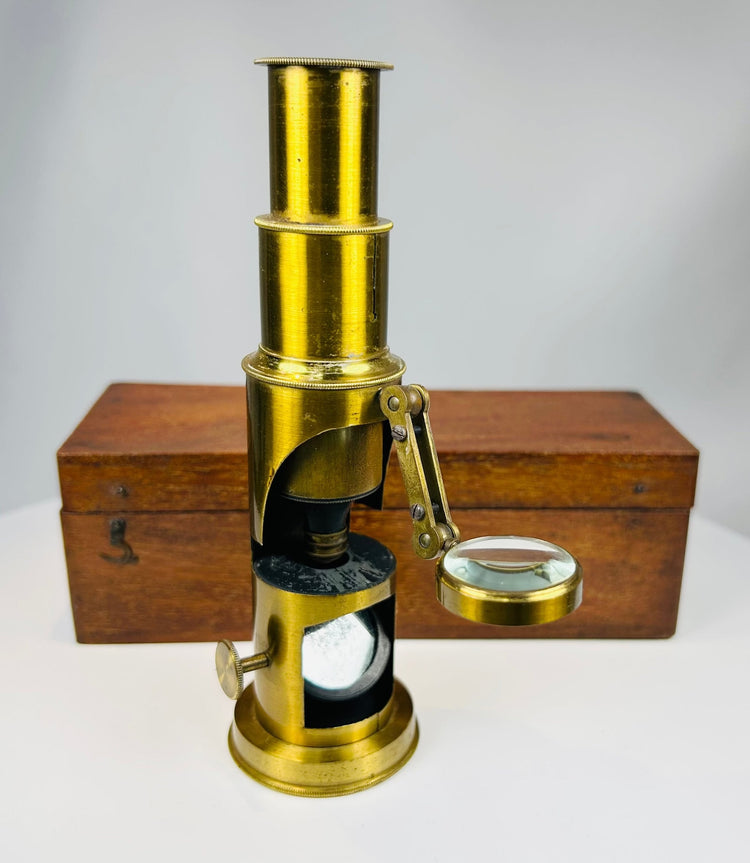
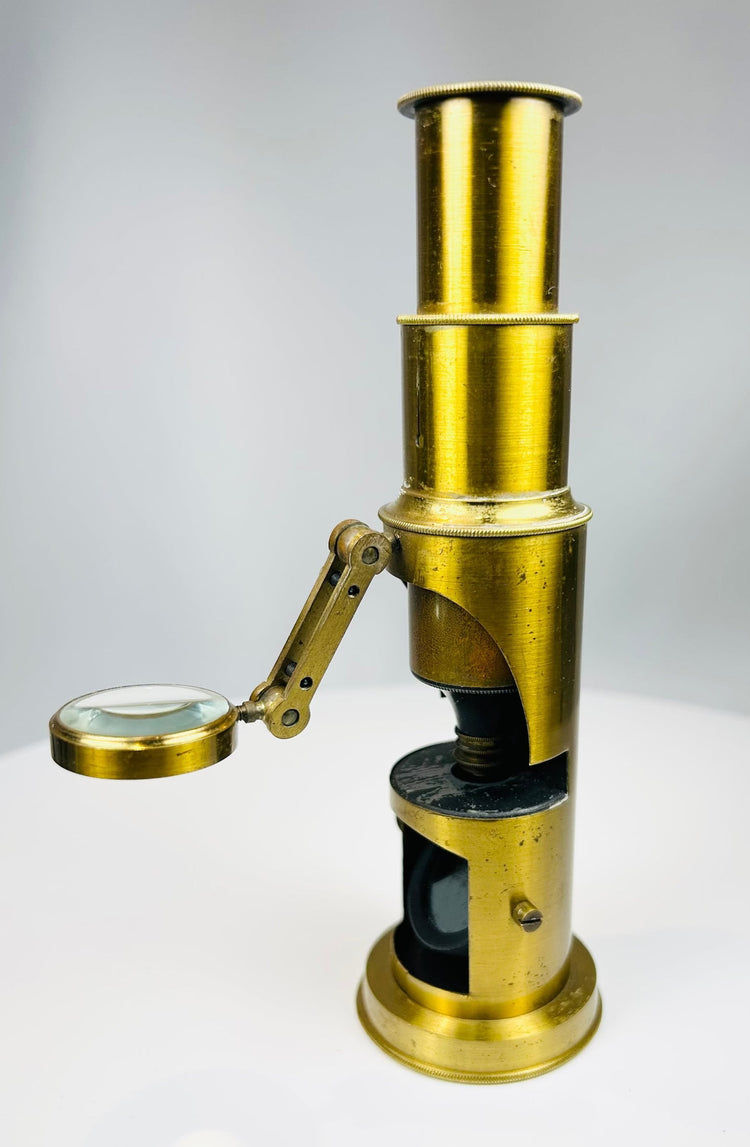
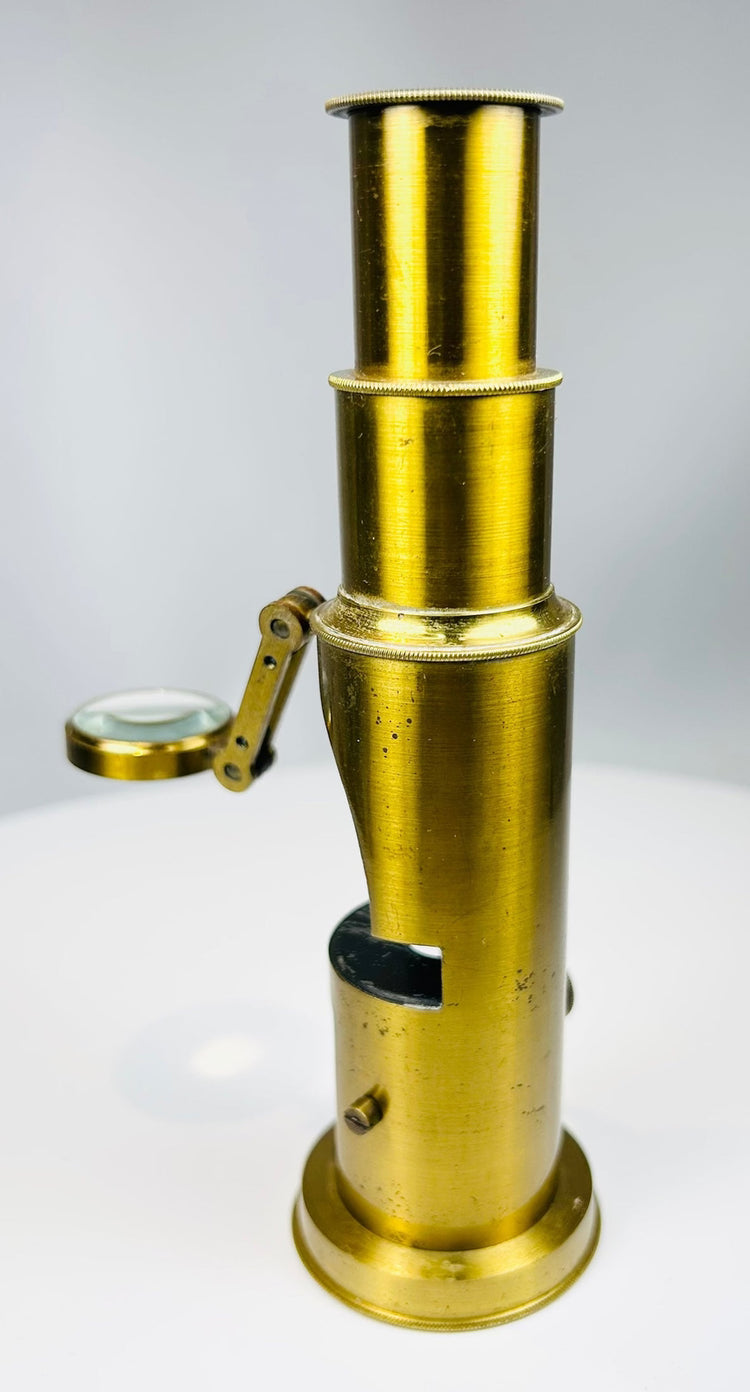
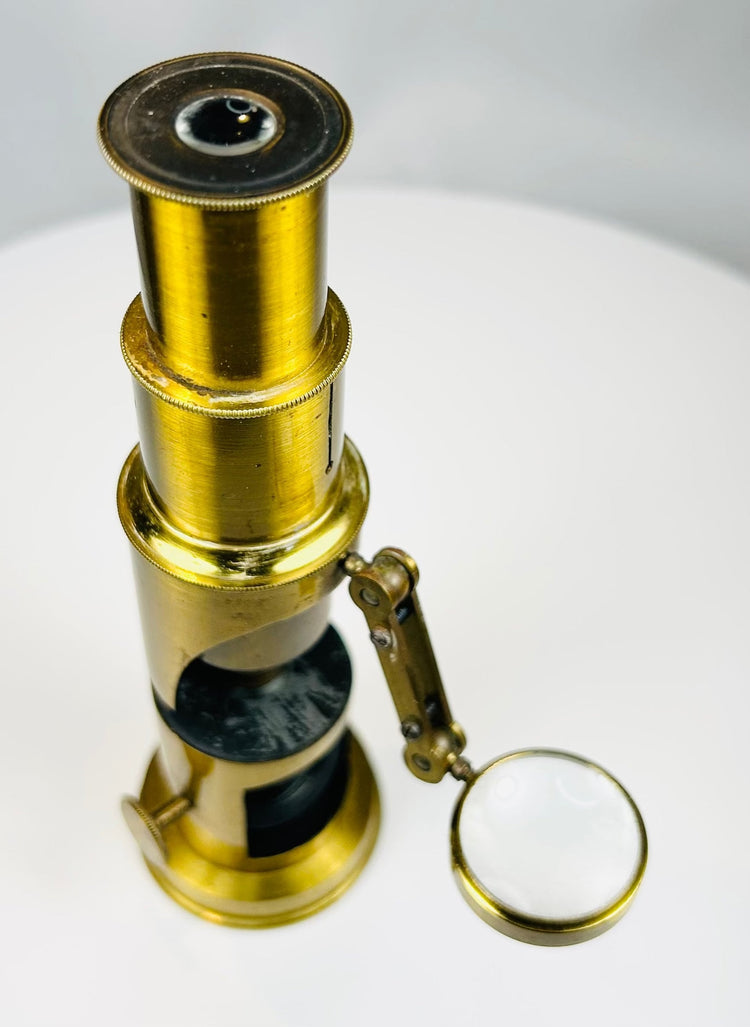
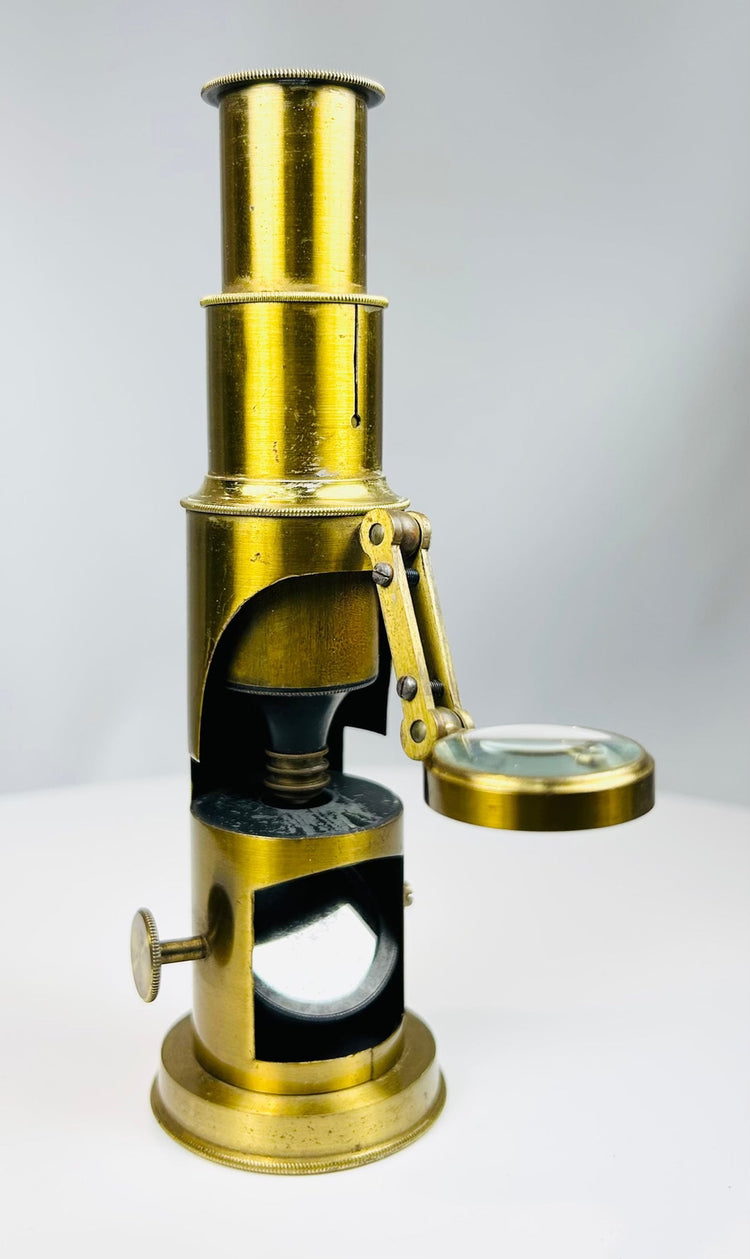
The microscope features a telescoping eyepiece tube above a simple stage and mirror illumination system. Beneath the specimen platform, an adjustable mirror directs light upward through the sample, while a finely positioned optical lens assembly allows close examination of botanical, mineral, and biological specimens. An articulated side arm supports a magnifying lens that could be swung into place for auxiliary observation.
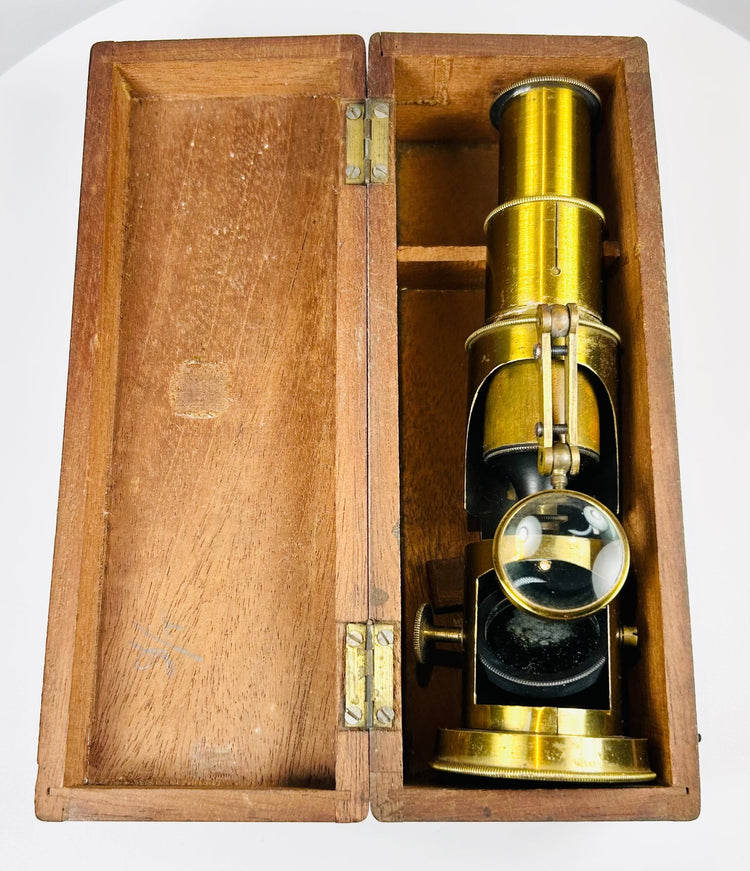
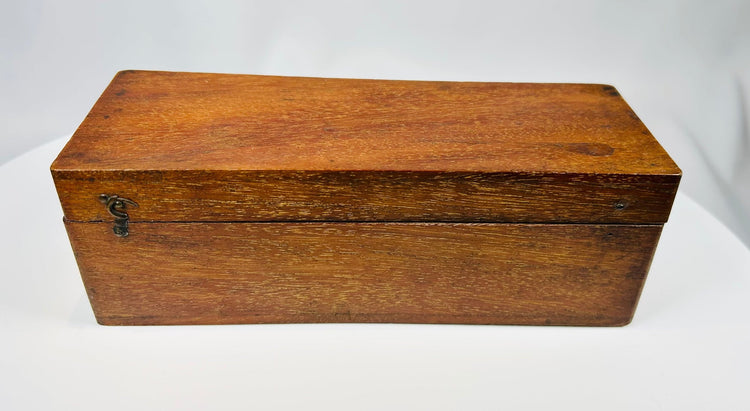
The instrument retains its original mahogany fitted case, which protected the microscope during transport and storage. Such portable microscopes were widely used throughout the Victorian period when microscopy experienced a surge in popularity among amateur scientists and collectors.
Its compact size, elegant brass finish, and intact case make this piece both a functional scientific artifact and a beautiful display object illustrating the development of early portable microscopy.
Features
- Compact monocular field microscope with cylindrical brass body
- Swing-out magnifying lens mounted on articulated brass arm
- Adjustable mirror illumination system beneath specimen stage
- Telescoping eyepiece tube for focusing
- Original mahogany fitted storage case
- Classic lacquered brass Victorian scientific instrument design
Cultural Significance
During the Victorian era, microscopy became one of the most fashionable scientific pursuits among both professionals and educated amateurs. Portable microscopes such as this example allowed naturalists to study specimens in the field, contributing to the rapid expansion of biological and botanical knowledge throughout the 19th century.
Condition
Very good antique condition with expected wear consistent with age. The lacquered brass retains a warm patina with minor surface marks from use. Optical components appear intact and the mirror remains present. The original mahogany case shows age-related wear but remains structurally sound.
Dimensions (Approximate)
Height: 5.9 in
Case Length: 6.75 in
Age (Approximate)
145–175 years old
Provenance
Sold through Waddington’s Auctioneers, Toronto, Ontario, Canada, in 2026. Subsequently held in a private collection in Toronto, Ontario.
Learn More
Explore the history and craftsmanship of Victorian field microscopes in this detailed article on Casartelli instruments
Description
Historical Context & Origin
Region: Europe (likely England or France)
Material: Lacquered brass, optical glass, mahogany case
Period: 19th Century (Victorian Era)
Description
This elegant Victorian-era monocular field microscope represents a fine example of 19th-century portable scientific instrumentation. Crafted in lacquered brass with a compact cylindrical body, the instrument was designed for naturalists, students, and early scientific enthusiasts who required a microscope that could easily travel into the field.
The microscope features a telescoping eyepiece tube above a simple stage and mirror illumination system. Beneath the specimen platform, an adjustable mirror directs light upward through the sample, while a finely positioned optical lens assembly allows close examination of botanical, mineral, and biological specimens. An articulated side arm supports a magnifying lens that could be swung into place for auxiliary observation.
The instrument retains its original mahogany fitted case, which protected the microscope during transport and storage. Such portable microscopes were widely used throughout the Victorian period when microscopy experienced a surge in popularity among amateur scientists and collectors.
Its compact size, elegant brass finish, and intact case make this piece both a functional scientific artifact and a beautiful display object illustrating the development of early portable microscopy.
Features
- Compact monocular field microscope with cylindrical brass body
- Swing-out magnifying lens mounted on articulated brass arm
- Adjustable mirror illumination system beneath specimen stage
- Telescoping eyepiece tube for focusing
- Original mahogany fitted storage case
- Classic lacquered brass Victorian scientific instrument design
Cultural Significance
During the Victorian era, microscopy became one of the most fashionable scientific pursuits among both professionals and educated amateurs. Portable microscopes such as this example allowed naturalists to study specimens in the field, contributing to the rapid expansion of biological and botanical knowledge throughout the 19th century.
Condition
Very good antique condition with expected wear consistent with age. The lacquered brass retains a warm patina with minor surface marks from use. Optical components appear intact and the mirror remains present. The original mahogany case shows age-related wear but remains structurally sound.
Dimensions (Approximate)
Height: 5.9 in
Case Length: 6.75 in
Age (Approximate)
145–175 years old
Provenance
Sold through Waddington’s Auctioneers, Toronto, Ontario, Canada, in 2026. Subsequently held in a private collection in Toronto, Ontario.
Learn More
Explore the history and craftsmanship of Victorian field microscopes in this detailed article on Casartelli instruments
You May Also Like
